
Quote
Stanford was a wonderful opportunity to step outside of my day-to-day environment, challenge some of my thinking, and reflect on the kind of leader I wanted to be.
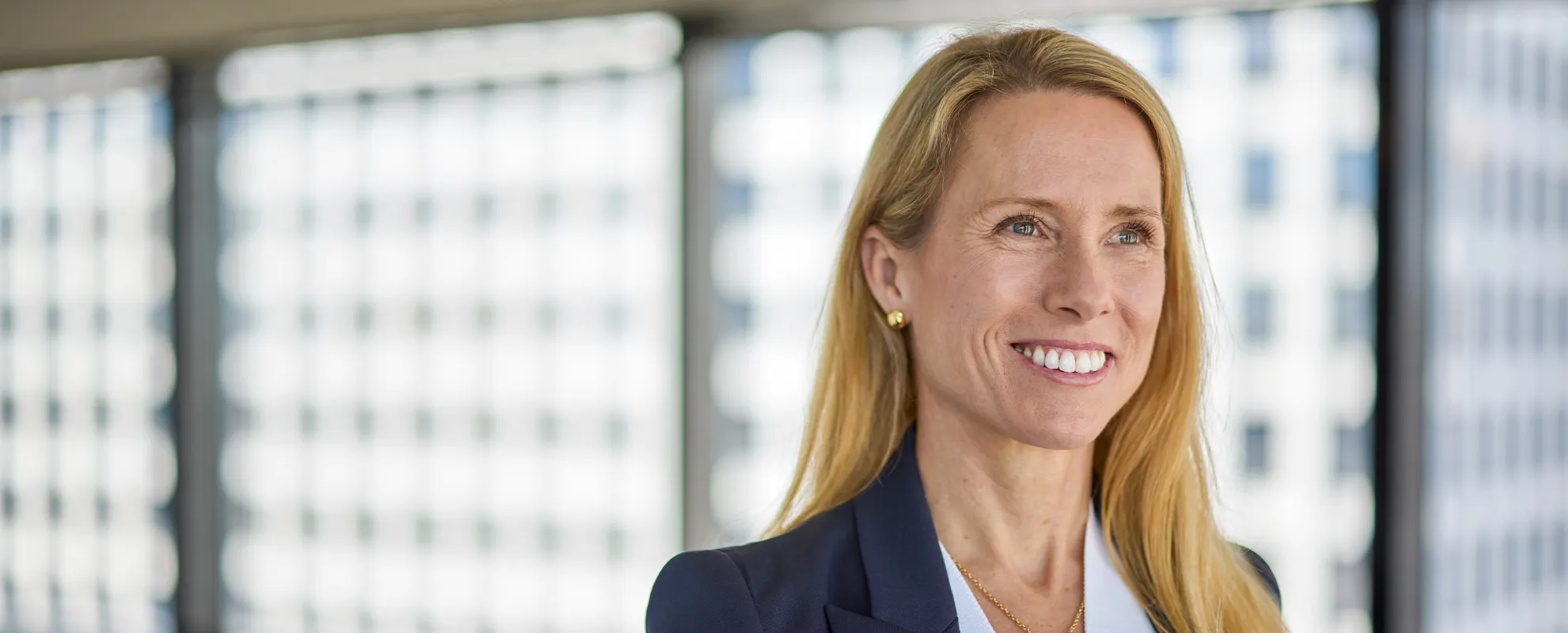

Sierra Signorelli, SEP ’19, Zurich U.S. CEO and Zurich Commercial Insurance CEO, likes to say that risk is at the heart of her business. And as her career demonstrates, she’s not averse to taking some herself.
Born and bred in Silicon Valley, Signorelli earned an undergraduate degree in environmental science at the University of California, Santa Barbara, and worked at an environmental engineering firm before pivoting to become an underwriter at multinational insurance and finance giant AIG. Over the next 17 years, she took on a series of increasingly senior roles in California and New York, ultimately moving to Singapore for a global leadership position.
In 2017, Signorelli changed roles — and continents — yet again when she moved to Switzerland to become chief underwriting officer for Zurich Insurance’s commercial lines.
Never one to coast, she subsequently enrolled in the Stanford Executive Program (SEP) from Stanford GSB Executive Education — and had such a meaningful experience that she decided to share it with her colleagues, helping to design and facilitate short custom programs for emerging talent at Zurich.
By 2021, Signorelli had become Commercial Insurance CEO at the firm, and in 2026, she relocated to Chicago to add Zurich U.S. CEO to her duties. Today, she leads a team of 13,000 insurance experts who advise a global client base on all aspects of risk, generating approximately $30 billion in annual revenues.
I studied environmental science because I wanted to have an impact and make the world a better place. I started with an environmental engineering firm and serendipitously landed in insurance: I had a colleague who said, “Come talk to this insurance company; I think you’d be interested in this business.”
At its best, insurance is not just a financial product; it’s really an enabler of progress. It allows businesses to build, communities to recover, and leaders to make decisions in the face of volatility. So, I’m passionate about our ability as an industry to help solve some of the world’s most complex challenges.
We have the opportunity to help businesses think about their cost of risk, and not only insure it, but help them understand how they can reduce that cost through loss control. That saves assets, but more importantly, it saves lives.
Throughout my career, I’ve had the opportunity to work across markets and cultures in both regional and global roles.
It’s taught me that leadership is not one-size-fits-all. You can’t make any assumptions about people’s views and approach; you have to understand the local realities while also having a clear view of what you’re trying to achieve globally for your organization.
It’s important to keep learning even when things are going well; success can create momentum, but it also can create blind spots. Stanford was a wonderful opportunity to step outside of my day-to-day environment, challenge some of my thinking, and reflect on the kind of leader I wanted to be.
One of the most powerful aspects of the program was that it was intensive and immersive: You are 100% engaged. Up until that point, I hadn’t had an opportunity to dedicate time away from the day-to-day demands of business to reflect and think deeply about the trends shaping the world, or to engage with diverse peers who were experienced leaders and who were all reflecting on similar themes from different perspectives.
I was also coming back to my roots: I grew up not far from Stanford, so at that stage of my career, it was both professionally energizing and personally meaningful.
Seeing leadership as a system and not just as a set of individual decisions.
In large organizations, what’s visible to most people is often just the final step. But what matters just as much as the decision is who has a voice? How is dissent surfaced? Is there real engagement? And do people really feel accountable for the outcome?
Another takeaway was the importance of having focus if you want to drive impact. It’s easy to keep adding new priorities, new meetings, new initiatives, new expectations. But if we want to have a real impact, we have to be just as vigilant about what we stop doing as what we start doing. That means being intentional about how our teams spend time and making sure that I’m protecting time for customers — and time to think.
It also encouraged me to think more about designing conditions in our organization for better decisions, rather than always trying to make decisions myself: creating clarity around purpose; inviting challenge early; being disciplined about priorities; and ensuring that teams understand not only what we’re trying to do but why it matters, so that we can drive better outcomes.
Zurich has invested in two separate executive development program sessions for the next generation of high-potential leaders in our commercial insurance business. There’s a lot going on in our industry as we push to grow and adapt, and I wanted leaders to have the incredible experience that I had. So, we worked with Stanford to develop a one-week immersive experience that gave them a similar opportunity to step away from their day-to-day roles, to learn together, to reflect, and to engage in some of the leadership practices that are shaping the future of business.
One of the most valuable outcomes for us has been the global network that it creates. We bring in 40-plus people from all parts of the globe, and we’ve seen really strong connections come out of this program between people who didn’t know each other before, but who were amazed by how many similar challenges they had across different parts of the company. It gives us a larger group with similar tools and a common language as we look to lead change in our organization.
I attended along with a couple of other people on our executive team because it gives me the opportunity to meet and engage with some of our top talent: to understand how they think, what they see in our business, and how we can accelerate their development.
So many of the challenges that we face are ultimately the challenges that our customers face, and they’re becoming more interconnected than ever. There’s economic uncertainty, climate and natural catastrophe risk. We have changing expectations from our customers because data is more readily available, and they expect more insights from us. When you think about the future of the workforce, a lot is changing there as well.
That presents us with pressure, but also with opportunity. Risk is at the heart of what we do as an industry: Clients and partners look to us to help make competent decisions about the risks that they face.
The toughest decisions are rarely purely financial or operational. They’re usually decisions where data is incomplete and multiple stakeholders are going to be affected, but you still have to draw a conclusion and balance near-term performance against long-term resilience — and also strike a balance between taking decisive action and having empathy for those people that will be impacted.
The most important thing that I’ve learned over time is that you have to have consistency between words and actions; and while speed does matter, so does alignment in an organization. You can make a quick decision, but if you don’t have the organization moving with you, it won’t move very quickly. I view my role as not only making the call, but also helping the organization understand the direction that we’re moving in — and not being afraid to adjust as I see new information emerging.

“When you are trying to lead an organization, trust, judgment, and clarity of purpose become critical. So, at a certain point in your career, you need to pivot from collecting technical skills to making sure that you’re gaining confidence in how you make decisions, how you communicate, and how you lead across an enterprise.”
– Sierra Signorelli
