
We empower faculty to design and discover original research that challenges conventions and creates breakthroughs that push boundaries of knowledge.
Publication Types
Journal Articles
Books
Working Papers
Case Studies
Browse Publications
Corporate Conservatism, Herd Behavior and Relative Compensation
This paper demonstrates that in a simple setting with managerial concern for reputation and asymmetric information on ability, most managers may refrain from undertaking innovations which stochastically dominate an industry standard. Common…
A Cross-Sectional Analysis of the Theory of Corporate Disclosure Due to Adverse Selection
In this paper we examine the determinants of firms’ level of voluntary disclosure. We use analysts’ published evaluations of firms’ disclosures as a comprehensive measure of disclosure level and use a model of discretionary disclosure to explain…
Cultures in Organizations: Three Perspectives
Despite the surge of interest over the last decade in cultural phenomena in organizations, researchers of widely differing disciplinary backgrounds, epistemologies, methodological preferences, and political ideologies continue to disagree…

Delegation and the Regulation of Risk
It has been argued that U.S. regulatory agencies take an extreme and often inconsistent approach to the regulation of risk: they tend to overreact to dramatic, well-publicized accidents and disasters. The standard explanation invokes the…
Divided Government and U.S. Trade Policy
We develop a distributive politics theory of delegation and accommodation in U.S. trade policy. Congress may choose to delegate trade policymaking authority to the president in order to implement more efficient and less protectionist trade policy…
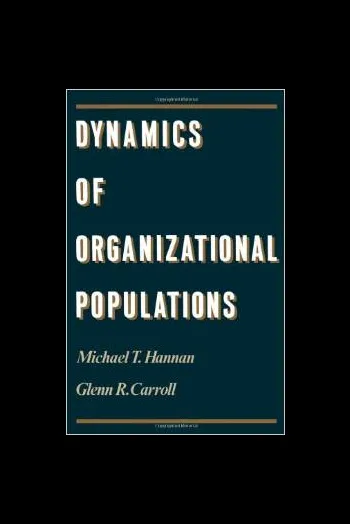
Dynamics of Organizational Populations: Density, Legitimation and Competition
Why does the number of organizations of any given kind vary over time? Utilizing a diverse group of organizations including national labor unions, newspapers and newspaper publishers, brewing firms, life insurance companies, and banks, this book…
Employee Stock Options
This paper considers the optimal exercise policy for employee stock options taking into account the tax incidence of exercise on both the employee and employer as well as the employee’s risk preferences. A recursive algorithm that determines the…
Escaping the Inherent Conservatism of Empirical Organizational Research
Those of us who have uncooperative political convictions and a commitment to doing empirical organization research have a problem: Empirical research in our field trends to be inherently conservative. Presuming that we confine our data collection…
Fading Memories: A Process Study of Strategic Business Exit in Dynamic Environments
The comparative study of the evolution of Intel Corporation’s strategic position in two semiconductor memory businesses and in the microprocessor business provides insight in the forces that drive the strategic business exit process in dynamic…
Feelings about a Disneyland Visit: Photography and the Reconstruction of Bygone Emotions
Hedging in Incomplete Markets with HARA Utility
In the context of Merton’s original problem of optimal consumption and portfolio choice in continuous time, this paper treats an extension in which the investor is endowed with a stochastic income that cannot be replicated by trading the…
Home Bias and the Globalization of Securities Markets
This paper documents the available evidence on international portfolio investment in five OECD countries. We draw three conclusions from the data. First, there is strong evidence of a home bias in national investment portfolios despite the…
Information, Control, and Organizational Structure
This paper investigates how a designer of an organization (referred to as the regulator) should organize a production activity in which two different units produce components and where each unit has private information about its cost. Three…
Information, Liquidity and Asset Trading in a Random Matching Game
This paper shows that the extent of information available in the market about a security can crucially affect its liquidity. Following Kiyotaki and Wright (1989), exchange is modeled as a sequential random matching game. Agents who want to…
Institutional Constraints and Ecological Competition in the Early American Telephone Industry
This study examines the effects of institutional constraints — political boundaries and regulatory policies — on the organizational evolution of the early American telephone industry. State-level panel data on independent telephone companies…
Institutional Investment, Corporate Earnings and Managerial Incentives
Abstract not available.
Intertemporal Preferences with a Continuous Time Dimension: An Exploratory Study
Large Shareholder Activism, Risk Sharing, and Financial Market Equilibrium
This paper examines financial market equilibrium in the presence of a large investor, such as a pension fund, who has access to a costly monitoring technology allowing him to affect securities’ expected payoffs. Despite the free-rider problem…
Macro Organizational Psychology
Market 2000
In July, 1992 Release, the Securities and Exchange Commission [SEC] announced that the Division of Market Regulation was undertaking a “study of the structure of the U.S. equity markets and the regulatory environment in which those markets…