The Emerging COO: Driving Innovation and Operational Excellence from Stanford Graduate School of Business Executive Education is a nearly 12-week hybrid program designed for senior-level operations leaders, and emerging and experienced COOs.
Delivered through a blend of live online sessions, self-paced coursework, and a one-week on-campus immersive module at Stanford GSB, the curriculum addresses the dual imperative facing modern operational executives: driving continuous innovation while maintaining operational discipline. Participants build strategic and financial acumen, learn design thinking methodology, and complete an applied business challenge within their own organizations.
What Does The Emerging COO Program Offer Senior Leaders?
The role of the chief operating officer has moved past managing static supply chains and maintaining daily efficiencies. Operational leaders must build organizational capabilities that adapt to market shifts, technological disruption, and shifting business models. Especially in the age of AI, modern operational executives are frequently called to serve as both the driver of organizational change and the anchor of day-to-day stability.
As Kristiana Almeida, COO at Keep Tahoe Blue, observed during her time in the program, “One of the most powerful aspects of the program was realizing that, regardless of industry, COOs are grappling with the same core challenges, how to scale our people, operational models, and revenue in a world that is changing faster than ever, while also needing to serve as a steady hand to our teams.”
The program addresses these core leadership pressures by focusing on four primary operational excellence:
- Balancing Strategy and Execution: Connecting broad organizational goals with day-to-day operational decisions.
- Fostering Operational Innovation: Applying design thinking and agile methods to internal processes and value chains.
- Building C-Suite Alignment: Communicating financial, operational, and strategic priorities effectively to board members and executive peers.
- Navigating Organizational Friction: Leading change without disrupting ongoing performance.
Participants bring an active organizational project into the program to address these friction points. Over nearly 12 weeks, they refine this initiative using frameworks from Stanford GSB faculty, graduating with an actionable execution plan and a Stanford GSB Executive Education certificate of completion.
How Is the Nearly 12-Week Hybrid Curriculum Structured?
The program is structured in three distinct modules designed to integrate with a full-time executive workload.
Module 1: Build the Foundation (Online)
The first four-week module focuses on fundamental strategic and financial acumen. Through live online lectures and self-paced assignments, participants examine the underlying drivers of firm performance and value creation. This coursework establishes a shared analytical baseline before executives step foot on campus.
Module 2: Explore and Engage (In-Person at Stanford GSB)
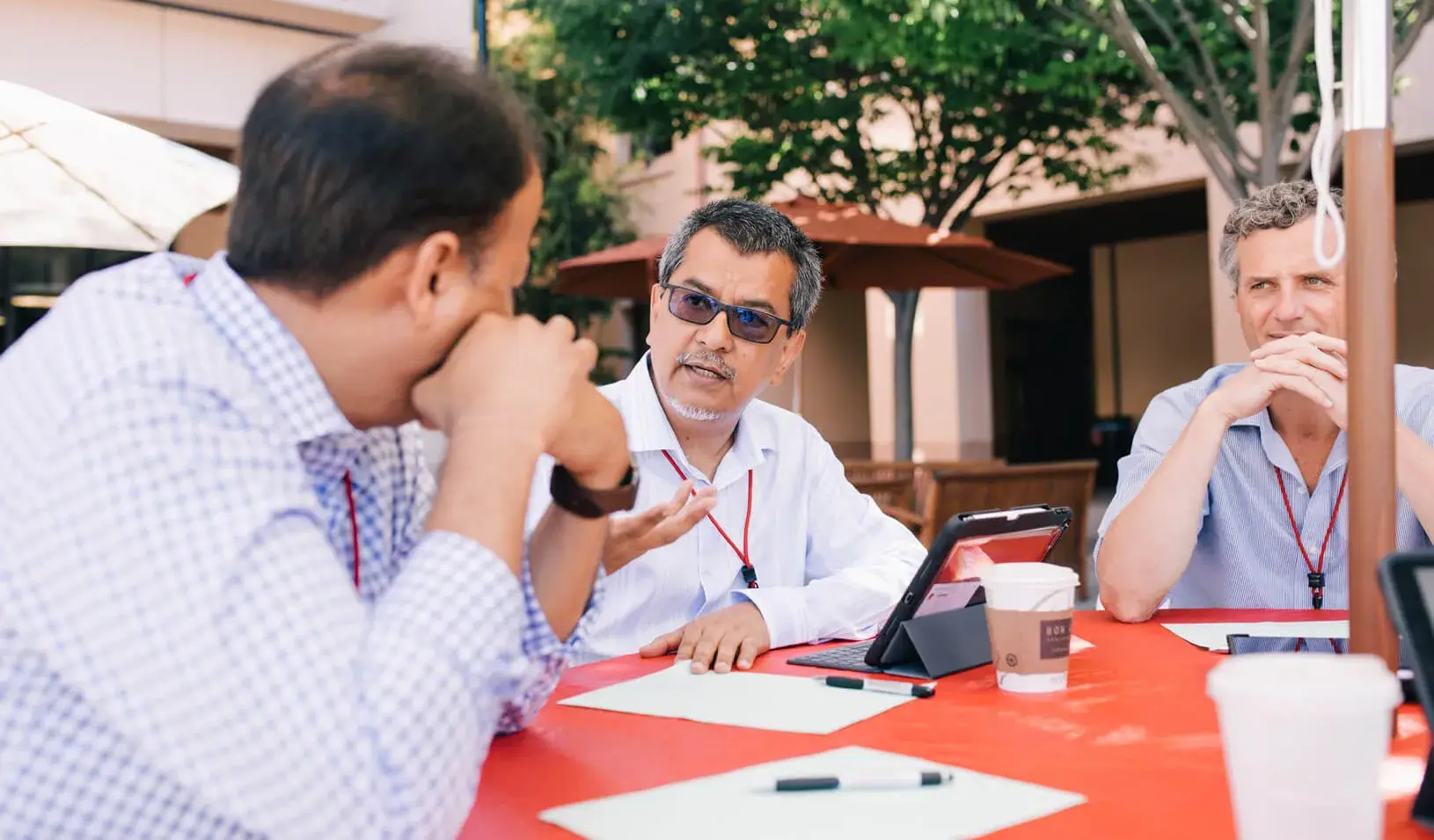
In the second one-week module, participants gather at the Stanford Graduate School of Business campus in Stanford, California. This immersive module features interactive case discussions, faculty lectures, peer workshops, and guest speaker sessions.
Isabelle Meyer Stapf, Vice President of Value Added Services at AppFolio, Inc., noted how thoroughly planned the campus experience felt: “The content, speakers, program facilitators, location, activities, everything was very well planned and applicable to my day-to-day life. I left with my ‘cup’ full of new ideas, validation for a lot of the good work that my team is doing, thoughts on my evolution as a leader, and a bunch of new, valuable contacts.”
Module 3: Apply and Innovate (Online)
The final nearly seven-week module brings theoretical concepts and campus insights directly back into the participant’s work. Executives work through design thinking frameworks to execute an organization-specific business challenge of their choosing, receiving ongoing feedback from peers and program facilitators. Ann Teranishi, Executive Vice President of Operations at American Savings Bank, highlighted that “being able to practice and use some of the concepts in a real-life work project is the key to getting the most out of an experience like this.”
Who Teaches in The Emerging COO Program?
The program is led by renowned Stanford Graduate School of Business faculty who publish research and consult across operations, strategy, finance, and organizational behavior. Faculty Director Stefanos Zenios frames the core objective of the teaching team is to “provide you with cutting-edge frameworks to help you balance the conflicting demands of your role in order to effectively drive growth, innovation, and operational excellence in your organization.” Faculty featured in this program include:
- Stefanos Zenios, Faculty Director of The Emerging COO, Professor of Operations, Information & Technology
Professor Zenios leads sessions on design thinking, lean startup, and operational innovation. He guides participants through financial modeling techniques and project evaluation strategies. - William Barnett, Thomas M. Siebel Professor of Business Leadership Strategy
Professor of Organizational Behavior
Professor Barnett teaches strategic leadership and competitive positioning, helping leaders diagnose organizational performance. - Peter DeMarzo, Staehelin Family Professor of Finance
Professor DeMarzo covers value creation, capital allocation, and financial frameworks essential for C-suite executive alignment. - Hau Lee, Thoma Professor of Operations, Information & Technology
Professor Lee focuses on value chain innovation, supply chain design, and agile operational routines.
What Academic Frameworks and Learning Methods Are Used?
The curriculum relies on experiential learning, interactive case analysis, and practical quantitative exercises. Key content themes include:
- Strategic Leadership & Identification: Diagnosing reasons behind organizational success and failure, evaluating firm performance logic, and using consumer feedback loops and A/B testing to refine corporate strategy.
- AI-Powered Decision Making: Analyzing responsible analytics, prescriptive AI models, resource allocation algorithms, and bottleneck identification. Leaders learn how to interface productively with data science teams to accelerate operational decision-making.
- Finance and Value Creation: Building robust financial models to evaluate new product or service launches, examining reliable capital return metrics, and using financial sensitivity analyses to prioritize executive focus.
- Value Chain Innovation: Expanding sources of innovation beyond traditional product features to include external suppliers and value chain partners.
Joseph Appert, Managing Director, North America at ALT Group Babymoov Corp, emphasized how these practical frameworks reframed his day-to-day management approach: “Learning about design thinking at Stanford was huge. It’s very present in my mind now, to take a customer-first approach, along with prototyping, testing, failing, learning, and growing from there. Leading by design for my team also really stuck with me.”
Who Attends the Program?
The cohort comprises mid- to senior-level leaders across technology, finance, manufacturing, healthcare, and non-profit sectors. Participants include current COOs, Vice Presidents of Operations, Executive Directors, and senior division heads preparing for executive advancement.
Because the COO function operates at the intersection of leadership and execution, stepping away to evaluate operational strategy alongside peers is critical. Almeida reflected on this mindset shift, sharing that: “the COO role is incredibly unique because it requires continual growth, forward thinking, and adaptability to remain relevant and truly useful; because this role is often at the leading edge of an organization’s ability to innovate. This program created the rare space to step back and examine innovation as a process, something we can drive and own, so that continual evolution now feels deliberate and not reactive. And that space happens to be facilitated by the world-class faculty of Stanford’s Graduate School of Business.”
That high level of peer interaction forms a cornerstone of the cohort experience. Appert reflected on the value of that shared background, noting that “this was the perfect program to go in-depth with other executives who know what it’s like to run a business. To learn among my peers was very, very valuable.”
Sabrina Stover, CFO & COO at ERPA Group, similarly pointed to how the peer perspectives helped shift her focus outward: “The knowledge that I’m taking back from this program will give my company a huge advantage because it will help us to further operationalize what we’re doing and to think outside of the box. For me, this was one of the big goals, was to be able to stop looking inward so much and look at what’s happening in the marketplace and how should we change our organization.”
Ready to Apply for The Emerging COO?
To learn more about the curriculum, download a sample schedule, or begin your application, visit The Emerging COO: Driving Innovation and Operational Excellence program page.