Quote
Our work is very much about problems in the real world, which need sensible descriptions — and sensible solutions.
Author Name
— Joey Feffer


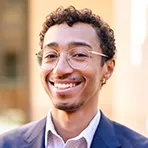
Joey Feffer says he was born a “math kid” through and through. Even as a child, when others nursed visions of becoming firefighters or professional Lego builders, he dreamed of growing up to become a math professor. His upbringing suited this natural inclination: He and his four siblings were homeschooled, and his medical doctor parents designed a STEM-focused curriculum in which Feffer thrived.
“I think the fact that I was homeschooled means I wasn’t around some of the social attitudes toward math that can put people off from it,” Feffer says. “To me, math is like riddles, and everyone likes riddles and logic puzzles! I just always had so much fun learning math, talking to other people about math, exploring my creativity through math.”
While an undergrad at Harvard, Feffer became active in community organizing and advocacy. For a time, he tried to find an application of theoretical math that could further the social justice issues he cares most about. But he started to feel that he was “forcing the two together in ways that were unnatural for both,” he says.
As a doctoral student at Stanford Graduate School of Business, Feffer feels he has finally found that balance between his academic and personal interests. He still nurtures his passion for social change and advocacy: Among his many commitments, he is a Knight-Hennessy Scholar — part of a prestigious university-wide Stanford program that helps prepare students to be collaborative leaders who take on the world’s most difficult challenges.
He is also able to delve deep into the mathematical theory he loves while discovering practical applications for his scholarship. The potential for his work to have impact beyond the classroom, he says, is “built into the culture of doing econ theory at Stanford: Our work is very much about problems in the real world, which need sensible descriptions — and sensible solutions.”
One summer in college, I did a math research experience on this graph-theory problem: You have a set of nodes and a bunch of edges between those nodes, and you want to find the minimal number of ways that you could color the edges to satisfy certain properties.
I thought it was a lot of fun, but it felt very removed from the real world. And I had this fear that I would wake up at 45 and be like, “What have I done with my life?”
It was the summer of 2019. During this research experience, some of my friends and I were watching the Republican presidential primary debates and talking about social issues and economic policy. I felt this juxtaposition of doing the really abstract stuff during the day and then talking to my friends about very practical things at night.
I learned that summer that I really liked doing theoretical research — and when I say theoretical, I don’t mean in contrast to applied, I mean in contrast to empirical, data-based work — but I wanted it to be focused on questions that were real.
And so when I left that summer experience, I knew that the econ conversations were interesting to me, but the day-to-day of doing theoretical math was exactly what I wanted to be doing. And so that was how I ended up in econ theory.
I would describe my work as mechanism design. I’m interested in settings that are typically viewed as complicated to solve mathematically or complicated for some real person in the world to know what to do.
And I think some of the reasons that they’re complicated are because the ways that we’re modeling them are not fully correct. In a lot of the work I do, we tend to have really strong assumptions on how people are going to behave or how rational people are. I try relaxing those assumptions to give us clearer solutions for what to do.
I think auctions have been a good playground for these ideas because there are notorious instances where the theoretical tools we have just don’t give us anything. Either they don’t give us anything realistic, or we just can’t solve the problem with them. And I think as someone who values math and values theoretical thinking, that just feels very unsatisfying to me.
Because when we say, as theorists, we can’t do something, then the problem gets shunted into the world of, “OK, let’s try to use some data. Let’s try to simulate things. Let’s try to just do this kind of imprecise guesswork.” I really believe in theory. I really believe that these tools can be useful. We’re just not using them in the right ways.
This could apply to not just any auction, but to any game.
Mechanism design is a field with applications from kidney exchanges to how we allocate wireless spectrum.
And all of these theories started with a basic question: If you’re a monopoly seller, how do you sell a good? It turns out that these basic economic problems that seem really theoretical can actually be connected to a lot of different settings.
Fundamentally, it’s about the fact that people have their own incentives. If you were thinking about what connects kidney exchanges to spectrum bidding, that’s what my answer would be: What you’re designing needs to respect people’s incentives in some way.
Right now, I would say that even though the problems that we can solve can be varied across all of these settings that I talked about, they’re still limited in the amount of complexity they can have, to be able to give a clean solution or clean intuition. I see my work as trying to expand on the amount of complexity that we can deal with. My hope is absolutely that in doing that, people are then able to take the stuff I do to other settings outside of auctions.
I have great advisors who are real-world focused. That was why I chose Stanford: because I knew that I have sensibilities that could just take me in super conceptual directions, and I wanted to have grounding forces. The way the people at Stanford GSB approach economic theory, it’s a very unique perspective. There’s no place like it.
There’s a version of my work that could just look at a bunch of fake matrix games, and if someone were to ask me where they show up in the world, I wouldn’t really have an answer. The interplay of the practical problems and the need to refine tools to solve them is really productive for me.
Michael Ostrovsky is one of my main advisors, and he’s very good at making sure his students pay attention to the real world. If you say to him, “I don’t know what I should be working on,” he’ll say, “Go read the newspaper; the world’s a mess. There’s a bunch of things we can’t do that we need smart people to figure out.”
That attitude is just in the air here. All of my friends and co-authors here are of a similar persuasion. If we’re not going to be consultants, consultants can read our work, or the people designing the next government auction or government program can read our work. It’s just this equilibrium where the people who come here and want to do theory understand that that’s a big part of the place — and that’s why we chose it.
I really love the econ group at the GSB. It’s such a great group of students. When I was an admit and talking to people at different universities, I was blown away by the people I talked to here. They just seemed like people I wanted to spend my time with; they were smart, curious, ambitious to do something interesting and to do the interesting thing well. That’s the community of people I want to be in. That’s the type of person I want to be.
We don’t come to grad school divorced from who we are and what we care about. And I felt like I was just putting so much on myself because there are not a lot of other people in places like this with perspectives like mine. I felt like all these parts of my life had to fit together. And it felt like I was putting so much pressure on my research to change the world.
I’ve gotten to a place where I’ve decided that every paper doesn’t necessarily need to be about making the world better for marginalized people. That has allowed me to get more creative about how to have both in my life in a way that feels right. Now, the way I see myself helping is through mentoring, advising, and doing stuff outside of the academy.