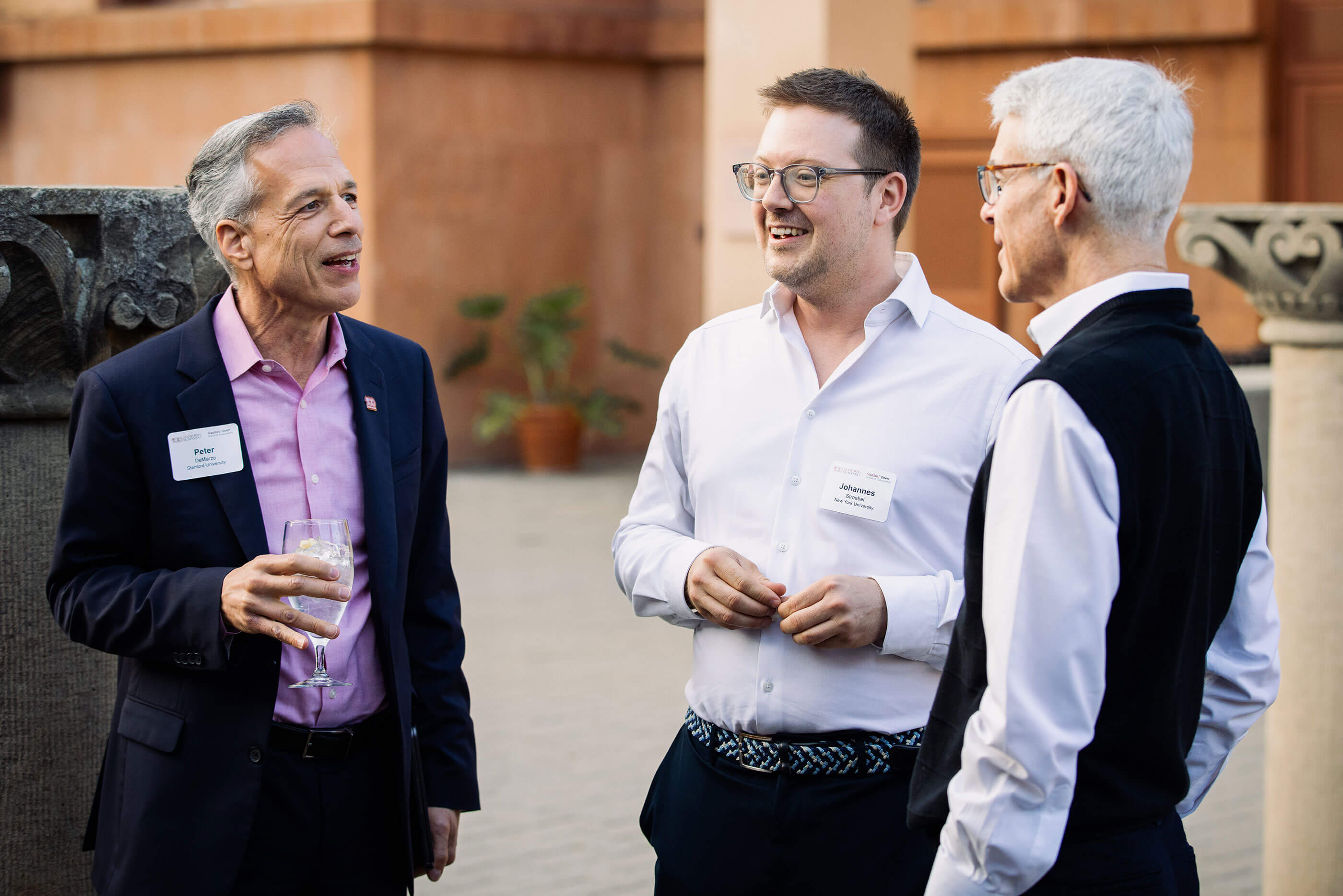
In Mongolia, nearly a third of the population lives a traditional nomadic life of herding. Nomadic people influence the country’s economy and politics and also offer something to the rest of the world: Their culture and mindset “present an alternate worldview that could help people more broadly globally,” said Badruun Gardi, BA ‘09, to the audience at the Stanford Sustainability Summit at Stanford Graduate School of Business (GSB) in mid-July. As founder of the New Nomad Institute, Gardi researches nomadic culture and philosophy, aiming to apply them to efforts addressing climate adaptation and migration.
Also participating in the Sustainability Summit was Daniel Jimenez, MS ‘15, founder and chief executive of Brazilian company Silva, which connects plant nurseries selling native tree seedlings with large buyers such as agroforestry initiatives. The company’s mission, said Jimenez, is forest restoration in the Brazilian Amazon.
Closer to Silicon Valley, the J-Impact venture fund invests in companies that benefit the environment, said the fund’s managing partner and event attendee Eran Sandhaus. Among the fund’s priorities are supporting firms in clean energy and ocean health.
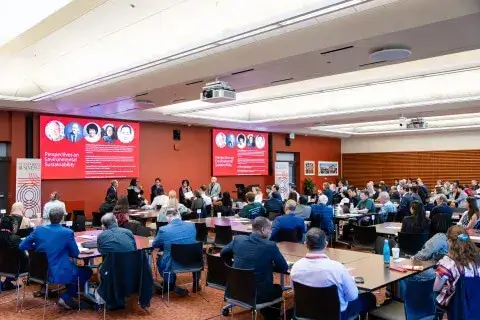
Gardi, Jimenez, and Sandhaus were among the 40 changemakers from around the world at the event, where assembling a wide range of geographic and cultural perspectives in one room was by design. Environmental sustainability “cannot be understood from the perspective of Palo Alto,” GSB Professor Bill Barnett told the gathering. The changemakers, as organizers dubbed the government officials, entrepreneurs, researchers, funders, and non-profit leaders in attendance, each spoke about their mission and challenges. Their expertise ranged from biological preservation and ocean science to food security and poverty, underscoring both the complexity of environmental sustainability and the possibility that diverse groups can successfully address it.

The Sustainability Summit, part of the GSB’s Centennial Celebration, began with an introductory panel moderated by Barnett and Chris Field, professor at the Stanford Woods Institute for the Environment. Panelists included Keiichiro Asao, MBA ’92, head of Japan’s Ministry of the Environment, Honorable Maria Antonia Yulo-Loyzaga, former secretary of the Department of Environment and Natural Resources in the Philippines, and Mbong Akiy Fokwa Tsafack, associate communications director for Africa at the nonprofit Human Rights Watch. The panel suggested important issues for attendees to examine, including voter reaction to climate policy and balancing adapting to climate change with mitigating it. Tsafack raised a question that resonated throughout the event: “Can we change the system on the back of the same system that created the current problems?”
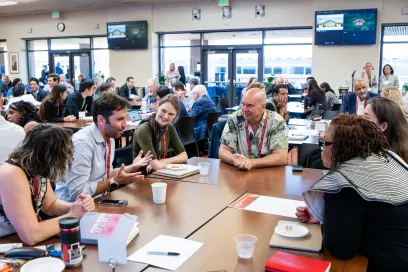
Participants afterwards broke into small clusters to gain a deeper understanding of the impacts of environmental sustainability in different regions. Each group discussed possible solutions, with each proposing “What if …?” ideas and presenting its conclusions.
Barnett advised participants to think broadly and consider both new technologies as well as existing ideas they can recast or combine in new ways. He discouraged falling back onto “fail-safe systems,” or overly risk-averse solutions, and reminded participants that the best ideas often emerge from groups with varied skills but a single shared purpose.
Each group’s presentation was videorecorded for later viewing by GSB students seeking inspiration and potential internship leads. The GSB’s Business, Government & Society Initiative, which supports environmental research, and the Stanford Doerr School of Sustainability (SDSS) sponsored the event, with welcome remarks by GSB Dean Sarah A. Soule, Doerr School Dean Arun Majumdar, and GSB Professor Ken Shotts.
Modifying mindsets
Participants agreed it’s difficult to change people’s behavior and attitudes and proposed ideas to persuade more of the world’s billions to adopt a mindset geared toward sustainability. Some ideas were adventurous: One group suggested recruiting international celebrities and pop-culture figures – think soccer heroes and K-Pop stars – to help support “a peace movement for sustainability,” said one attendee.
Another group noted that many individuals and small businesses are indifferent about technology and the long-term benefits of sustainability but might be interested in ways sustainable practices can save them money today. Any collective action would need communities and individuals to hold each other accountable, participants generally agreed.
Changing a mindset may require people to believe that resources are finite and that they can prioritize caring for people and surroundings over production, consumption, and profit. “As changemakers, we should constantly ask ourselves, ‘What is the story we are telling the world about what success looks like?’” said Tsafack. Another attendee suggested that society might begin redefining what constitutes wealth and adopting “a mindset of less-is-more, a tiny-home type of thinking.”
Litigation of course remains a way to try to force people or organizations to change their behavior. But because suing is expensive and time consuming, at environment law nonprofit EarthRights International, “99% of our time is spent on non-litigation work” such as negotiating and advocacy, said Shannon Young, deputy executive director. When EarthRights sues, she added, “we are trying to test new legal theories and bring cases that will help the communities use the law to their advantage.”
New knowledge
Attendees discussed a range of technologies in varying stages of development. The government of Japan is studying artificial photosynthesis, or mimicking plants’ natural process of converting sunlight, water, and carbon dioxide into energy and oxygen. Successful artificial photosynthesis would remove carbon dioxide from the air and produce fuel useful to society in a “social implementation of photosynthesis,” said Asao.
Meanwhile, Zero Cow Factory in Gujarat, India, is developing animal-free milk and dairy products through bioengineering. The company’s technology requires little water and energy and produces far less carbon than conventional dairy operations, said Sohil Kapadia, co-founder and chief executive.
In the United Kingdom, the Oxford Commission on Sustainability Data aims to organize the scattered data that companies produce about their sustainability into standard formats and datasets. The initiative, based at Kellogg College at Oxford University, envisions a system allowing companies to log information about their sustainability efforts into a database, which would be easy to analyze and audit. Having that information from many sources in a single place would improve accountability and help companies and regulators track trends and progress, said Mazi Zarrehparvar, one of the Commission’s organizers.
Some noted that valuable insights needn’t always be high-tech or fresh out of the lab. “We’re looking at new types of knowledge, not just scientific knowledge but local knowledge and traditional knowledge and how that intersects with what we know about our environment and ecosystem,” said Yulo-Loyzaga.
Gardi’s New Nomad Institute, for instance, is studying the traditional Mongolian yurt as a sustainable mobile structure that could play a role in mitigating housing crises caused by natural disasters.
Restore and replenish
Besides replanting trees in rainforests, restoration also includes regenerating other kinds of areas damaged by overfishing or development. The Swiss firm rrreefs works to regenerate coral reefs in the Philippines, Ecuador, and elsewhere. In the Pujada Bay in the Philippines, the company has installed hundreds of terracotta clay structures over 100 square meters to create a foundation that encourages coral growth and helps fish populations.
Rebuilding biodiversity is a major goal in the Philippines, said Jonathan Anticamara, professor at the Institute of Biology at the University of the Philippines Diliman. “Biodiversity underpins most of our economic development” and leads to an improving quality of life, he said.
Efforts to replenish and protect natural resources must allow for social and economic realities, especially the need for local employment, some noted. “You have to solve certain things before you solve deforestation,” said one attendee, adding that governments at times have “put the environment ahead of social issues and that tends to not work.”
Eventually, governments, businesses, and communities may need to “reimagine what world we’d actually like to live in,” said Yulo-Loyzaga. “Part of that is accepting that the environment supports our economy rather than the economy owning the environment.”