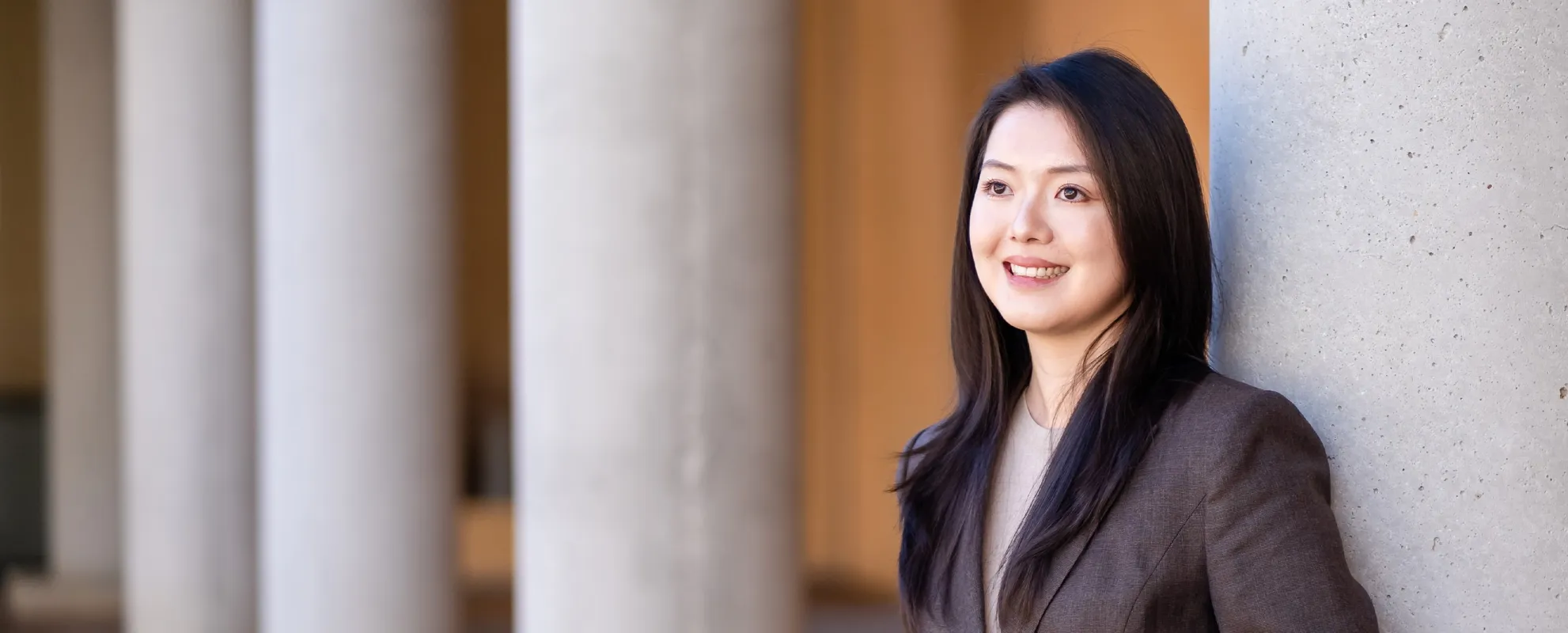
When Louise Lu was growing up on a college campus in the small Chinese city of Linhai, one of her centers of gravity was the daily family dinner table — and the multigenerational debates that surrounded it. Lu’s grandfather, a professor of political economy, would moderate what she calls “small seminars,” raising a hot-button social or economic issue and expecting everyone around the table to take a position. Lu, as the eldest grandchild, was often asked to opine first.
“In our home, family life and intellectual life were inseparable, and my connection to academia began before I even understood what research is,” Lu says. “Academia came to represent to me a life of asking thoughtful questions, of developing ideas through critical debate — with others, and also with myself.”
Inspired by her family’s scholarship, Lu majored in economics as an undergraduate at Zhejiang University of Technology, working closely with a faculty mentor who was among the few scholars in China studying consumer behavior at the time. Inspired by the topic, Lu also relished the chance to participate closely in active research projects.
“The projects were interdisciplinary, bringing together marketing, psychology, neuroscience, and economics, which launched my interest in that type of research,” Lu says. “I saw interdisciplinary research as a way to produce knowledge that was both theoretically rigorous and also socially useful.”
Since the field of consumer behavior research was still nascent in China, after college, Lu became the first person in her family to pursue graduate school and study abroad. She completed her master’s in behavioral and decision sciences at the University of Pennsylvania, and is now pursuing her PhD at Stanford Graduate School of Business.
Today, some of the central questions animating her scholarship at Stanford GSB reflect the family dinner conversations of her childhood, when she was weighing whether to step into a debate — and considering what she should say. Her research sheds light on something she’s always known: Our perceptions of what our audience expects from us are powerful determinants of our behavior.
How did you realize ways your research could be useful outside of academia?
With my family background being so immersed in academia, during my undergrad years, I started to think, “Maybe I should deliberately step outside academia before graduating.” I wanted to gain experience in industry and in government because I really wanted to make a meaningful impact on society and see how industry and government might need the kind of research I’d been learning about. I needed to understand the practical challenges these types of organizations face, so I could decide how to connect my interests to that.
So, during my senior year of undergrad, I interned at Tencent, one of China’s biggest tech companies. I also worked in the local government in China, and later served as a part-time policy analyst for the city of Philadelphia while studying at Penn.
Those experiences gave me valuable exposure to both industry and the public sector. That time also showed me how eager practitioners and officials are for research grounded in practical realities. It really strengthened my desire to integrate multidisciplinary knowledge to address real social problems.
I came to see research as the bridge between theory and practice. I saw how empirically tested knowledge about human behavior could be drawn upon to better design policies, institutions, and decision environments.
What were some problems you confronted during those internships, and how did they spark possible research questions?
At Tencent, we were analyzing consumer data and deciding which advertisements to post to most effectively compel and persuade consumers. We were always coming up with different A/B tests from scratch, without any kind of scientific guidance. It was just my manager in the department and me, brainstorming about possible approaches that might be compelling and persuasive to consumers.
I started to think about how I could have used more of a scientific foundation to decide how to do that kind of marketing more rigorously and more cost-effectively.
Quote
Academia came to represent to me a life of asking thoughtful questions, of developing ideas through critical debate — with others, and also with myself.
But this doesn’t just apply to companies. Yes, companies need to maximize their profits, but governments also need to maximize their outcomes. This type of research can serve different purposes, but I noticed that both the public and private sectors lacked methods to scientifically determine how to achieve the outcomes they were interested in.
That experience in industry and government helped me determine what kind of research I wanted to do, which was both scientifically rigorous and also impactful in socially meaningful ways.
What is the focus of your research now?
My research on social influence begins with a simple premise: We never speak in a social vacuum. In my research with Professor Zakary Tormala, I study how the audience we think we are facing shapes our communication and persuasion. Whether we are expressing our own views or trying to persuade someone else, we first form at least a rough impression of the people we are addressing. Who agrees with me, how strongly do they feel, and will it be safe to speak up? Is my audience open to being persuaded? Those impressions shape what we do next.
With Professor Jennifer Aaker, I’m researching how we find and experience beauty in the age of AI. As AI-generated content becomes part of everyday life, what catches our attention? When AI is a distraction, how can people still experience beauty and authenticity in their everyday lives? We’re also exploring how exposure to AI-generated content is reshaping consumers’ aesthetic preferences.
What are you learning from your research?
We find that as the level of support for a given person’s opinion rises from zero to a moderate level — approximately 40% to 50% — they are more likely to express their opinion. After that, their expression plateaus, meaning there won’t be an additional increase in their likelihood of speaking up.
This rise-and-then-plateau pattern reflects two competing motives: The first is that my psychological safety increases as more people agree with me within the group. Second, the perceived impact of sharing an opinion is also driving my decision of whether or not to speak up. In fact, my perception of impact peaks when the group is relatively divided, and my voice might change the course of the conversation overall.
I’m also examining how our perception of others’ attitudes shapes our persuasion strategies. So if I’m an advertiser or salesperson, if I perceive you to have extremely negative feelings about my product, I’ll use more emotional appeals to persuade you. On the other hand, if I find you to be only slightly negative about my product, I’ll use information to appeal to you. This is because people generally perceive more extreme attitudes as emotion-based, whereas they perceive more moderate attitudes as objective and information-based.
In my AI research, I find that in an age of fragmented attention, using beauty as a filter for everyday experiences encourages people to preserve and foster more lasting memories, more so than other types of experiences. I have also shown that AI sources can make people more open to opposing views and studied how AI shapes the way we form judgments and make predictions.
What are some contexts where these findings from your dissertation can be applied? Volatile online environments come to mind.
Yes, AI and technology have made other people’s attitudes highly visible and almost impossible to avoid. Even before responding to group chats, online reviews, or social media discussions, we encounter other people’s comments. These signals do not merely measure public opinion; they shape who will potentially participate. And that participation, in turn, reshapes the public opinion we see.
My research shows that people do not need an overwhelming majority behind them to speak up. A moderate level of visible support is often enough to unlock their ability to express an opinion, and in fact, additional support offers little further benefit.
These insights are important for leaders, educators, brands, and also online platforms: Even making moderate, rather than overwhelming, support visible may be a cost-effective way to draw silent consumers or audience members into a conversation. Unanimity isn’t required to make people feel able to contribute.
Why did you choose Stanford GSB as the setting to pursue these projects?
I’ve always been part of such an interdisciplinary environment. Growing up on campus, my family immersed me in topics of the social sciences. As an undergraduate, I majored in economics and conducted research studies in the discipline of consumer behavior. During my master’s studies, I had training in machine learning and natural language processing.
I wanted to continue to immerse myself in an academic atmosphere that supports interdisciplinary research, and that’s why I chose Stanford.
How have your research and your thinking been shaped by the mentorship you’ve received at Stanford GSB?
On Admit Day, I met with Professors Zakary Tormala, Jennifer Aaker, and Yu Ding, the faculty members I wanted to work with, to discuss my research interests. One thing that was really weighing on me when I was thinking about my PhD studies was: How should I choose what to study? Should I pursue a hot topic or simply follow what I am most passionate about?
Their answers have stayed with me. They told me that fashionable topics can be tempting, but that research is a long process filled with failures, difficult revisions, critical feedback, and rejections, and that when a project encounters obstacle after obstacle, what keeps you going is a genuine love for the question itself. Their advice: Choose the questions you are most passionate about and find topics you genuinely love.
Years later, after navigating all the unavoidable setbacks and obstacles involved in developing and publishing my own research, I understand exactly what they meant. And the research projects I have carried forward are based on the questions I genuinely love.
It sounds like you have strong mentorship support across a range of research topics.
I’ve found that GSB professors really do encourage us to focus on our passions. I appreciate that I’m both getting trained to focus on research that’s big and important for tackling theoretical gaps and also on more practical work for real-world, urgent issues.