
We empower faculty to design and discover original research that challenges conventions and creates breakthroughs that push boundaries of knowledge.
Publication Types
Journal Articles
Books
Working Papers
Case Studies
Browse Publications
Culture and Demography in Organizations
How do corporations and other organizations maintain and transmit their cultures over time? Culture and Demography in Organizations offers the most reliable and comprehensive answer to this complex question to date. The first book on the…

Debt Literacy, Financial Experiences and Overindebtedness
We analyze a national sample of Americans with respect to their debt literacy, financial experiences, and their judgments about the extent of their indebtedness. Debt literacy is a component of broader financial understanding that measures…
Design and Renegotiation of Debt Covenants
We analyze the design and renegotiation of covenants in debt contracts as a specific example of the contractual assignment of property rights under asymmetric information. Specifically, we consider a setting where managers are better informed…
Does attitude certainty beget self-certainty?
Efficient Intertemporal Allocation of Risk and Return
Efficient allocation of a stochastic stream of financial income is characterized by an explicit stochastic differential equation for the case that each agent has stationary preferences and the probability law of the stochastic process is known.…
Federal Competition and Economic Growth
We examine the question of how competition between governments within metropolitan areas affects economic growth outcomes. Using data on metropolitan statistical areas (MSAs) in the United States, we find that the number of county governments is…
From Streets to Suites: How the Anti-Biotech Movement Penetrated German Pharmaceutical Firms
How do social movements affect decisions within corporations, such as the commercialization of new technologies? We suggest that the effect of movement activism is conditioned by the internal polity and therefore varies across organizations. This…
Fundamentals of Financial Management (13th edition)
A practical introduction to understanding the Financial Management of companies in today’s rapidly changing business world.
Maintaining its dedication to the financial decision-making process and the analysis of value creation, this new…

Heterogeneous Learning and the Targeting of Marketing Communication for New Products
New product launches are often accompanied by extensive marketing communication campaigns. Firms’ allocation decisions for these marketing communication expenditures have two dimensions—across consumers and over time. This allocation problem is…
How to Negotiate and Update Climate Agreements
Any climate change agreement ought to be negotiated and updated later on, as we learn more about the costs and benefits of abatements. Anticipating such negotiations, countries may distort domestic decisions (regarding R&D and adaptation, for…
Human Capital, Bankruptcy and Capital Structure
We derive the optimal labor contract for a levered firm in an economy with perfectly competitive capital and labor markets. Employees become entrenched under this contract and so face large human costs of bankruptcy. The firm’s optimal capital…
Information Aggregation in Dynamic Markets with Strategic Traders
This paper studies information aggregation in dynamic markets with a finite number of partially informed strategic traders. It shows that for a broad class of securities, information in such markets always gets aggregated. Trading takes place in…
Leadership Development in Business Schools: An Agenda For Change
There is surprisingly little evaluation of business school or, for that matter, company leadership development efforts. What evidence exists suggests that business schools have not been particularly effective, overall, in their leadership…
Limited Records and Reputation
We study the impact of limited records on reputation dynamics, that is, how the set of equilibria and equilibrium payoffs changes in a model in which one long-lived player faces a sequence of short-lived players who observe only limited…
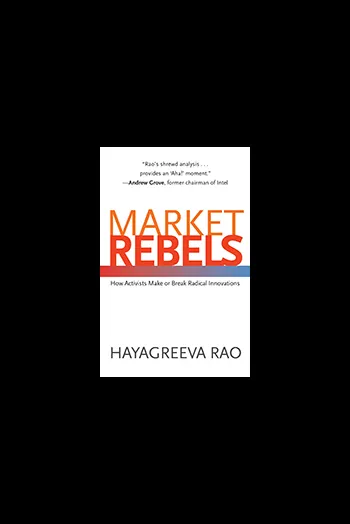
Market Rebels: How Activists Make or Break Radical Innovations
Activists who challenge the status quo play a critical but often overlooked role in both promoting and impeding radical business innovation. Their importance stems from the very nature of innovation, which frequently challenges existing interests…
Modal Constructions in Sociological Arguments
This paper introduces modal logics to a sociological audience. We first provide an overview of the formal properties of this family of models and outline key differences with classical first-order logic. We then build a model to represent…
Models of Job Preference for Stanford MBA's '78
An experiment was conducted to determine if the decision-making process for choosing between alternative job offers by Stanford MBA’s is affected by a task requiring an individual to evaluate hypothetical combinations of a limited number of job…
Multiple roles for minority sources in persuasion and resistance
Research on minority influence over the years has revealed that although sources in the numerical majority tend to be very persuasive on an immediate, public, and direct level, sources in the numerical minority tend to be resisted on this level (…
Objective versus Subjective Indicators of Managerial Performance
Managerial bonus payments are frequently determined by both objective and subjective indicators of managerial performance. By its very nature, subjective information is not verifiable for contracting purposes. The inclusion of such information in…
On the Heritability of Choice, Judgment, and "Irrationality": Genetic Effects on Prudence and Constructive Predispositions
Despite the very long history of research on heritable traits, we still know very little about genetic effects on judgment and choice, including consumer decision making. Building on recent advances in epigenetics, we hypothesize that people…