From flying fighter jets to floating in space, he’s learning to lead in any atmosphere.
![]Marcus_Wandt_in_Cupola Key Image](/sites/default/files/styles/webp/public/2026-10/key-Marcus_Wandt_in_Cupola%20credit%20ESA%201.jpeg.webp?itok=wtryshEk)
Marcus Wandt, SEP ’26, doesn’t mind the commute from Linköping, the town in southern Sweden where he lives with his wife and three sons, up to Stockholm, where he works as head of strategy and technology at the global defense company Saab.
But it isn’t nearly as exciting as his previous one: 250 miles straight up from Kennedy Space Center to the International Space Station, where he spent 21 days orbiting Earth before splashing down in the Pacific Ocean.
“I would definitely go back,” says Wandt, who crewed the 2024 Muninn mission, a joint venture between the European Space Agency (ESA) and Axiom, a private American space company. “It was magical.”
Wandt admits that he wasn’t one of those kids who dreamt of becoming an astronaut. But as a veteran military aviator and test pilot, he does have a history of pushing boundaries, and riding a SpaceX Falcon rocket into space was, he says, “an extreme way” of doing that.
While attending the Stanford Executive Program (SEP) at Stanford Graduate School of Business was a lot less risky — much of his astronaut training involved preparing for emergencies that could have left him and his colleagues stranded in the vacuum of space — it was motivated by the same urge to explore the unknown: Having landed his executive position soon after he returned to Earth, Wandt wanted to acquire a new set of tools and a fresh perspective to match his new role.
“It’s always good to challenge yourself, and to ask yourself: Why? Why do I think this makes sense? What do I want to achieve here?” he says.
Journey to Space
As a high schooler, Wandt planned to study engineering at Chalmers University of Technology, one of Sweden’s leading research institutions. But he was selected for compulsory military service, and characteristically chose the most demanding option.
“The word on the street was that the hardest, most challenging thing you could do was Airborne Rangers,” he says, referring to the elite paratrooper unit within the Swedish Army’s special forces group. “So I applied.”
Wandt enjoyed the teamwork and sense of purpose involved in military duty so much that even after he’d fulfilled his obligation and enrolled at Chalmers, he returned to the Airborne Ranger School to serve as a winter survival instructor. So he decided to combine his interests by studying electrical engineering while becoming a fighter pilot in the Swedish Air Force. By 2006, he had founded a startup, Intuitech, to sell technology he developed to improve the tactical capabilities of flight simulators. By 2007, he had earned an officer’s commission and completed a master’s thesis on harnessing AI to help pilots perform evasive maneuvers.
As an active-duty fighter pilot, Wandt patrolled Swedish airspace and engaged in military exercises with other Nordic countries as well as NATO forces. When Sweden joined NATO in enforcing a no-fly zone over Libya during the country’s civil war in 2011, he helped keep Libyan civilians safe from airborne attack, flying numerous missions overhead.
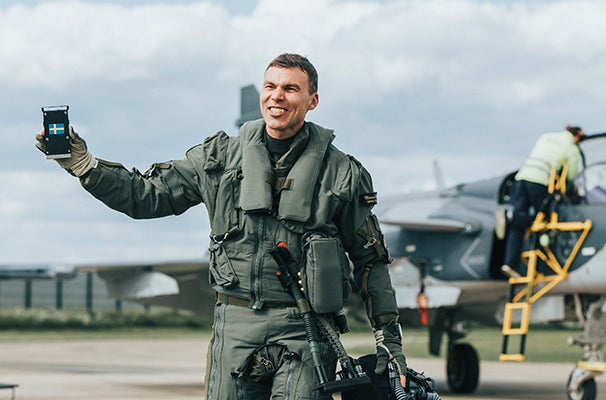
Wandt shown with an AI agent that helped pilot a Saab Gripen E fighter jet on a test flight. | Saab
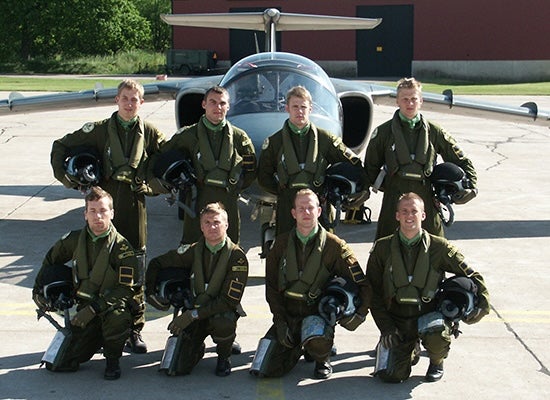
Wandt (standing, second from left) with members of his Swedish Air Force training cohort.
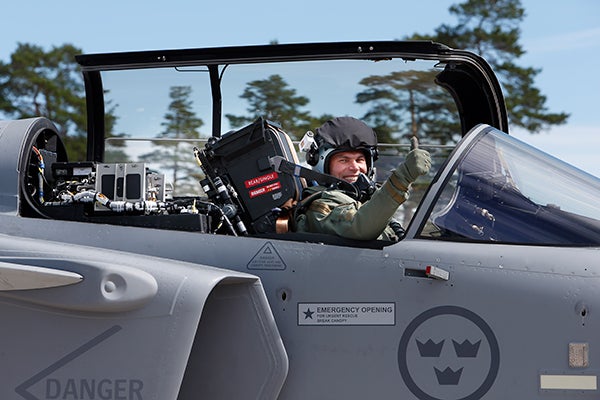
Wandt taking a Saab Gripen E jet on its inaugural flight in 2017. | Saab
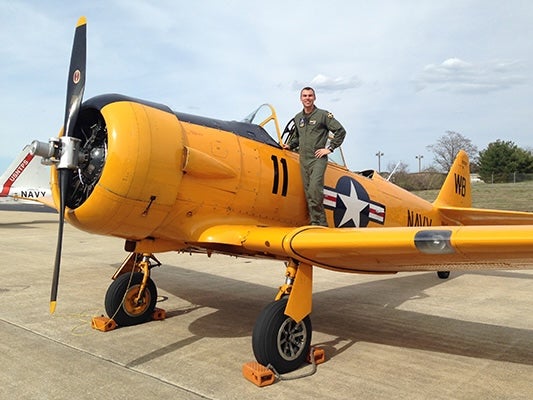
Wandt graduated top of his class at the U.S. Navy Test Pilot School. | Marcus Wandt
Wandt loved the camaraderie — and the challenge — of being a fighter pilot. (He retains the rank of lieutenant colonel in the SAF and continues to fly with his squadron several times a year.) “It’s a very tight brotherhood and sisterhood,” he says. “It’s also rewarding when you get it right, and very punishing when you get it wrong.”
But when the SAF announced that it needed test pilots to help develop a new fighter jet with Saab, he couldn’t resist the opportunity to fly the plane while building it. “I didn’t expect to get the job when I applied for it, but I figured if I didn’t apply, then I definitely wouldn’t,” says Wandt, who graduated first in his class at the U.S. Navy Test Pilot School and took the new fighter on its maiden flight in 2017.
Wandt remained on loan to Saab from the SAF for several years afterward, eventually becoming the company’s chief test pilot and head of flight operations. Once again, he loved the job, in part because it involved regularly pushing the envelope: sometimes taking an aircraft to its physical limits, often blowing right past them.
But true to form, he couldn’t pass up the opportunity to do something even more extreme: leaving the atmosphere entirely.
In 2021, Wandt’s wife saw that the ESA had put out a rare call for astronauts. Wandt figured his chances were slim but submitted an application anyway, then promptly forgot about it until he got an email informing him that he’d been selected for testing.
In the end, Wandt was one of only 17 people chosen to join the ESA Astronaut Corps from among more than 22,500 eligible applicants. He was assigned to the Muninn mission in 2023 and rode a Dragon spacecraft into orbit in January 2024, setting a record for the fastest-trained astronaut in history.

As a mission specialist on the Muninn mission, Wandt flew to the International Space Station in 2024. | SpaceX
When he wasn’t conducting microgravity research (performing stem-cell experiments, monitoring his own brain activity) and educational activities (discussing life in space with school groups, running student code on ISS computers), Wandt spent as much time as he could gazing out the window at Earth below — an experience that changed his perspective on our planet and its place in the universe.
During the 45 minutes of orbital daylight, when the sun is visible but the stars are not, “our planet is so beautiful, but it also looks very alone,” Wandt says. But as the sun sets and the inky void of space fills with stars that seem bigger and closer than they do from Earth, with the polar auroras coruscating as they have for billions of years, the picture rapidly changes. “All of a sudden, the planet doesn’t look alone at all anymore; it looks like it’s part of something very, very big that’s been ongoing for a long, long time.”
A View of Leadership at Stanford GSB
Back on Earth, Wandt was appointed chief innovation officer at Saab, then put in charge of strategy and technology across the company’s entire portfolio, which spans everything from sensors to submarines. He’s also responsible for partnerships, ventures, and mergers and acquisitions.
Faced with those new responsibilities, he decided to enroll in the Stanford Executive Program at Stanford GSB to get a better sense of how to communicate with — and think like — his fellow executives.
“I was hoping to get an understanding of how people in those roles think: what is important to them, and what they focus on,” says Wandt, who had spent plenty of time interacting with C-suiters but had never been one himself. “And I did get that.”
What he didn’t expect to get was an understanding of cross-cultural differences and the role they can play in creating small frictions within teams — something that he expects will help him manage differences in opinion and approach across Saab’s global businesses.
“It was good to have people from 39 different countries and all those different backgrounds giving different perspectives,” he says, adding that he appreciated the range of viewpoints offered by the faculty as well. “It’s seldom that one solution — one perspective on strategy or one perspective on finance or one perspective on innovation — is true in all cases,” he says. “But if you have several perspectives and you synthesize them, you have a really good foundation to address all those topics.”
It may even prove useful for his extraterrestrial pursuits.
As Wandt points out, space is a global sport. The ISS, for instance, was built by 15 different collaborating countries, all with their own cultures, incentives, and approaches to problem-solving. And the current push by both NASA and the ESA to return to the moon will require close international cooperation between the public and private sectors.
Perhaps unsurprisingly, the engineer in him also appreciated SEP’s emphasis on sharing evidence-based insights into leadership. “It’s really good to know that there are case studies and science behind it, because that creates a higher credibility in your decisions,” he says.
Related

Marcus Wandt
Explore More
Office Artifact: Erica Plambeck’s Miniature Rickshaw
Jenna Nicholas, MBA ’17: What Matters to Me Now and Why

Krish Mehta, MBA ’24: Extracting Mountains of Value from Coal Ash