Quote
I see an opportunity for Vannevar to be a strategic partner to the government on the most important national security problems that we’re facing.
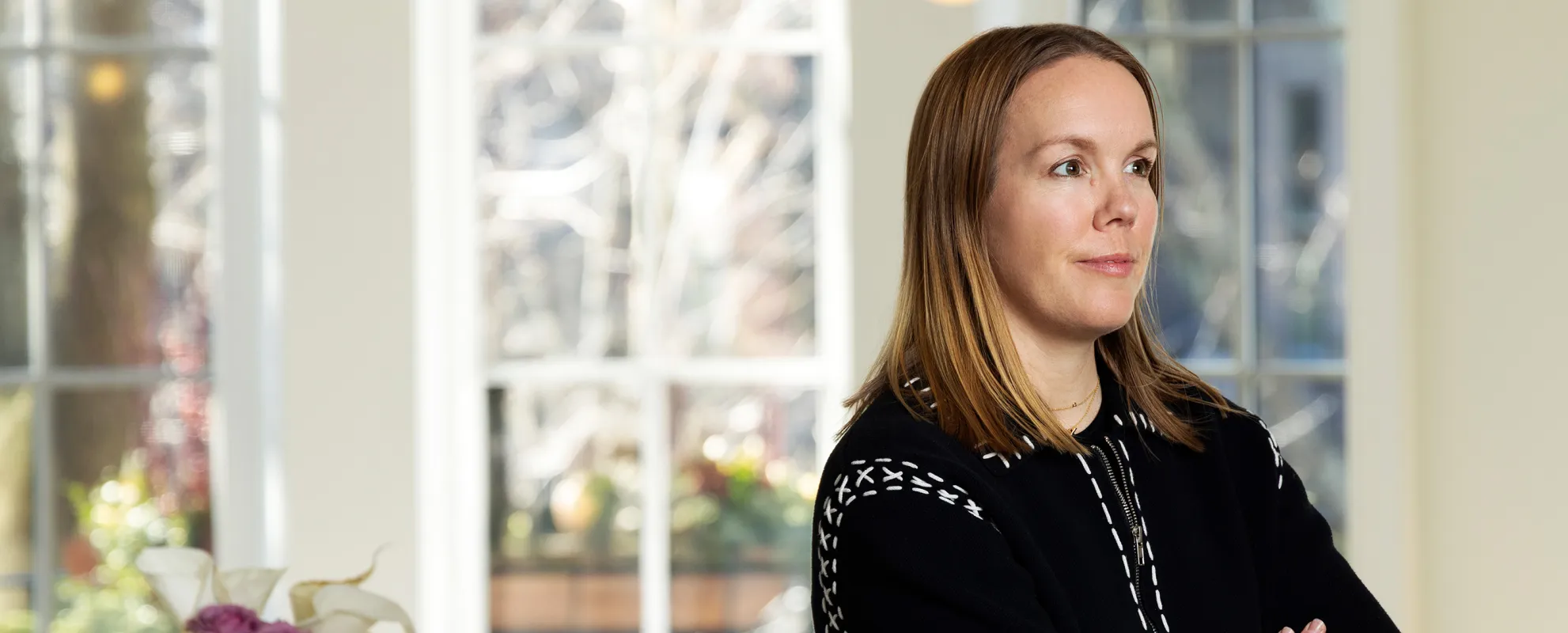
Nini Hamrick had been working in the U.S. Defense Intelligence Agency as a counterterrorism intelligence officer for just six months when she was deployed to Afghanistan. Recently graduated from college, and embedded with a small team tracking al-Qaeda and Haqqani network targets, she spent 18 hours a day manually parsing battlefield data to help her operations team better understand their adversary’s operations.
During that mission, Hamrick worked with a software engineer who was building bespoke tools that sped up analysis.
“He watched me working one night, and said, ‘I think there’s probably an easier way to do this than having you manually pore through this data,’” Hamrick recalls. As a solution, he built Hamrick a relatively simple software tool that helped her scrape data and feed it into one of her analytics tools. That simple tool saved her an estimated 10 hours a day.
“I was so grateful to him,” Hamrick says. “I kept trying to replicate that experience afterward: How do I find a great software engineer who really understands national security and can help me move faster?”
That experience inspired Hamrick to eventually co-found Vannevar while at Stanford GSB, with fellow student Brett Granberg. Vannevar’s first product, Decrypt, was released in 2020 and is an information-collection platform that leverages AI to help intelligence analysts process, translate, and analyze troves of textual and non-textual battlefield data.
Vannevar now has a suite of products focused on the company’s central mission: building advanced AI and decision-making systems to support U.S. defense. Over the last few years, the company scaled from $3 million to $80 million in annual revenue. She plans to continue this trajectory and take the company public over the coming years.
9/11 happened when I was in middle school. I was in a school in downtown D.C., and many of my classmates had parents who were serving in government. Some of them were in the Pentagon that day.
My dad, a federal prosecutor, had worked closely with folks at the FBI. One of them was the director of security at the Twin Towers, and he saved a number of people before he lost his life when the towers collapsed.
I started to understand the impact of a national security failure. I felt it very viscerally, on behalf of my classmates who were scared for their parents’ lives that day, and for my dad, who lost his colleague. After that point, I started thinking very specifically about a career in national security and intelligence.
That was very intentional, to make myself a useful potential analyst in the intel community. I had seen that the government was looking for experts in the Middle East and for people who had spent time in the region and spoke the languages. I also wanted to study abroad. I wanted to actually spend time in the region, get to know what life was like there and improve my Arabic.
I spent several months living in Damascus, Syria. This was in 2009, two years before the Arab Spring broke out and several years before the war in Syria. I feel really lucky that I got a chance to see that country and get to know the people, given what they’ve experienced since.
My first role out of college was in the Department of Defense. I was selected to be a counterterrorism intelligence officer at the Defense Intelligence Agency. Within six months of graduating from Harvard, I was on our watch floor at DIA, covering the Europe-Africa desk.
In my first year on the watch floor, we encountered the terrorist attack against the U.S. facility in Benghazi. I was the watch officer on duty for that overnight, and in the aftermath, trying to find the perpetrators of that attack and bring them to justice.
Six months later, I was deployed in Afghanistan for a tour there as a counterterrorism intelligence officer. I was on a small team looking for al-Qaeda and Haqqani network targets who’d been responsible for the deaths of Americans and allied forces in Afghanistan.
It really launched me very, very quickly. When you’re in the intelligence world, being on the watch floor for Benghazi or being in Afghanistan going after high-profile attack network members — those are the highest-impact roles you can have.
Yes, I was definitely intimidated.
I volunteered for that Afghanistan deployment when I first got to DIA. There were calls for civilians to go to Afghanistan and support small analysis cells helping with those operations. And I thought, “Why don’t I volunteer early? I know I won’t get selected because I’m so junior, but I’ll get on the radar, and maybe I can go to Afghanistan years down the line.”
I didn’t realize that almost all of the other analysts at DIA had already been to Afghanistan two or three times and were pretty tapped out. This role was probably three or four levels above my pay grade. But they got me through pre-deployment training very quickly, and I was there two or three months later.
I was very quiet for the first several weeks, just observing everyone around me. Eventually, I realized that what commanded respect among the people I was working with — pretty senior military officers — was just how hard I was willing to work. They believed talent could come from anywhere. I just gave it everything I had, and they recognized that.
That was important for me in forming my own leadership principles for Vannevar. I still believe talent can truly come from anywhere.
I’d been doing counterterrorism analysis for a number of years in Afghanistan, and then I covered Syria for a long time — hostage recovery efforts and other things that were really important, but also really tough. I took an internal rotation to be the chief of staff to the director of my agency. That meant that, all of a sudden, I vaulted forward 20 years in government time, and I was able to shadow the director in all his meetings.
I got to watch him interact at the National Security Council and with heads of state. It was this incredible view into how someone at the pinnacle of their government career is making decisions and having influence and impact.
I realized I wanted to be part of those kinds of major decisions moving forward, but I wanted to do it having taken time outside government. I needed to see how senior decision-makers inside great companies think, and see how they operate, and bring that back to government.
I came to the GSB with the idea of working at the intersection of national security and technology. I had never contemplated starting a company.
Brett and I both had this intel community background. [Brett had worked at In-Q-Tel, a venture arm associated with the CIA.] Soon after we met, he said to me, “I think that there needs to be more great AI and software engineering companies that are focused on the hard problems that people like you worked on in government.” Once he said it, it just clicked. And we started working on Vannevar right away.
The GSB was exactly where I needed to be when I was starting a company. I had no private-sector experience. And yet I was going to be leading go-to-market and building our sales motion and helping find product-market fit. These were all foundational topics in the classroom at the GSB.
We were able to raise capital through many of the connections that the GSB naturally creates within the venture capital community, which is a couple doors down on Sand Hill Road. After we raised capital, I had access to the opportunities that only Stanford offers to actually build parts of your startup inside a classroom or incubation environment. Through StartX and other classes, I was able to test ideas I had for Vannevar. I enlisted several of my classmates who came from the military or had other experiences in government as our informal board of advisors.
Vannevar and the GSB just became a very integrated part of my life. I really couldn’t imagine one without the other.
We learned a pretty foundational startup lesson early at Vannevar. The first product we tackled was meant to take large volumes of really messy data coming off of battlefields in Syria, Iraq, and Afghanistan and turn it into quickly actionable insights for an operations team.
We had really high conviction in the product because both Brett and I had seen this problem in action in the intel community. We knew it was a really hairy problem, and we spent about 12 months building this fully featured natural language processing pipeline for this data.
But by the time we released it in 2020, counterterrorism was no longer the primary problem the U.S. government was focused on; the government was shifting focus toward nation-state adversaries like China and Russia. No one wanted to buy what we had built. I think I did a hundred demos, and maybe in one of them, someone asked if they could launch a pilot with us.
But in a couple of these demos, a user would raise his hand and say, “What if you applied this same technology to Mandarin or Russian?” And that was the seed of the idea that became Decrypt.
Yes. The first version of it was essentially just a PDF reader. The idea was, how do we ingest PDFs that are in foreign languages, make them machine-readable and searchable? That’s a very simple product, but it speaks to the size of the gap that we’d identified.
Two weeks after we’d started building it, we showed it to a really important national security group out in Hawaii that covers adversaries in the Pacific region. And five minutes into the demo, they said, “When can we pilot this with you?”
That was a $25,000 pilot. Within three months, just through word of mouth in Hawaii, with teams that were working on similar problems, it converted to a $1.3 million deployment.
That was when we figured out, okay, this is what product-market fit looks like.
I see an opportunity for Vannevar to be a strategic partner to the government on the most important national security problems that we’re facing.
There are very few public defense companies that have emerged since the 1960s and 1970s, when the U.S. was starting to build large aircraft and ships. It’s exciting to see Vannevar among a generation of new defense companies that have the opportunity to get to that level of partnership with the U.S. government, where they’re trusting you to take on some of the government’s largest problems.
That’s taken the emergence of companies like Vannevar, and our ability to recruit top Silicon Valley engineering talent and apply that talent against these problems. It has also taken an appetite from government to start to work with new players who are nontraditional, who look different from the traditional primes that have dominated this market for decades now.
Our success has been defined by delivering AI products that actually work in the field. In just the last few months, with the advent of reasoning agents, we’ve seen AI agents deliver outcomes that weren’t possible before. It feels like a real inflection point, and our focus now is getting mission-defined agents into the hands of every operator and senior leader. Our goal is to build an enduring company that can go public and deliver on our vision at a national scale.
Photos by Josh Edelson