Quote
I want to build the future of autonomous systems to liberate people to be creative or pursue more meaningful objectives… but we need to do it responsibly.
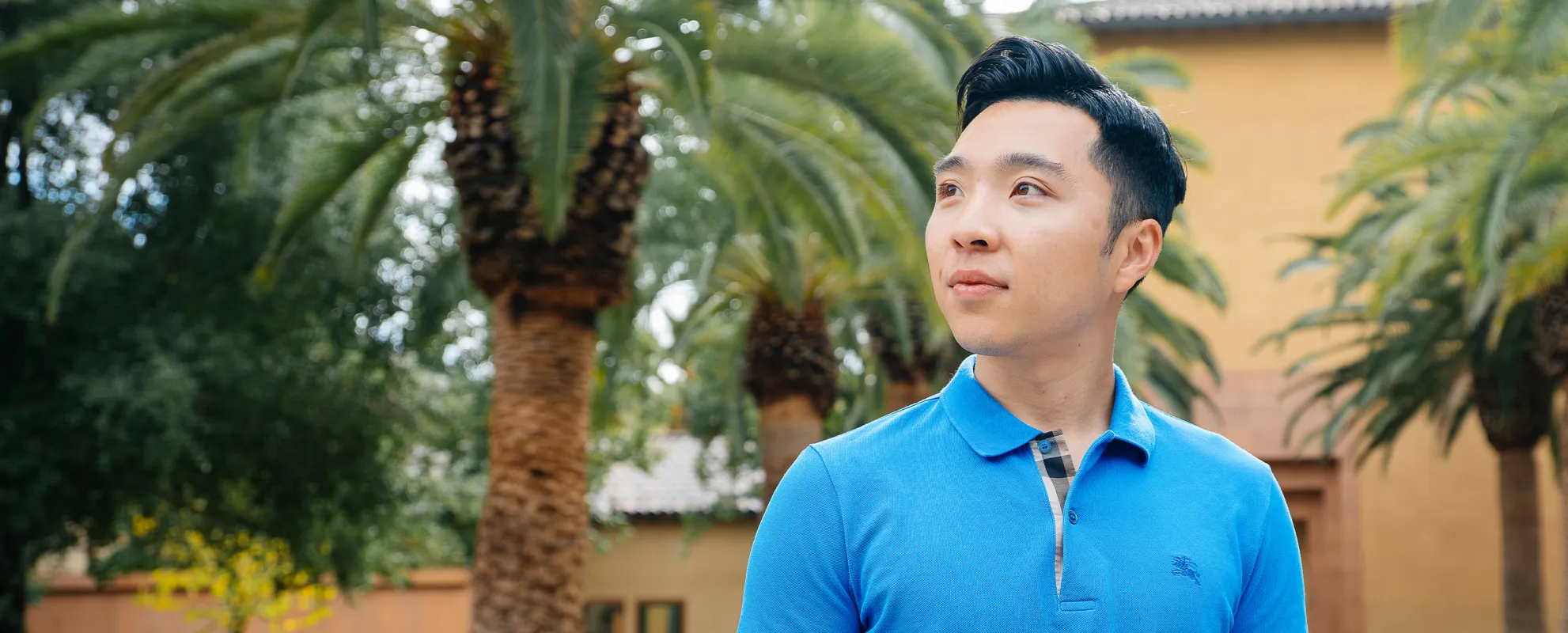

Kevin Chau’s pivot after arriving at Stanford Graduate School of Business might be surprising to some, but he has no trouble connecting the dots between his diverse background — from founding a healthy fast-food startup to investment banking and autonomous systems work — to his current plan to implement autonomous systems at the world’s most advanced tech giants.
“It’s been a journey,” says Chau, who is the president of Stanford GSB’s Future of Mobility Club. “But working in venture capital and at Amazon changed how I perceive where the world is going.”
To Chau, it’s about making an impact. “Before, I could only impact people who care about healthy lifestyles. Now I want to leverage my skill set to build the future of autonomous systems by combining robotics and AI agents to transform how work gets done. I took a lot of transferable lessons from building a food startup to get to this vision.”
Food played a dual role in my life growing up. On one hand, trying new dishes brightened my day. At the same time, I was stress eating. There’s clearly a light and dark side of food for me. This culminated in my first year of investment banking when I was working crazy hours and not taking care of myself. I knew I needed to make a change, but it wasn’t as easy as flipping a switch. I always try to break through seemingly binary decisions to find a better way, so I started looking for a third way.
I began looking at recipes on YouTube for healthier versions of a Big Mac or pizza. My first attempt was a pita bread pizza, which was lower in calories and used turkey instead of pepperoni. One day, I brought samples to the office for my co-workers. They really liked my recipes and couldn’t tell they were eating a healthier version. I knew I was onto something, and co-founded a food startup with three other friends, two with ties to restaurant chains in Hong Kong. We started by making dumplings, and they were a home run.
First, I developed a customer-first philosophy. The success of our dumplings symbolizes the moral of the story. We had two target customers: bodybuilders and 40- to 50-year-old white-collar professionals. Both wanted healthy lifestyles. Bodybuilders cared more about protein, and the white-collar professionals cared more about the taste. At first, we tried to do everything — burgers, pizza, dumplings — and lost focus. We decided to specialize on Chinese dishes to find our beachhead market instead of being a miscellaneous fast-food provider.
The traditional model is to build a product and mass-distribute it to customers with minimal tailoring. But in an age of agentic AI, where our product needs to tie closely with the workflow of Fortune 500 customers, we needed to build out one key workflow function that the companies most need to automate. It doesn’t mean we have to build bespoke products for every customer, but we could use our learnings in creating different types of products and still be able to distribute to other companies.
There’s the short-term displacement of, or need to upscale, workers. That’s a common topic at Amazon. When a new system is introduced, current workers have some level of overlapping expertise with robotics. So there’s a need to help them transition from doing what the robot does to orchestrating or reviewing that work. This takes time and resources, but it has been done countless times in our history, whether during industrialization or the internet era. We also have to address reliability issues and have plans for backup systems if the robot systems go offline.
The challenge for Amazon and others is that the upper stream of the whole value chain is still manual. Vendors deliver pallets to warehouses, and they need to be moved by human workers, dragging these pallets with a pallet jack. It’s not efficient, and there are potential ergonomic risks for these workers. Robotics could help automate the process from start to finish.
First, I want to build the future of autonomous systems to liberate people to be creative or pursue more meaningful objectives. But we need to do it responsibly. During my time at Amazon, I saw the human side, and it opened my eyes. I realized we need to deploy automated systems to improve working conditions and help people build meaningful lives, not just replace workers. The interdisciplinary nature of the program makes me feel empowered to make change in the world.
The Future of Mobility Club brings together students interested in everything from autonomous robots to logistics automation. It’s all connected by the same core technology. Through the club we host treks and career events to help students learn about this exciting area.
Conversations in Management is a case-based, role-play course where we tackle different cases. It’s challenging. You have to be prepared to role-play, and that puts you on the spot. One case was about an employee who is the best sales rep in the company, but he’s violating company policies. Do you keep this employee even if it might potentially damage the reputation of the company or incentivize others to do whatever they can to make sales? Or do you fire this sales rep, which might cost millions of dollars of business? There are no clear right or wrong answers.
In order to build trust, don’t be afraid to express your vulnerabilities and self-disclose. Self-disclosure builds connection. You’re expressing that you trust your business partner enough to share that vulnerability and work to a positive conclusion.
I host weekly poker games with fellow students. Poker is a good way to bring people together across ages, race, and professions. At a poker table, it doesn’t matter what your views are. It’s about how you play in a very interactive, dynamic situation. You might lose the hand, but what matters is that you control what you can control and worry less about the outcome. It’s the process that defines you, not the outcome.
Photos by Elena Zhukova