Quote
I care passionately about health and people. You can’t understand someone’s health until you understand them as a person.
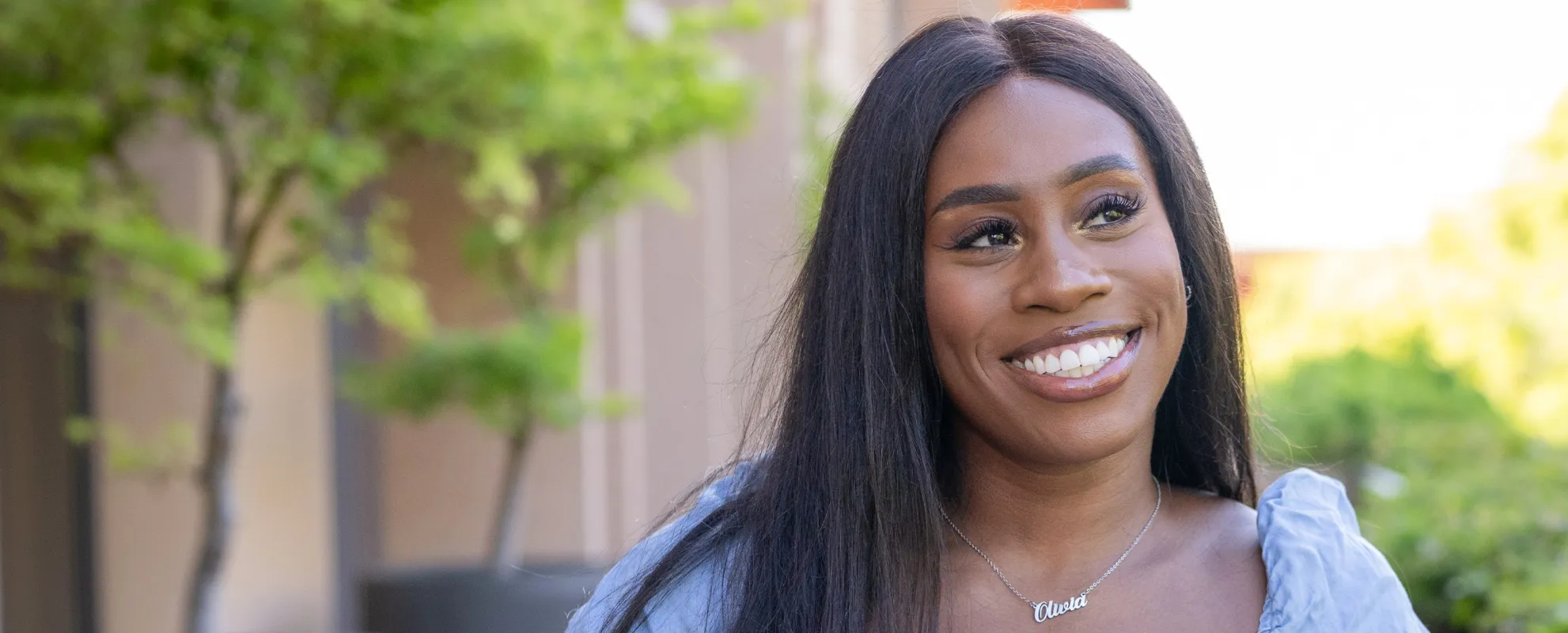
When Olivia Okoli was 10 years old, her family moved from the U.K. to her parents’ native Nigeria. She wondered how that move would impact her life and identity.
“The idea my dad impressed upon us was that we are Nigerian no matter where we were raised,” says Okoli, who will earn both her medical degree and her MBA from Stanford. “He said, ‘These are the giants upon whose shoulders you stand,’ and wanted to know how each of my siblings and I planned to give back to the heritage that raised us.”
With that in mind, Okoli came to the MD/MBA dual degree program with the long-term goal of improving Nigeria’s healthcare system. She knew she needed not only to train as a surgeon, but also develop the leadership abilities, business acumen, and grassroots organizing skills she’d eventually require to take on that ambitious task.
I’ve anchored on specific keys to my success. First, I want to organize at the grassroots level to develop a new generation of physicians and help them navigate the financial, economic, and educational challenges that may arise. Second, I want to build the infrastructure and resources they need to succeed. I get frustrated when they lack tools to provide care. Third, I want to support a new generation of physicians so that they choose to stay in the country, and create incentives for doctors to come back.
One of the biggest barriers is getting government buy-in and making sure the funds that are allocated are actually used for their intended purpose. It’s no secret that corruption is an issue in Nigeria. Public health education is lacking, too. We don’t have good public information about basic medical care and how annual health screenings can save your life. Fundamentally, if the Nigerian people are to get better then they have to believe they deserve better.
Healthcare doesn’t exist in a vacuum. It intersects with a lot of things I needed to understand — economics, accounting, finance, impact investing, to name a few. I also realized that to have the most impact, you need top-notch leadership skills. I needed to understand: What does leadership mean to me? How do you become a leader? What do I bring to organizations? How do organizations start, evolve, and grow over time? What is the ethos of the mission and how do you get people to buy into that vision? Now I feel prepared to start and navigate those conversations and work with collaborators to achieve my career goals.
I care passionately about health and people. You can’t understand someone’s health until you understand them as a person. We think of healthcare as science, but at the end of the day the art and science of medicine can’t be separated because you don’t treat someone based on the science itself. You have to understand where they’re coming from, how they see the world, how they see themselves, how they see their health. You combine leadership skills and medicine to come up with the best-tailored solution for that specific patient.
There’s a physician at Stanford Hospital who has served as a mentor to me. She leads with warmth and competence. I met her early in my medical school education and, as a Black woman in medicine, she quickly became someone I wanted to get to know. She has given me great career advice, and is always willing to carve out time to have those conversations. I also admire the work she does in Rwanda. She has the life and practice I envision for myself. She has committed her life work to raising up and supporting a new generation of physicians, especially Black med students and Black physicians.
I learned about the emerging markets for new drugs. It was amazing to see the cross-sector collaboration that went into something I naively thought of as simple — launching a new drug. Many different constituents have a say in pricing and go-to-market timing. Healthcare is incredibly complex, and you constantly have to make decisions among multiple stakeholders and shareholders.
The entire first year was incredibly challenging for me. I was learning to speak a completely new language. The terms “VC” or “PE” or “term sheet” were new to me. It’s alphabet soup. One of the classes that really pushed and enlightened me was Corporations, Finance, and Governance in the Global Economy. I had to absorb so many terms and concepts and, at the same time, apply all that to real world contexts.
Interpersonal Dynamics. There’s something so vulnerable about sitting in a room with people and having to explore the depths of yourself. What makes you tick? What triggers you and where does that come from? You’re really getting at the question of who you are. You’re exploring the forces that shape how you show up in any given moment, and you have to navigate group dynamics at the same time.
I volunteered in my second year of med school and I am so glad I did. I worked with patients and attending physicians to develop a medication plan for patients in an underserved community. That was impactful to me because I hope to work with underserved communities in Nigeria. I wanted to learn how to adapt the U.S. patient experience, built on a comparatively simpler system, to settings that are more complex and resource-constrained.
I am a member of a women’s group and the Black Business Student Association, both of which have connected me with the GSB community. The women’s group gave me perspective about women and management, the unique challenges we face, and how to support one another on campus and in our future careers. The BBSA has helped me explore how identity shapes my experience and leadership, and it’s given me meaningful ways to engage with and support my peers.
I was a short sprinter, and my favorite event was the 60-meter race. I love the feeling of pure explosion, power, and strength.
There’s a friendliness to U.S. culture that caught me off guard — being in an elevator and having a person you don’t know spark up a conversation with you, or being in a grocery store and the person behind you compliments you. I appreciate that part of the culture, because it made me feel not so far from home.