Quote
I loved the Essentials of Strategic Communications course because it made me uncomfortable. That’s when I know I’m learning something.
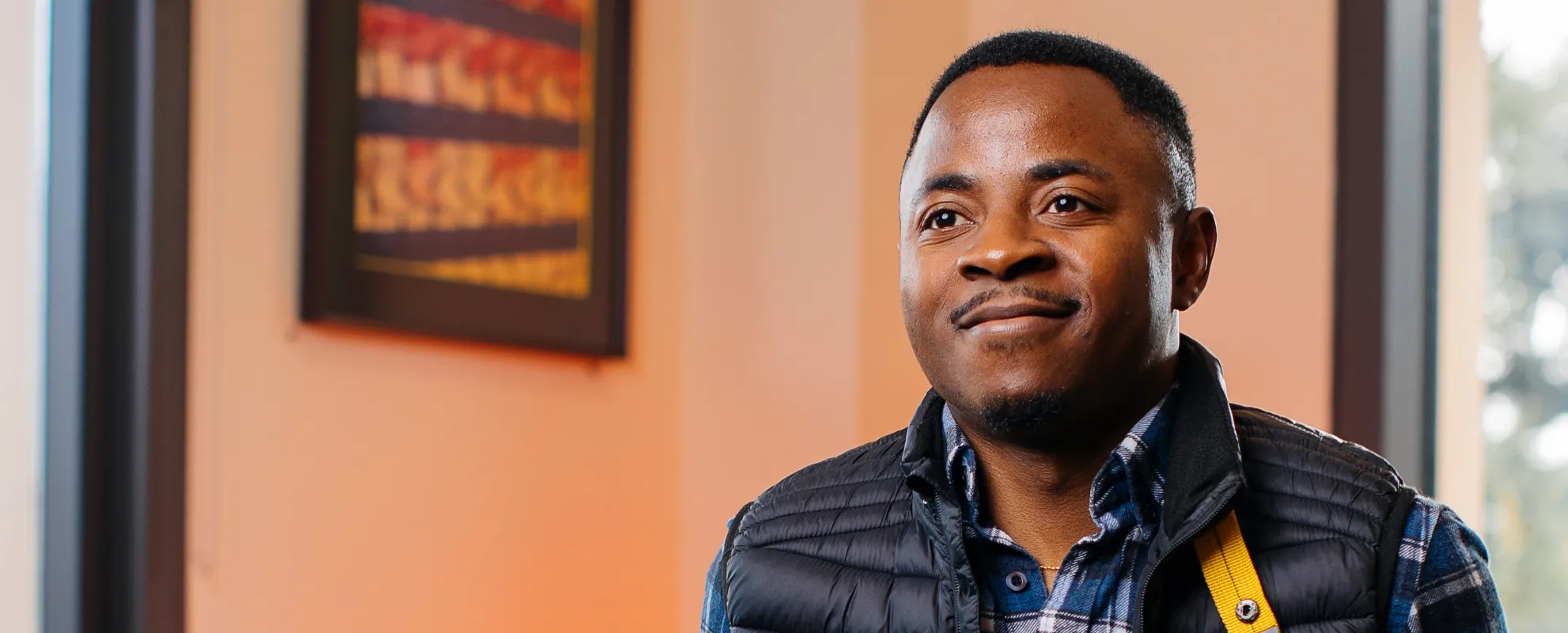

MBA student Patrice Tsafack was born into a family that had been farming land by hand in West Cameroon for generations.
“There was no machinery or even animals to help. They used their hands to work,” says Tsafack, who left a position as head of construction engineering for Egis, a global engineering firm, to attend Stanford GSB. “My father was prepared to become this kind of farmer, just like his father.”
Tsafack credits a local road and bridge for providing his father with other choices. Those pieces of local infrastructure led his father across a river to a school in another village, where he discovered his love of education. “Because someone built a road and a bridge, suddenly my father’s universe expanded. He knew that his village wasn’t the only place on earth. He went to high school, then medical school, and became a doctor. That story really empowered me because I saw how infrastructure provides opportunities.”
With his family history in mind, Tsafack focused his own ambitions on engineering and infrastructure to help create opportunities and expand the world for others like his father.
I was in elementary school, watching the National Geographic Channel. The first program I saw documented the inside of an automotive factory and explained how raw materials are made into an automobile. I was fascinated by how humans were working together to build a car. I knew then that I wanted to build things too.
I’ve always been attracted to the quantitative aspect of things. I was good at math and physics so I went to an engineering school and got my degree. For most of the time, I was working in technical fields where everybody had the same background, mainly advanced technical training. I needed to learn skills outside of that bubble. I realized an MBA degree would teach me communication skills, leadership, and critical frameworks that would help me pursue my dream career.
I loved the Essentials of Strategic Communication course because it made me feel uncomfortable. That’s when I know I’m learning something. I’m learning to communicate, present, and influence, and that inspires me.
For the Paris Olympics, I worked on the athletes’ village in Seine-Saint-Denis, north of Paris. That part of France is mostly populated by immigrant communities, which made the project especially meaningful to me. It wasn’t just about constructing buildings, but about helping the neighborhood shine. I was proud to welcome the entire world and send a message of hope and unity for people from all backgrounds.
I worked on a bridge between Gambia and Senegal to increase economic activity and stabilize the region. Before it was built, you had to wait hours for an old ferry that wasn’t reliable and had an unpredictable schedule. I’m proud of what we accomplished because that bridge provides opportunities to a lot of people.
In 2018, a bridge in Genoa, Italy, collapsed because it was poorly designed and not maintained. That was a call to action for all European countries. France immediately launched an audit to investigate and analyze some of the bridges that needed the most repair. The bridge I worked on was at the top of the list. It was an open bridge, meaning that the structure was very elegant, but there was unprotected steel outside the concrete. We had to tackle challenges with a steel facade and the impact of the corrosion caused by salt from the sea. We also had to carefully replace steel cables by balancing their massive tension and weight. It was very technical and dangerous, and there was a risk that the bridge might collapse. Luckily, we were successful in the repairs.
My daughter was born in 2021, and I joined EGIS in 2022. I realized my daughter would join the workforce in 20 years, and I wanted the industry to be a supportive place for her. I had the power to influence how women are integrated into the transportation industry, and so I stepped up.
My father was born in a remote village, in a community where no one had access to education. He figured out how to become educated and become a doctor. He worked while he was studying and paid for his education. He showed me that where you come from doesn’t matter. If you have the determination, you can achieve anything.
I saw how infrastructure transformed my father’s life, and my father then changed my life. I developed a deep conviction to bring mobility and infrastructure to places that need it most. To me, bridges are more than structures; they are tools that open new doors and change lives.
Midfielders need to be fast and resilient, and they need to understand that they’re only part of the chain. When you’re a midfielder, you connect the strikers at the top, the defense at the bottom, and the goalkeeper. What I like about the midfielder position is that you understand you can’t do everything on your own. You are part of something bigger, and you have to rely on your team to achieve your goal.
Photos by Elena Zhukova