In recognition of the 30th anniversary of the GSB’s Center for Entrepreneurial Studies, we are featuring stories about entrepreneurship at the GSB, including those of some of its alumni founders.
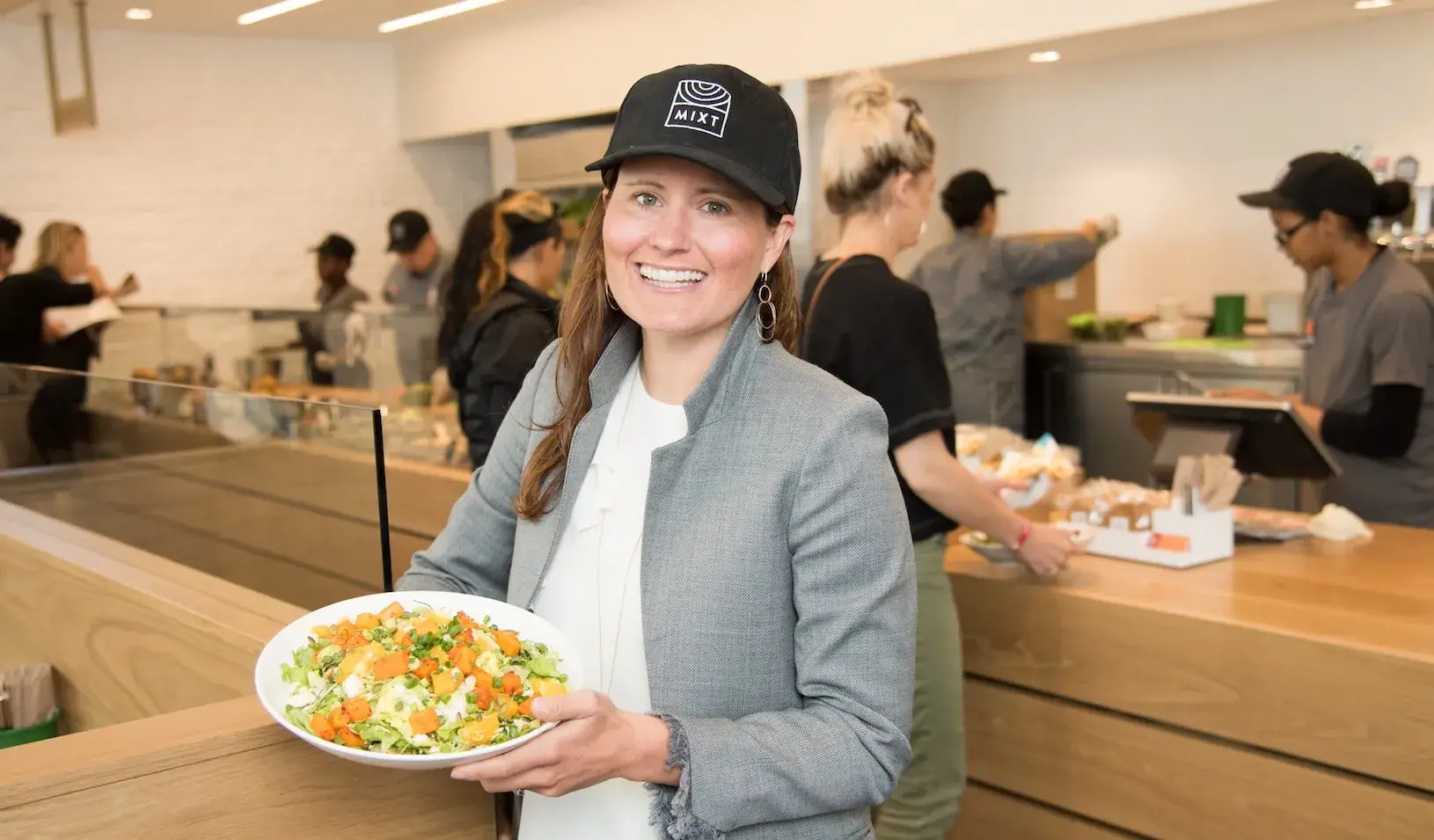
Leslie Silverglide, MBA ‘11, in action at MIXT
When Leslie Silverglide (MBA ‘11) was thirteen, her mother decided to start a school in their New Jersey hometown. Her mom didn’t have a background in education administration or entrepreneurship, but she saw a group of children with learning differences who weren’t being served, and she couldn’t stop thinking about them. She fundraised scrappily, recruited teachers through sheer force of persuasion, and built the Banyan School from the ground up. Leslie spent summers in her teenage years working the front desk.
“My mom was super scrappy in how she raised money, got the school built, recruited teachers, and brought on others to join her,” Leslie recalls. What she absorbed watching her mother wasn’t a business lesson, exactly. It was something more foundational: that if you see a real gap, and you believe deeply enough in what you’re building, you get started building.
Leslie has been building things ever since. She started a salad restaurant at twenty-four, before she’d taken a single business class. At the GSB, she founded a fitness technology company, sparked by a workout DVD and a guest speaker in one of her classes. And then, in a surprise second chapter at the restaurant she’d founded, she bought the company back, and now was making a long-term bet on a company that aligned with her values.
The First Company: A Gaping Hole in the Market
Leslie studied environmental engineering and geography at Johns Hopkins, then moved across the Atlantic Ocean for a master’s program in biodiversity, conservation, and management at Oxford. She returned to the United States at twenty-four carrying a framework she’d been refining for years: the triple bottom line, the conviction that a business could be simultaneously accountable to people, planet, and financial sustainability. The question was what industry to pursue.
She found her answer in food. She wanted to bring fresh, locally sourced, organic ingredients to a downtown, fast-casual lunch setting. Initially, the concept drew skepticism from almost everyone she consulted. Most told her that no one would eat salad as a meal, that the sourcing strategy couldn’t support the volume, and that there wasn’t a real market. She and her then-boyfriend David opened the first MIXT Greens in downtown San Francisco in April 2006 anyway.
The response was immediate and overwhelming. In a four-and-a-half-hour lunch window, the restaurant was serving 800 people. By the end of the first month, it was clear they’d found what Leslie calls “a gaping hole in the market.” They quickly opened a second location two blocks away, which performed even better than the first. A third followed shortly thereafter. Each of the restaurants was within the dense lunch geography of downtown San Francisco, and each proved the model more definitively than the last. MIXT was bootstrapped, profitable, and genuinely beloved by its customers.
What Leslie didn’t yet have was the vocabulary or the frameworks to fully understand what she’d built. That gap came into sharp focus during a meeting with a prominent venture capitalist, when Leslie found herself quietly Googling “EBITDA” under the conference table. “I didn’t have a formal business background whatsoever,” she reflects. She’d been operating on instinct, passion, and a clarity of vision that was real, but unstructured. When Nestlé’s private equity arm contacted her three years into her journey with an acquisition offer, with the financial crisis deepening and Leslie feeling, in her own words, as if she were flying by the seat of her pants, she sold the company.
GSB: Building the Foundation, and the Next Company
The sale created the opening that sent her to Stanford GSB, and Stanford changed what came next in ways she couldn’t have anticipated. The decision to attend business school came quickly. Leslie took the GMAT and applied to the GSB within three weeks. The Nestlé transaction closed the same week she started at GSB.
She arrived on campus with an unusual profile: a founder mid-exit, finishing the brand transition with Nestlé part-time through her first year, surrounded by classmates who were largely encountering entrepreneurship as an idea for the first time. She audited Irv Grousbeck’s Managing Growing Enterprises class after not getting in through the lottery. She took classes from legendary professors like Joel Peterson, Jim Ellis, and Mark Stevens. Those professors became advisors, sounding boards, and eventually investors.
During her second year at the GSB, Leslie started exploring the idea of starting another company. The idea that would become Wello grew from two specific moments at Stanford. The first was a talk in Peterson’s class by Cisco executives about their telepresence technology — high-fidelity, live, two-way video that made remote presence feel real. The second was more informal: Leslie and her friends had taken to gathering in the lounge at the GSB Residences to complete Insanity workout videos together, following the infamous instructor Sean T. through the workouts. Leslie noted what made Insanity workouts so engaging: the energy in the room, the accountability of doing them together, and the motivation from a memorable instructor. She kept returning to a single question: what would it mean to make that feeling available to anyone, anywhere, with a live trainer on the other side of the screen?
Wello was the answer — a live, two-way video marketplace connecting people with fitness and wellness professionals, built on the conviction that the real barrier to personal training was access and consistency as much as cost. She co-founded it with her closest friend from GSB, Ann Scott Plante, and dove headfirst into building the company after graduation. As a two-sided marketplace, Wello attracted thousands of trainers and users from around the world, and introduced the world to live, online workouts for the first time.
Wello was acquired by Weight Watchers in 2014, marking the company’s first acquisition in its 50-year history. Weight Watchers turned Wello’s San Francisco office into its West Coast technology hub, and Leslie stayed on for a year and a half. When Peloton was raising money, its pitch deck described the company as “the Wello for biking.”
While Leslie was still at Weight Watchers, her husband David bought MIXT back from Nestlé. The corporate chapter had run its course, and the brand was ready to come home.
Coming Home: MIXT at Twenty
Leslie rejoined MIXT around 2015 and has led the company as CEO ever since. Under her leadership, MIXT became a Certified B Corporation, with compostable packaging, rigorous waste-diversion practices, and a deliberately rebuilt supply chain, one region at a time, from local, sustainable producers. The growth philosophy matched: majority-owned, expanding market by market, with the sourcing infrastructure established before new restaurants open. Every new store gets seeded with a manager who grew up inside the company.
MIXT is now approaching its twentieth anniversary, and Leslie describes the brand as more resonant than ever. Demand for conscious eating, transparent sourcing, and genuinely clean ingredients has grown steadily, and MIXT has been making that case through its food, practices, and culture for two decades. The company operates across California and Texas, and it is growing with the same intentionality that has characterized it from the beginning.
Leslie is clear-eyed about what that discipline makes possible. “We want to be a multi-generational, beloved brand,” she says. That’s what Leslie is building toward: a MIXT that her customers’ children grow up eating at, that stands as proof that a restaurant company organized around genuine values — real food, fair wages, environmental accountability, leadership grown from within — can be a lasting business.
Stanford gave Leslie the frameworks, the investors, and the community of people who became her closest friends and collaborators. The underlying orientation arrived much earlier, at the front desk of her mother’s school, watching someone build something meaningful from nothing but belief and a refusal to wait for the conditions to be perfect.
Thirty years into CES’s history, Leslie Silverglide’s story is a useful reminder that the most durable companies are built by founders who know why they’re building, and who carry that answer with them every day.