December 19, 2025
| by Jennifer WelshMarie Mookini remembers when she handed Charles Bonini a 15-page narrative budget request for the Stanford Graduate School of Business’s MBA admissions office. Bonini glanced at the stack of prose, paused, and looked at her with gentle disbelief, asking where her spreadsheet was. When she admitted she didn’t know how to make one, he sat her down and taught her. It was typical of Bonini — a quantitative thinker who approached life with patience, kindness, and a desire to help others succeed.
“He always had time for my questions,” says Mookini, who was director of MBA admissions in the early 1990s while Bonini led the MBA program. “He would drop what he was doing and ask how he could help. I’m really fortunate to have had him to guide and support me.”
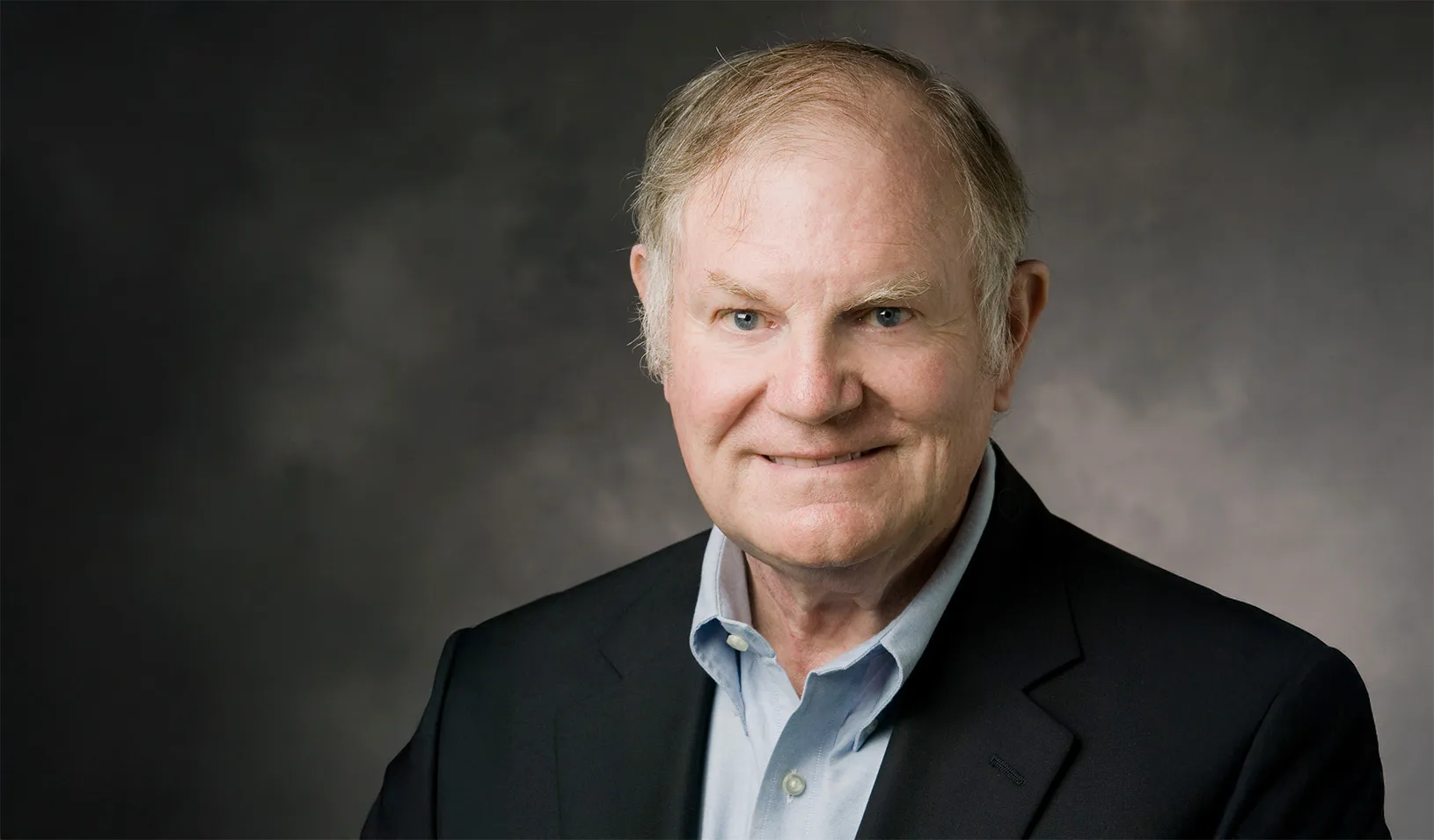
Charles Pius “Chuck” Bonini, the William R. Timken Professor of Management Science, Emeritus, died peacefully at his home in Stanford, California, on June 6. He was 91.
“Chuck was at the GSB for over half a century if you include his emeritus years, and he was always a key player in the background,” says George G.C. Parker, MBA ’62, PhD ’67, the Dean Witter Distinguished Professor of Finance, Emeritus. “During his time at Stanford, he made immense contributions to what the school has become — in the classroom, in the school’s administration, and in executive education. He was truly an important part of the fabric of the place, and he will be deeply missed.”
With his warm, unassuming presence, Bonini is remembered as a quiet force at Stanford GSB — a steady and trusted figure whose humility and generosity shaped daily life at the school.
“Chuck went to staff holiday parties — as comfortable with us as he was with global leaders and Nobel Prize winners,” says Maureen McNulty, who worked for Bonini as director of the Career Management Center from 1989 to 1993. “He listened better than most people — he wasn’t just waiting for his chance to talk.”
King of the Core
Born in 1933 in Ridgeway, Pennsylvania, Bonini earned his BA from the College of the Holy Cross, then attended Carnegie Mellon University for his doctoral studies. Hired by Stanford in 1959 — one of the first hires of former dean Ernest Arbuckle, MBA ’36 — Bonini completed his PhD at Carnegie Mellon in 1962 while already serving on the Stanford GSB faculty.
He arrived at a pivotal moment in the school’s evolution. A cohort of scholars from Carnegie Mellon joined the faculty around the same time, and a significant report on the business school curriculum pushed for rigorous analytical training. With his teaching emphasis and quantitative expertise, Bonini became a central figure in this transformation.
As technology evolved from hand calculations to mainframes, Bonini integrated computing into the classroom, even writing early statistical programs. “He was one of the principal faculty members who brought the GSB into the computer age,” says David M. Kreps, the Adams Distinguished Professor of Management, Emeritus.
Among his scholarly contributions, Bonini is most often associated with “Bonini’s Paradox,” the observation that as a model of a complex system becomes more realistic, it becomes as difficult to understand as the system itself. It’s a foundational caution in systems theory, simulation modeling, and decision science. The paradox emerged from Bonini’s work in the 1960s and 1970s, and he incorporated it into many of his courses at Stanford GSB.
During his more than four decades on the faculty, several of Bonini’s classes, including statistics, were required coursework. The MBA Class of 1984 crowned him King of the Core for his impact on their required curriculum.
“Chuck was a workhorse in the GSB, teaching what needed to be taught and filling roles that needed filling,” says Kreps. “He was always willing to lend a hand.”
Bonini authored and coauthored textbooks that helped define the fields of decision analysis, optimization, and quantitative modeling. His most influential publication was Quantitative Analysis for Management, co-authored with Harold Bierman Jr. and Warren Hausman, professor emeritus of management science and engineering at Stanford Engineering. The widely adopted text introduced business students around the world to analytical decision-making.
Remembering their collaboration during remarks at Bonini’s 1999 retirement celebration, former dean Robert K. Jaedicke told colleagues, “In the early days, I got conned into being coauthor on a textbook. When it comes to writing, enthusiasm is not a good substitute for ability, so I turned to Chuck. Nine editions later, I’m still very grateful.”
Shaping Student Community
At Stanford GSB, Bonini helped shape not only the curriculum but the community. From 1987 to 1993, he served as associate dean and director of the MBA program, guiding admissions, supporting student life, and helping elevate the school. He pushed to recruit students with intellectual curiosity and a passion for ideas, Mookini says.
During this time, with Bonini’s guidance and support, the Stanford GSB Career Management Center rose in rankings from the teens to the top echelon in just two years, remembers McNulty, who adds that Bonini believed that improving students’ quality of life was central to the school’s mission.
In the mid-1990s, he helped establish what became the Charles P. Bonini Partnership for Diversity Fellowship Program, which supported exceptional MBA students from diverse backgrounds. “Chuck was a champion for educational access and opportunity for the underserved,” Mookini says.
Bonini also taught in several of Stanford GSB’s executive education programs, including in South Africa, Yugoslavia, Australia, and Iran. He and colleagues worked with the National University of Singapore to launch a Stanford GSB executive education program in Singapore; Bonini taught and served for many years as Stanford’s co-director of that program.
His contributions to Stanford GSB were recognized with the faculty’s 1999 Robert T. Davis Award, honoring his extraordinary service to the school.
Bonini officially retired in 1999 but kept teaching for many years. Outside of academia, he enjoyed traveling, line dancing, attending Stanford basketball and football games, and tending his many rose bushes. For 47 years, he shared his life with his wife, Barbara, and treasured time with his children, grandchildren, and close friends.
He is survived by his wife, Barbara; his children, Julia, Barbara, Sheila, Griffin, Colin, and Cissie; his stepdaughter, Liz; and nine grandchildren. His son, Charles, predeceased him.
For media inquiries, visit the Newsroom.