January 14, 2026
| by Katie ClaryWith four Stanford degrees and five decades living on campus, David “Dave” B. Montgomery was Cardinal to the core. He influenced what 60 years ago was an emerging business field, helping to launch marketing science’s first conference, first academic journal, and some of its first academic texts.
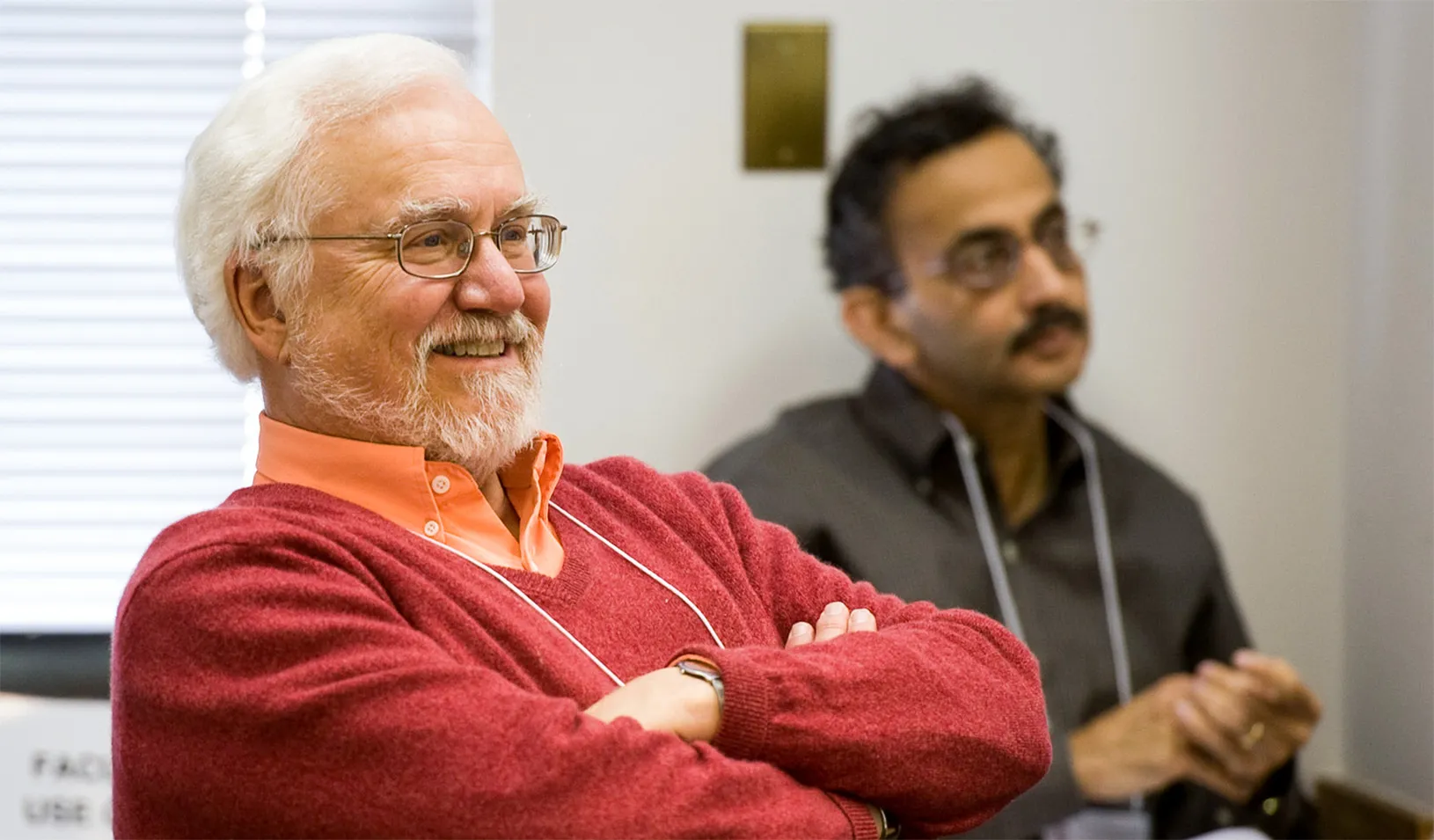
“He was a fantastic professor, scholar, institution builder, and a great friend,” says V. Seenu Srinivasan, the Adams Distinguished Professor of Management, Emeritus. “He was genuinely funny, and it was just wonderful to be around him. I will absolutely miss him.”
Montgomery, the Sebastian S. Kresge Professor of Marketing, Emeritus, died November 14 in Denver, Colorado. He was 87.
“Beyond his professional accomplishments, Dave was a supportive and generous colleague, always offering thoughtful and sincere words to those around him. His commitment to his students and to the broader academic community inspired countless people in their pursuits of knowledge and excellence,” said Sarah A. Soule, the Philip H. Knight Professor and Dean at Stanford Graduate School of Business and Morgridge Professor of Organizational Behavior, in a message to faculty and staff.
Leader in His Field
Montgomery was born in Fargo, North Dakota, in 1938, and grew up in Minnesota and California, where he excelled in high school science and math. He earned a BS in electrical engineering at Stanford before enrolling at the business school with a plan to become an entrepreneur in addition to being an engineer.
Realizing he preferred analytical tools of management science, marketing, and economic modeling to electrical circuits, he earned his MBA before also completing an MS in mathematical statistics and his PhD at the business school in 1966. Montgomery joined the junior faculty at MIT Sloan School of Management for three years before returning to Stanford GSB in 1970, where he spent the rest of his teaching career.
Montgomery had a talent for starting things. While at MIT, he and a colleague created TIMS Marketing College (a predecessor to today’s INFORMS) as part of the Institute of Management Sciences, with a goal of bringing more management scientists into the marketing field and more broadly integrating management science technology with industry applications. He also co-authored an influential book called Management Science in Marketing in 1969 with Glen Urban. The text matched common aspects of marketing to relevant mathematical models, showing pathways for future research.
“I got my first taste of quantitative marketing through that book,” says Srinivasan. “The book was highly influential because at that time, there was nothing else.”
In 1969, Montgomery became the first departmental editor for marketing, a new section of Management Science, and later helped publish a special issue on marketing management models.
At Stanford, together with Dick Wittink, he initiated and co-hosted the first-ever Marketing Science Conference in 1979, which has since evolved into an annual event that regularly attracts over 1,000 practitioners and policymakers. Those in attendance at that first conference decided their field needed a dedicated academic journal, and so in the early 1980s, Montgomery helped start Marketing Science, which is now considered the premier scientific publication for empirical and theoretical quantitative research in marketing. He served on the editorial boards of seven leading journals in total.
His impact on the field was recognized with many honors, including recognition as an inaugural Fellow from the INFORMS Society for Marketing Science and a Mahajan Award for Career Contributions to Marketing Strategy from the American Marketing Association.
Prolific Researcher
Montgomery’s research provided a significant course correction for marketing science at the time.
In the 1970s, the prevailing belief was that buyers’ past decisions informed their next purchase in a way that could be mapped mathematically, a model that had been developed to study rats in mazes called a linear learning model. His studies showed that this was a fallacy and that if you looked at consumer data more closely, the results were far more nuanced.
“Dave’s research helped us to understand that unless we are careful, we may mistakenly conclude that consumers are changing their behavior, when in fact what we may be seeing is differences in behavior across consumers, who are in fact not changing at all,” says James M. Lattin, the Robert A. Magowan Professor of Marketing, Emeritus. “Current students of marketing all learn this; in that sense, they are standing on the shoulders of Dave and other marketing scientists who have come before them.”
In 1988, Montgomery published a seminal paper, “First-Mover Advantages,” in Strategic Management Journal, co-authored with UCLA professor Marvin Lieberman. Their paper surveyed the literature on the competitive edge gained by a company by being the first to introduce a new product, service, or technology to the market. It has since been cited more than 6,400 times.
“So many papers don’t get more than two or three citations. A paper that has 6,400 citations is just out of the ballpark,” says Srinivasan.
Over the course of his career, Montgomery published more than 100 articles and 10 books and special journal issues, with a focus on consumer behavior, competitive strategy, and global markets. “David was a prolific scholar,” says George G.C. Parker, MBA ’62, PhD ’67, the Dean Witter Distinguished Professor of Finance, Emeritus. “He just produced a ton of research published in highly rated academic journals.”
“Dave made important contributions to some of the most fundamental insights in marketing science,” says Lattin. “The lessons we’ve learned from Dave’s research are enduring and still relevant today.”
Cardinal Advocate
Montgomery was a strong presence at Stanford GSB, instrumental in recruiting faculty to the business school, such as Seenu Srinivasan and Peter Wright. “He was an important architect of our marketing group,” says Lattin.
His colleagues remember Montgomery as both brilliant and able to juggle his priorities in a down-to-earth way. As a result, he maintained decades-long friendships with colleagues.
One such friendship was with George Parker. Together with Jack McDonald, the Stanford Investors Professor of Finance, they graduated from Stanford GSB in the MBA Class of 1962 and went on to earn Stanford PhDs. By 1973, all three had returned to campus as faculty with their young families.
“It made Jack, Dave, and me very good friends for 50 years,” says Parker. “He managed to maintain a dimension of balance in his life that is not always quite so apparent in a lot of high-achieving people.”
He was motivated more by curiosity than cutthroat competition, says his wife, Toby. She says Dave would joke that he wanted to cross the line first, but holding hands with his colleagues. On weekdays, Montgomery would bike or walk to school, sometimes bringing his golden retrievers to the office. Every summer his family hosted a dinner for the GSB executive education participants.
“Dave was very unselfish as a colleague,” says Lattin, who counted Montgomery as a mentor. “He shouldered a lot of the load when it came to directing and teaching in executive programs.”
He was also an observant advisor who helped students shine. Gwen Ortmeyer, PhD ’86, recalls advice that he gave her for a conference talk. Montgomery noticed that she communicated better in dialogue than in monologue. So for her presentation, he sat in the front row and asked her questions right away.
“It made all the difference,” she says, and even today uses his advice in her corporate consulting with companies like Rubbermaid and Cisco, turning client presentations into conversations.
“As an emeritus, I remember him being very generous with his time in advising junior professors. He was always curious about their work,” says Sridhar Narayanan, the current Sebastian S. Kresge Professor of Marketing. “He had a tremendous influence on the field of marketing and on Stanford in particular.”
Global Scholar
Montgomery’s greatest love, aside from his family, was traveling. His appetite for international exploration was whetted as an undergraduate when he studied at the first Stanford in Germany program and met his wife, a fellow student who would earn three Stanford degrees herself. Over the course of his life, he visited or lived in some 120 countries around the world.
In the summer of 1969, he was a visiting professor at the Indian Institute of Management Calcutta, helping establish what is now one of India’s top business schools. Together with Toby and their young children, they traveled throughout Asia. Then, after Montgomery retired from Stanford GSB in 1999, he and Toby moved in 2003 to Southeast Asia, where he became the dean of Singapore Management University’s business school.
Yet despite all the international travels, “our life was very, very entwined with Stanford,” says Toby, of the community they built in the Frenchman’s Hill neighborhood of campus, surrounded by faculty friends. “Our whole world was Stanford.”
The couple moved to Highlands Ranch, Colorado, in 2018 to be closer to family.
Montgomery is survived by Toby, his wife of 65 years; children David, Scott, and Pamela; and five grandchildren.
For media inquiries, visit the Newsroom.