Quote
Knowing what you’re good at and what sorts of problems you might be good at solving are important attributes for success.

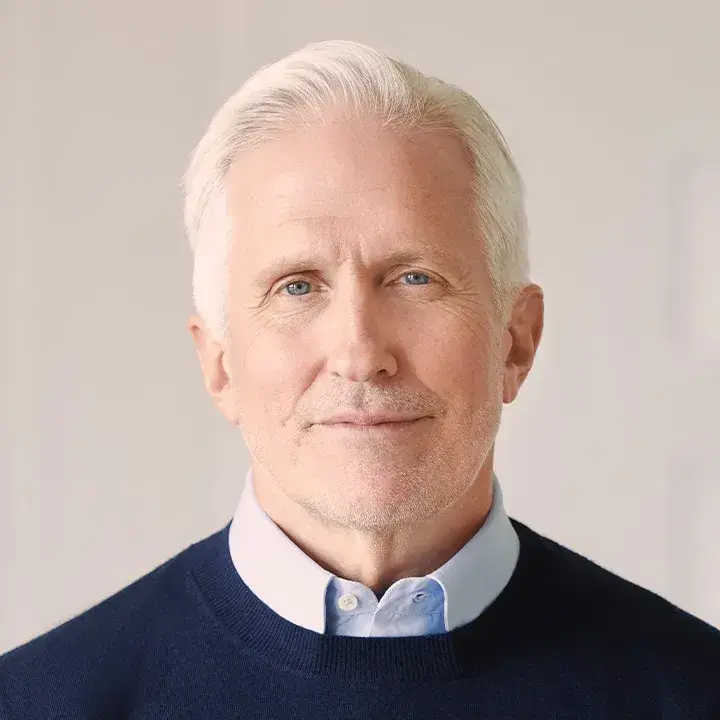
Jim Coulter absorbs lessons wherever he can find them, whether working with rock star Bono or coaching 8-year-old soccer players. “I have been very fortunate to have great relationships that have shaped my journey in a powerful way,” he says. “They have taught me so much.”
An entrepreneur and investor whose private equity company TPG manages more than $250 billion in assets, Coulter approaches problems with a simple, clarifying belief: that “and” is better than “or.” Trade-offs may be necessary when confronting complicated issues, he notes, but win-win solutions not only provide desirable short-term answers; they also help reshape attitudes about what is possible going forward. “You can build a family life and a successful business. You can be compassionate and conservative. You can be liberal and financially responsible. I hope we can search for and find ‘and,’” he says. “‘And’ is smart. ‘And’ is generous. ‘And’ is usually right.”
Beginning with a risky leveraged buyout of struggling Continental Airlines in the early 1990s — a move that resulted in a profit of more than $640 million — Coulter (along with his business partner, David Bonderman) founded and grew TPG into a global behemoth by “solving problems in new ways,” he says. “My career has really been a series of problem-solving exercises.”
Coulter also helped launch The Rise Fund, an investment platform dedicated to socially conscious businesses. (That’s where Bono comes in.)
Raised in a middle-class family in upstate New York, Coulter holds a bachelor’s degree from Dartmouth College, where he graduated summa cum laude, and an MBA from Stanford GSB, where he was named an Arjay Miller Scholar. Earlier this year, he was named the 2025 recipient of Stanford GSB’s Arbuckle Award.
When introducing Coulter at the Arbuckle ceremony, Jonathan Garfinkel, MBA ’05, a partner at TPG Rise Climate and lecturer at Stanford GSB, said Coulter’s devotion to friends and family parallels his business commitment. “Regardless of how busy he might be, he underscores to those he holds most dear just that — by always showing up when it matters most, whether that’s flying to meet a CEO on the other side of the world or showing up on a Saturday morning for my daughter’s bat mitzvah.”
It may be fitting, given that legacy, that it was Coulter who suggested what is now the school’s tagline: “Change Lives. Change Organizations. Change the World.”
I grew up in a town on the Erie Canal, which sort of peaked in 1840, before the railroads. My first job was working for my family’s fruit and vegetable farm. Every day I loaded a ’56 Dodge truck with fruits and vegetables and drove to a farmers market.
My second job was selling Christmas trees in downtown Buffalo, which, besides being enormously cold, was enormously informative. If you want to understand group decision-making, watch a family buy a Christmas tree. The farmer I worked for refused to put prices on trees, so my job was not only to sell the trees, but to figure out what someone would pay for them.
I was the only kid in my high school who went to an Ivy League school, thanks to financial aid. That was a formative experience, and why I have had such a deep commitment to education.
After college, I had to decide between working on an oil rig in Africa or going to Wall Street. I ended up choosing Wall Street without really knowing what an investment bank was. It was sort of a seminal moment.
It’s okay not to have a plan. The lack of a plan opens you up to possibilities.
While I came thinking that specific skills I would learn would be most important, I’ve come to appreciate that it was really the breadth that helped me the most. It introduced me to a broader definition of what a business career might look like; it massively expanded the aperture of how I viewed the world. It also gave me a better understanding of risk. There are times in any successful career when you must be willing to take risks. Learning the stories of people who had done that in different ways helped give me perspective and confidence.
And it helped me develop self-awareness, which has echoed throughout my career. Knowing what you’re good at and what sorts of problems you might be good at solving are important attributes for success.
We often focus in business on vertical relationships. My experience has been that building horizontal relationships over long periods may be as important or more important. How the partnership works within our firm, but also how we partner with CEOs and portfolio companies, how we partner with investment banks and consulting firms. Building an ecosystem of interdependence and excellence has been a more important skill set than I might’ve anticipated.
Business entrepreneurship is often portrayed as an individual pursuit, but understanding the dynamics of teams and the management of teams has been crucial. Decisions in a private equity firm are made by investment committees, which are our teams. You want voices to be heard, to have respectful disagreement. Diverse teams are harder to manage, but they do better.
Much of my job is like being a general manager of a sports team. How do you get the right people in the right spot? How do you create the right locker room? Chemistry is important. Clarity of purpose. Are you running the right offense?
I learned a lot about team management by coaching first-grade soccer. You can tell the kids over and over to stay in their position, but that seldom works. The best way is to let them go into the scrum, and at some point, the ball will pop out and they will realize that if they had stayed in their position, they would’ve had a great chance to score a goal. In soccer, you look for open space, that’s where the opportunity is. The same is true in investing.
And you have to put the right people in the right positions. There are some people who make every room they’re in better. There’s a character in the movie The Boys in the Boat that exemplifies this. His name was Joe Rantz. He was never considered the best rower, but every boat he was in won. You have to identify those people and nurture them.
I was 32 years old, I had two kids under the age of two, and I didn’t have a job. I had to develop a relationship with risk. It was like having a new roommate that you had to pay attention to but couldn’t obsess about or your house would wind up in ashes.
Building a private equity company is essentially a game of three-dimensional chess. You must invest well, but it’s not enough to invest well. You must build a firm with good people so that your company will have longevity and resilience.
From the very beginning we had a sort of family orientation that still echoes in our business. It’s a long-term perspective; it’s generational, not transactional. Secondly, we believe you should only show up in the newspaper in obituaries or wedding announcements. I would say to people, “If you’ve never heard of me, it’s because our approach is working.” What we do isn’t about us. That’s one reason we didn’t name the firm after ourselves.
Some of the things that keep me up at night are the investments we said no to [that became very profitable]. And then there’s a series of things we said yes to that we should’ve said no to. There are disappointments in both directions. But you learn to face the setbacks and the triumphs both with introspection and equanimity.
It began with a question: What might happen if we took our investing skills and pointed them at industries whose products and services have a positive social impact? We were good at building investment platforms, so if we could apply that to healthcare access or financial inclusion or climate solutions, we could scale them and have a bigger impact. It’s another “and” situation: You can build a business and help your community.
It’s a false dichotomy. You don’t build a sustainable company unless it has sustainable returns. Our platform is now almost $30 billion. People aren’t investing unless they believe we are delivering. The industry is maturing. We’ve gone from venture capital and concessionary returns to massive scale and non-concessionary returns. This new era has proven very good for investors and for the social goals we are interested in. I’m not going to claim it’s better than other types of investing, but there’s no evidence it’s worse, either. I feel immense responsibility as part of it. Our job is to put capital in the right place to make things happen at scale. We need to stop talking about what and why and answer “how.”
Part of what [SLI] can do is provide leaders with the aperture and the tools to understand the broader effect they have. There are three ways to address societal issues: charity, which is valuable but limited; government, which is effective in some areas, but often too caught up in power and politics; and then there’s business. We want business leaders to make choices with a broad, long-term view. Here again, it’s an “and” question, not an “or” question.