Quote
Software and AI are enabling experiences that once belonged purely in science fiction — from intelligent assistants to fully autonomous capabilities.
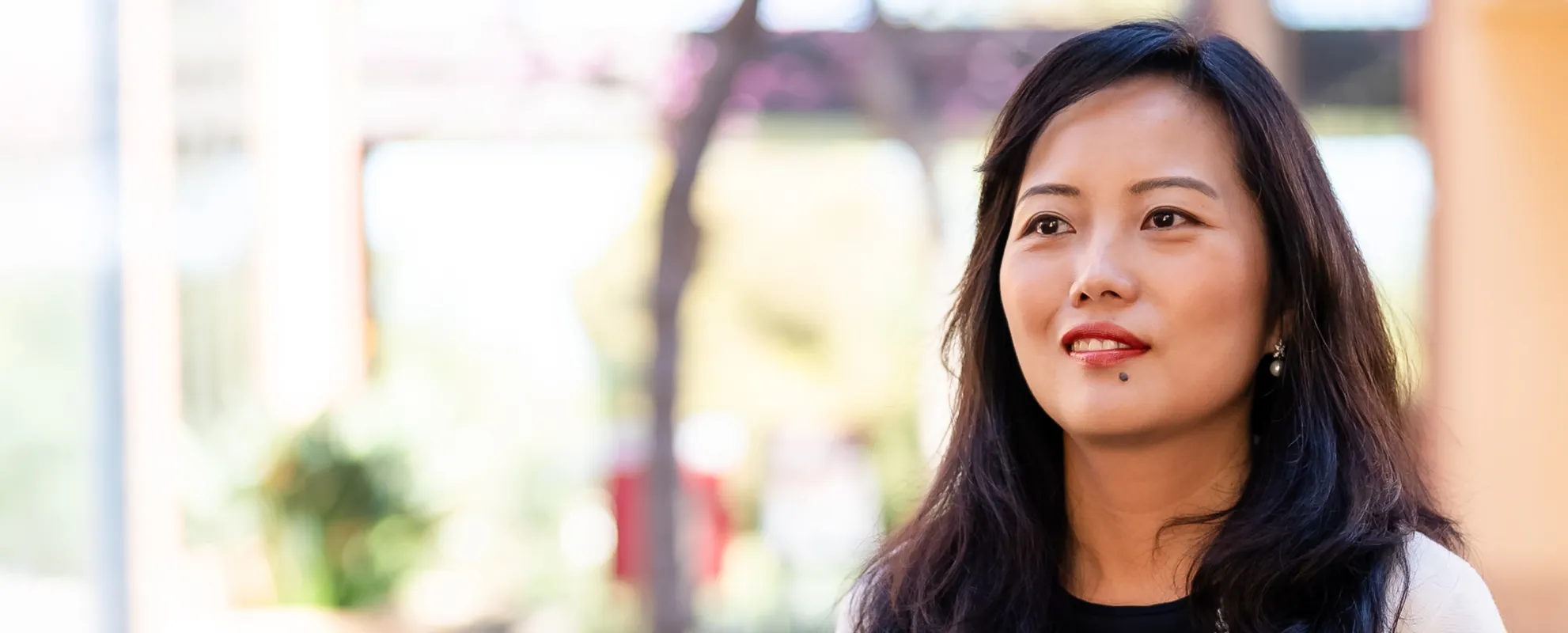
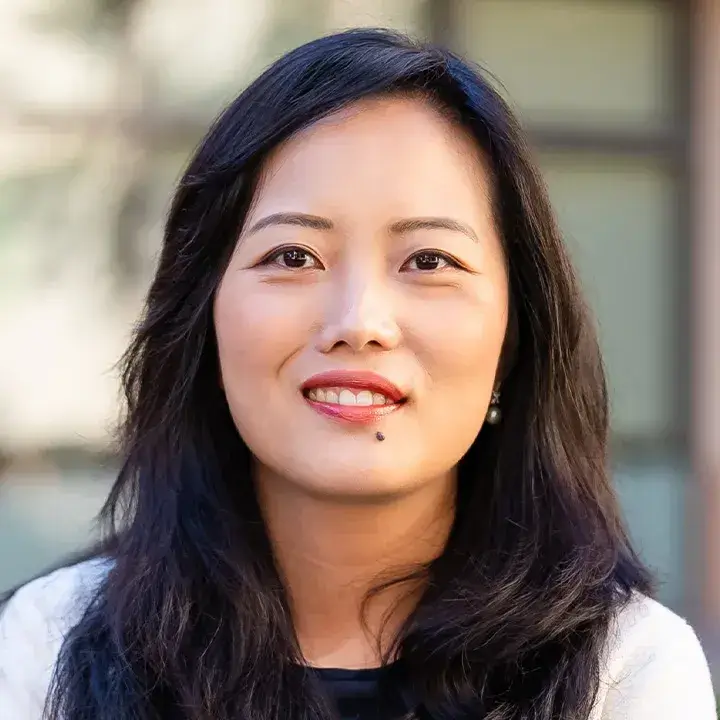
When Sabrina Yuan left her job as general counsel for Porsche in China, she was leaving her life in Shanghai behind for an unknown future in Silicon Valley. “I had zero connections here — my connections were on the East Coast and in the legal industry,” she notes.
A pivotal year at Stanford GSB helped her gain her footing and transition from a legal career into business executive roles in the tech world, and then back to the automotive industry. Now, a decade later, Yuan is in the driver’s seat at Rivian and Volkswagen Group Technologies, a joint venture between Porsche’s parent company and Rivian, based in Palo Alto. As the senior director of product planning, she works on next-generation electric vehicle (EV) technology, developing a software platform for Rivian and all VW Group vehicle brands.
The company’s goal for the new platform is ambitious: providing the new software-defined vehicle architecture and operating system for Rivian, all VW brands, and beyond. “If we succeed, the platform could play a role similar to what Android did for the smartphone ecosystem — creating a shared foundation that enables innovation at scale,” Yuan says.
I’ve been a car enthusiast since I was 9 years old, growing up in China. I remember watching Formula One racing with my dad, who is a super-fan of German engineering. The early ’90s were a really interesting time in Formula One, and China had just purchased broadcast rights. Behind every race was an incredible collaboration between drivers, engineers, and strategists trying to push the limits of performance. It was my first glimpse into the world of high-performance engineering and innovation.
My mom was a prosecutor and later became a judge. It required years of persistence and sacrifice, and she approached it with an unwavering focus. It showed me what it means to set a target and commit fully to achieving it. That mindset has stayed with me throughout my career.
At first, like a lot of kids, I didn’t want to have anything to do with my parent’s profession. But when you are taking the national exam in China [the high school test that determines your college], you have to declare a major. So I picked law, figuring that I could switch to something else later. And it turned out that I was extremely good at it. I thought my sweet spot would be working on mergers and acquisitions. After college, I got my master’s in law at Georgetown, focusing on securities and financial regulation.
I wasn’t specifically looking to join the automotive industry. But four years out of law school, I was recruited to help expand Porsche’s business in China. For a 28-year-old who loved engineering and performance cars, helping scale the business of one of the world’s most iconic automotive brands was a dream opportunity.
It was a general counsel position, but the whole company was only about 80 people, so every top manager had to lead a couple of different functions. I was heading up legal, compliance, and strategic projects. You have these rare chances to get on the leadership track without that much experience when the market is fast-growing. It felt like a startup hockey stick growth moment.
I was part of the early leadership group that helped transform China into the company’s number one market globally. The sense of shared purpose, the pride in the brand, and the intensity of the work were extraordinary. It felt like more than just a job — it felt like we were helping write a chapter of the company’s history.
I helped launch Porsche’s first plug-in hybrid, the Panamera, in 2012. For the rollout, we selected two service providers to install home charging stations in more than 50 major cities. We wanted customers to have a seamless experience instead of having to find an electrician and figure everything out on their own. When Tesla rolled out the Model S in the following year, they did the same thing.
There were also unforgettable personal moments, like the time I drove a Porsche on a Formula One racetrack. That felt like a full-circle experience.
My law school sweetheart worked in Silicon Valley after graduating, and we maintained a long-distance relationship. While I was at Porsche, he moved to China. Later, we got married, but we still lived in different cities. After years of traveling back and forth, and high-intensity jobs, we were both exhausted. Then he developed a major health condition that required a medical procedure in the U.S. So I decided to leave everything behind and move here.
I had business experience, but I had no connections in Silicon Valley. And after interviewing here, I realized that lawyers in the U.S. are generally more specialized, so their careers tend to be narrower than they are in other parts of the world.
It gave me an epiphany: I needed to pick a side, business or law. And going through a degree program and gaining foundational knowledge about Silicon Valley would help me pivot careers and countries.
Silicon Valley is its own ecosystem of startups and VCs and technology with its own jargon. Stanford was my entry into it, which was tremendously helpful. I also learned how to see business problems from a tech angle, which was different from how I had approached things before.
Going into Stanford, I was thinking about doing a self-driving truck startup, since shipping goods is lower risk than moving humans. I did an independent study where I cold-emailed companies and told them I was a Stanford student, and I was able to talk to all of them. I realized that the smart charging infrastructure was still very immature and not at the scale that I needed. Learning what to do is important, but learning what not to do is even more important.
Since my time at Stanford, I’ve continued to be very involved with the alumni community and volunteer my time with the Asian Alumni Chapter and Stanford Angels and Entrepreneurs. Stanford has been a great way to connect, not just for business but for more human aspects. Some of my deepest relationships come from this community, not just classmates and alumni, but people that I’ve interviewed for jobs and people that I’ve helped to support.
After the program, I had a short stint with a private equity firm focused on leveraged buyouts and business restructuring, and I soon found out that was not what I was passionate about. I then co-founded SecuritAI Inc., a computer vision startup, with an industry veteran. Our goal was to significantly improve image recognition accuracy and apply that capability to real-world environments. The service used AI to automatically detect people and patterns of suspicious behavior to secure any physical location.
Building a startup was an incredible experience. It allowed me to translate technological possibilities into a product and business strategy. I took away many lessons, but one of the biggest is that even the most innovative product needs the right market conditions to scale successfully. We had a really good solution, but our timing wasn’t right.
I’ve spent a great deal of time thinking about the application of AI in industrial systems, and EVs are one example of that broader transformation. They are where AI, mobility, and automation converge. From my time at Porsche, I could see this paradigm shift in mobility, and I was excited to find my way back to be part of this incredibly exciting transformation.
I joined an EV startup and ran global business development for Eli, which is a smaller vehicle with a lighter battery that goes at lower speeds and is a lot cheaper. It’s great for inner-city commutes and is perfect for retirement communities. It was an incredible journey; I am extremely proud that we worked through the whole supply chain shortage, the travel ban, the chip shortage during the pandemic, and launched the car successfully in Europe. Then I was recruited back to rejoin the VW Group and to help build their software-defined vehicle. The potential impact of the job is something I could not say no to.
Electric vehicles are essentially a highly sophisticated computing platform. Software and AI are enabling experiences that once belonged purely in science fiction — from intelligent assistants to fully autonomous capabilities.
In the software-defined vehicle — and soon the AI-defined vehicle — we can provide new functionality through software upgrades. Right now, you can put your car in “camp” mode, and it’ll use its air suspension to automatically level the chassis so you aren’t sleeping on a tilt. It also lets you keep the climate control running all night. Plus, you can use the mirror-mounted floodlights to light up your campsite while keeping your gear powered through the onboard outlets.
As a mother of a young child, I’m especially excited about in-vehicle AI assistants that can help manage tasks on the go — whether that’s coordinating schedules, handling navigation, or simplifying everyday logistics.
For example, while you’re driving, you can tell your AI assistant that you’re meeting your boss, ask it to find a restaurant in the area, and then ask it to craft a message telling your boss where to meet and when you’ll get there. At the same time, it can reschedule some of your other meetings so that you have enough time to get there. All without having to touch anything. We’re about to launch this any day now.
I’d like it to be able to drive itself. My 5-year-old son wants it to be able to fly. I think I’ll see both in my lifetime!
Photos by SF Photo