|
Program Toolkit
Print this material
Download a brochure
Email to a friend
Contact Program Director
Apply Now!
As they ascend the management ladder, many senior executives find that the soft skills of leadership constitute their hardest challenges. Furthermore, most executives have come to rely on a familiar set of behaviors and skills. Recent data shows that top-performing leaders exhibit high emotional intelligence; they are able to adapt interpersonally and thrive in a diverse range of situations. Based on two of the Graduate School of Business' most popular and longstanding courses, this program's unique T-group methodology and 12-1 faculty ratio provide a highly personalized learning experience for each individual participant. In this highly interactive program, senior-level executives learn how to engage in productive interpersonal exchanges, assess the impact of their own behaviors and leadership style, and excel at creating more powerful, professional relationships in a variety of contexts.
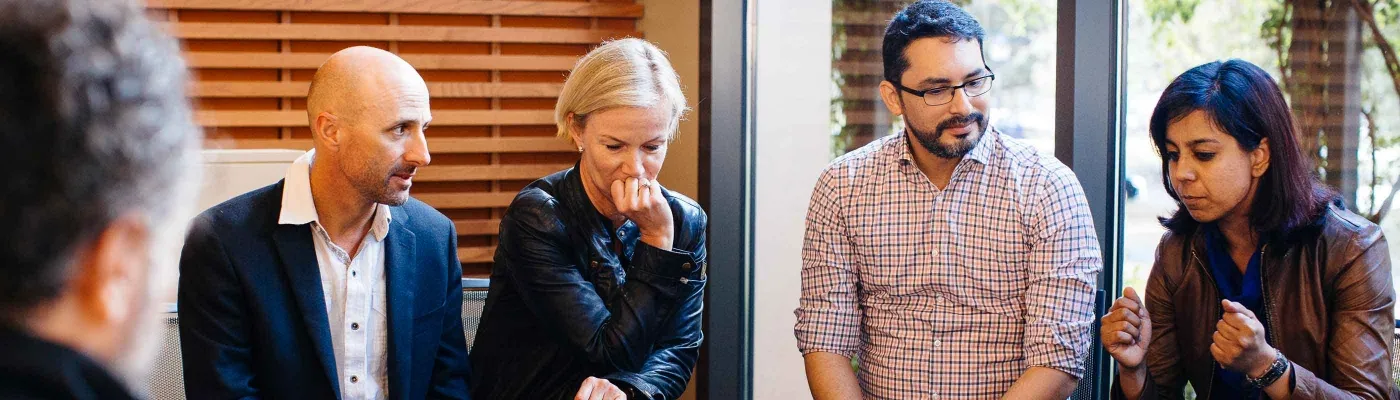
As a business leader, you live in an increasingly interdependent world where you need others to get your work done. As you move up the leadership hierarchy, "command and control" no longer works as the major source of power - the ability to influence others becomes the determining factor for success. This workshop focuses on improving your emotional intelligence via the T-Group (Training Group) methodology. In small, experiential group settings, you will observe how your individual behavior affects others in real time, customize your learning based on those observations, practice key leadership skills with peer feedback, and experience the power that comes from being more fully yourself while becoming more effective. Topics include influence in a direct, non-coercive way, how to address contentious work style conflicts, giving and receiving developmental feedback through "supportive confrontation", creating open, trustful, work environments. The afternoon application sessions transfer learning directly to participant's work situation. Class size is limited to 36 participants (divided into T-groups of 12) to ensure maximized interaction with faculty and peer teams.
A Leadership Questionnaire is distributed to each participant’s colleagues and direct reports before the program. Participants then use the results to develop their own leadership action plans tailored to their personal objectives and the needs of their companies.
This unique program, hailed as nothing less than transformative, was developed from 30 years of Professor Bradford and his colleagues' work. The program is offered as part of the Stanford MBA curriculum. Business executives
now will have the opportunity to benefit from this personally rewarding experience.
- Skills for developing, managing and adapting personal style and behavior to
a wider range of constituents for more effective leadership
- Frameworks and practice for inviting and providing feedback that strengthens
performance and relationships
- Application plans where participants apply the program learnings to their
own specific work situations and commit to a set of concrete implementation
goals
- Optional follow-up coaching within two months of the program to help participants
implement their application plan
- Practical tools that you can immediately apply based on the personalized Leadership Questionnaire
The Interpersonal dynamics course has been an eye opening experience. It took me out of my comfort zone and helped me connect with the leader I aspire to be. I truly believe that this experience was essential to get me to where I am, President and CEO of ThedaCare.

Dean Gruner
President & CEO, ThedaCare
Class of 2008
The program was one of the best I have ever attended, and I will carry the things I learned for the rest of my life.

Michael Flowers
Account Director, Sepracor, Inc.
Class of 2008
Program dates, fees, and faculty are subject to change. If a program is cancelled, Stanford will refund the program tuition in full but is not responsible for travel, accommodations or other expenses incurred by the participant.
|