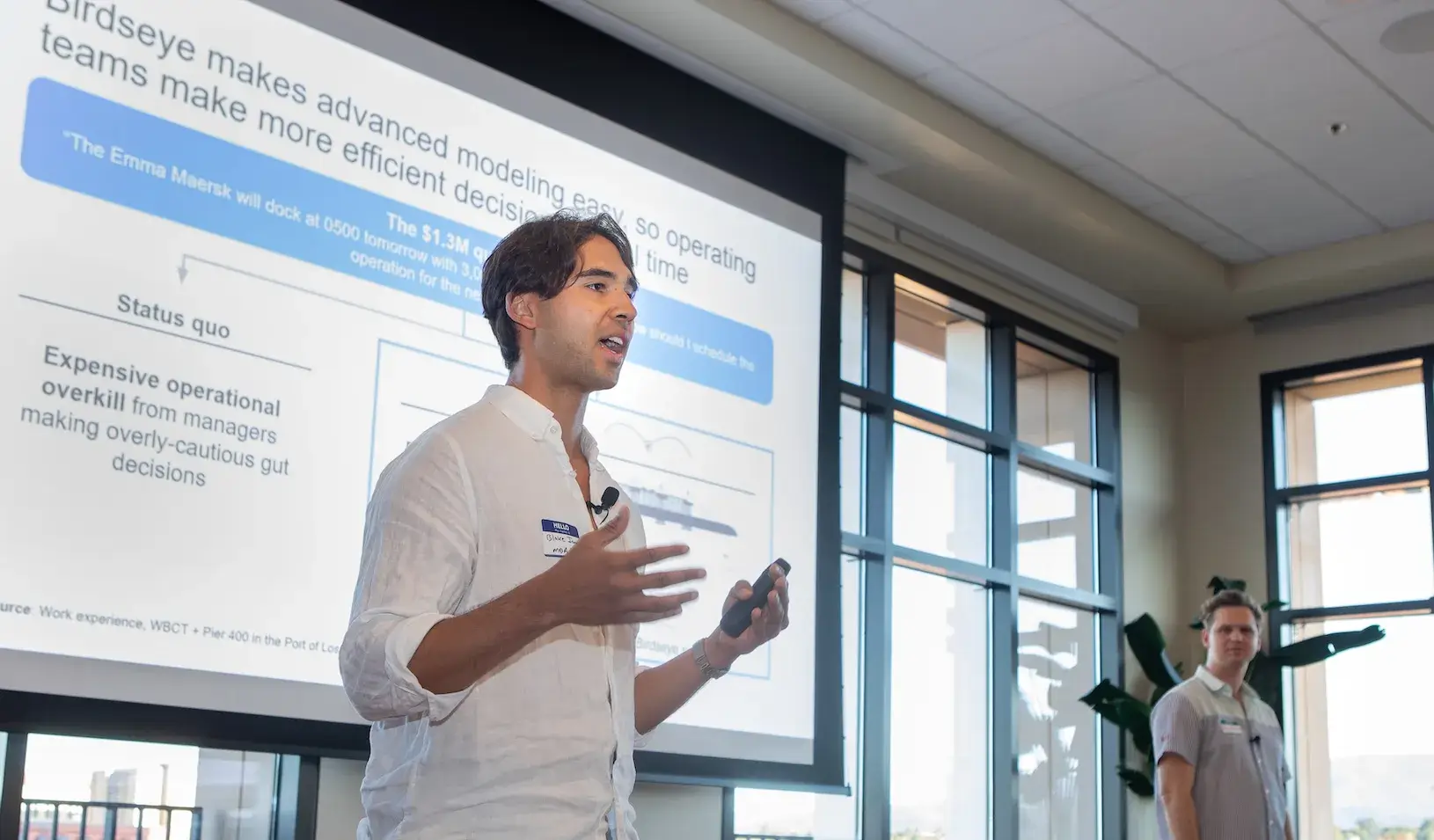
Blake Jones, MBA ‘26 and Spencer Adams-Rand, MBA ‘26 present Birdseye at Demo Day | Photo: Saul Bromberger
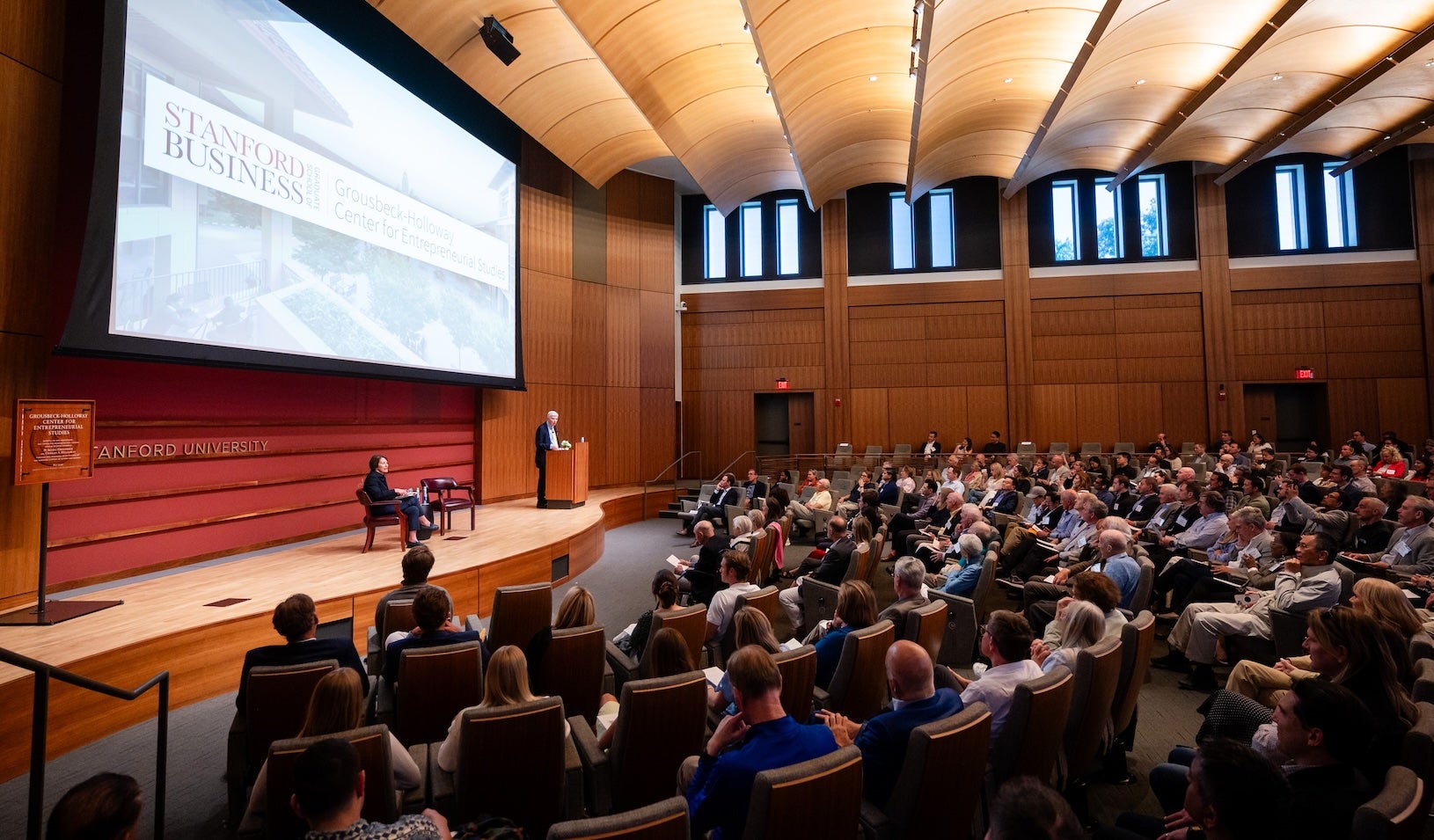
Hosted by the Grousbeck-Holloway Center for Entrepreneurial Studies’ Stanford Venture Studio in collaboration with the Center for Social Innovation, the event featured graduate student teams pursuing ambitious ideas across industries, including food systems, healthcare, industrial operations, environmental risk, AI infrastructure, consumer protection, and caregiving. Throughout the year, teams validated complex technical and market challenges while building prototypes, engaging customers, refining business models, and continuously testing new hypotheses.
Stanford Venture Studio and the Center for Social Innovation work to meet students where they are, recognizing that every entrepreneurial journey unfolds differently and advances at its own pace. While teams were not required to be investor-ready or actively fundraising, as graduation approaches, several teams are kicking off fundraising efforts. Regardless, each team shared specific “asks, ranging from introductions to pilot partners, researchers, and industry experts to prospective customers and future founding team members. The evening underscored that entrepreneurship is propelled by curiosity, conviction, and the power of community.
“It’s always fascinating to see the solutions students are creating. Some already have deep expertise in an industry and are innovating based on their knowledge,” said Deborah Whitman, Director of the Grousebeck-Holloway Center for Entrepreneurial Studies. “Others work hard to build understanding in an industry or problem space that is new to them. Either way, they bring determination, unique insights, and perseverance to bear.”
Throughout the academic year, teams immersed themselves in industry research, customer discovery, and rapid prototyping through a combination of GSB and Stanford entrepreneurship courses, along with co-curricular support from the Stanford Venture Studio and the Center for Social Innovation. Alongside their coursework, students participated in Startup Office Hours, workshops, community programming, and advising sessions that extended classroom learning into real-world venture exploration. Throughout the process, advisors, alumni, and industry experts challenged teams to sharpen their assumptions, better understand customer needs, test new ideas, and communicate their visions more effectively as their ventures evolved.
“As a GSB alum and Startup Garage instructor, I know firsthand that Stanford students have the potential to launch remarkable companies. I love attending Venture Studio events like Demo Day for a glimpse at the latest big ideas and a chance to meet the incredibly bright students behind them,” Sara Deshpande, MBA ’09
Photo: Saul Bromberger
Ideas Across Industries
This year’s Demo Day cohort reflected the breadth of entrepreneurship exploration at Stanford.
Several ventures focused on improving large-scale systems operating behind the scenes of daily life and industry. Blake Jones, MBA ’26, and Spencer Adams-Rand, MBA ’26, founded Birdseye to help ports, factories, and logistics hubs make real-time decisions about labor and equipment during operational disruptions. Kathryn Bacher, MBA/MS ’26, developed Telluscope, a platform helping investors and insurers uncover environmental liabilities hidden within real estate and infrastructure transactions. Emily Lee, MBA ’26, alongside Ethan Holtzclaw and Peter Holtzclaw, is building Terra Compliance, which streamlines waste operations and reporting for cities and enterprises pursuing Zero Waste goals.
Other teams explored scientific and operational innovation in food and sustainability. Loubaba El Ayoubi, MS&E ’26, launched Samwise Labs, an AI-enabled formulation platform helping food scientists evaluate nutrition, ingredient, cost, and regulatory trade-offs more efficiently. Lelina Chang, MBA/MPP ’27, founded Good Avenue, enabling cafés to produce fresh oat milk on-site while reducing packaging waste, emissions, and sugar content. Pingyu Wang, PhD/Postdoc ’26, Tooba Sofia Riaz, MA ’27, and Professor Will Tarpeh developed DropSense, which uses chemical monitoring technology to help wastewater facilities reduce energy use and improve operational efficiency.
Several ventures focused on trust, coordination, and consumer well-being. Gleb Vizitiv, MBA ’26, and Roche Kapoor created Anton Health, integrating STI verification and telehealth services into dating platforms to reduce barriers around sexual health. Losania Vernanda Hedianto, MBA ’26, founded NUOS Care, a platform supporting caregiver matching, training, and family coordination in Indonesia’s growing care economy. Dan Nelms, MSx ’26, alongside Tate Jarrow and Ethan Wolfe, introduced Rebound, a scam protection and reimbursement platform designed to help consumers navigate increasingly sophisticated digital fraud.
Other teams explored how emerging technologies are reshaping business operations and digital infrastructure. Alessandro Balzi, MSx ’26, Sahaj Saini, MSx ’26, Coco Wu, MS MS&E ’26, Yikai Cao, PhD MS&E, and Cameron Capers, MBA ’27, launched TrainedOnMe, which develops which develops AI interpretability technology aimed at helping copyright owners detect and attribute value when their content is used in AI models. Jason Sun, MBA ’26, and Stela Tong, PhD ’29, launched EIGEN Exchange, a market-based system for allocating AI compute resources more efficiently. JT Arenas, MSx ’26, alongside Mauricio Chiong and Martin Raddatz, created Eclectic AI to help small businesses automate operational workflows, while Steven Yan, MSx ’26, and Neo Zhang, MSx ’26, developed Argn, a platform bringing AI-powered decision intelligence to commercial real estate management.
Demo Day highlighted the creativity, initiative, and progress students made throughout the year, while reinforcing the strong network of peers, advisors, and supporters helping founders continue beyond Stanford.
View more details about the teams and ventures here.
Photo: Saul Bromberger