The Center for Social Innovation (CSI) at Stanford Graduate School of Business offers support and recognition for students committed to impact careers, empowering innovation and leadership opportunities centered around social and environmental change. This year, CSI is honoring four graduating MBA students with Stanford Impact Leader (SIL) prizes in recognition of the skills they have honed at Stanford GSB — and the positive impact they seek to achieve in the next chapter of their careers.
“At Stanford, we believe that the world’s most pressing challenges require more than just passion — they require the sophisticated orchestration of capital, infrastructure, and human talent,” says Neil Malhotra, the Edith M. Cornell Professor of Political Economy at Stanford GSB and the Louise and Claude N. Rosenberg, Jr. Director of the Center for Social Innovation.
Each SIL winner receives $20,000 in support of their impact-based professional paths. This year’s winners are joining organizations addressing diverse challenges: infrastructure development, healthcare delivery, anti-trafficking systems, and energy access. Each focus area is unique, yet all four are leveraging capital in effective, efficient, and innovative ways, working from a systems-level mindset.
The 2026 SIL prize winners:
-
Evans Adanya, MBA ’26, aims to close Africa’s infrastructure gap by financing the energy, transport, and connectivity projects that would have changed his own village growing up.
-
Alexis Cook, MBA ’26, seeks to combat human trafficking by deploying philanthropic and investment capital to reduce vulnerability, enforce accountability, and scale prevention through economic resilience.
-
Anshul Dhingra, MBA ’26, is committed to expanding access to quality healthcare in underserved communities by pioneering a talent-first model of philanthropy that strengthens nonprofit execution.
-
Sithara Rasheed, MBA ’26, is focused on advancing the catalytic capital structures that make equitable energy transitions possible.

Left to Right: Evans Adanya, Alexis Cook, Anshul Dhingra, Sithara Rasheed | by courtesy
“This year’s Impact Leaders embody a new era of leadership that moves beyond traditional aid to build resilient, scalable systems,” Malhotra says.
The awards demonstrate Stanford GSB’s commitment to the impact community.
“I grew up doing my homework by kerosene lamp in Adaklu-Kpodzi, a village in Ghana’s Volta Region where reliable electricity, clean water, and basic healthcare were luxuries — the same gap that still costs African lives every day,” Adanya says. “Winning the Stanford Impact Leader prize means Stanford is putting its weight behind the work of closing it. For someone from Adaklu-Kpodzi, it’s a door I never thought I’d walk through, and one I now intend to hold open for others.”
The prize also shows the school’s support for impact careers within existing organizations — and the financial support helps make pursuing these careers more feasible. “It reflects a belief that impact doesn’t only come from new ideas, but from committing deeply to execution inside existing institutions. It also represents Stanford’s commitment to supporting students who choose less traditional paths in the social sector and helping make those paths more viable,” Dhingra says.
Academic Credential for Impact
One way Stanford GSB supports the impact community is by offering a social innovation curriculum that prepares students for leadership in social and environmental impact organizations. The Certificate in Public Management and Social Innovation provides both rigorous education about pressing social challenges and a connection to the impact community. This year, 153 Stanford GSB students — including all four SIL winners — earned the certificate.
“To me, the certificate reflects the GSB’s tangible commitment to bringing rigorous business thinking to society’s most pressing challenges,” Cook says. “Earning the certificate connects me to a community of students, faculty, and alumni who continually pushed me to think more deeply about our collective responsibility to drive positive change.”
Clear institutional support for impact careers — and the certificate, in particular — attracts mission-driven students to Stanford GSB.
“I came from development finance and philanthropic capital — work that sits at an uncomfortable intersection that does not always have a natural home. I was looking for a school that took that intersection seriously, where business education and social impact were not in tension,” Rasheed says. “The certificate was evidence of that institutional intentionality. For someone who has spent their career arguing that rigor and impact can coexist, having the institution itself reflect that back means a great deal.”
Multi-Layered Support
CSI offers opportunities and programming for students to explore impact across all sectors — as impact entrepreneurs, capital allocators, government representatives, nonprofit directors, and impact intrapreneurs within existing organizations. To do so, the center has multiple ways to address student needs during their impact leadership journeys, including deep one-on-one relationships, help with impact pathway navigation, and cultivation of community during students’ on-campus experience. Examples include the following:
-
Board Fellows program: The Stanford GSB Board Fellows program, relaunched a year ago as a pilot program, connects pairs of MBA students with Bay Area nonprofit organizations to enhance board governance, strategy, and operational effectiveness. Students engage in board and committee meetings, gain insights from experienced board mentors, receive training and advising from CSI, and collaborate on strategic projects that align with boards’ organizational goals. In the two years since the program relaunched, it has received 115 applications and placed 33 board observers at 12 nonprofits.
-
Impact Fund: The GSB Impact Fund educates future leaders and investors about the process of impact investing — generating financial returns alongside measurable impact. The student-run fund, which has had 616 participants since 2015, grew by 20% last year by adding two climate-related teams. This year, it had 98 participants, including, for the first time, some from other Stanford graduate schools. The fund is a talent pipeline for the impact sector: A survey of alumni for the fund’s 10-year anniversary found that 45% have held an investing role since graduation and 55% have held impact-focused roles.
-
Advising and coaching: CSI offers one-on-one coaching to help students make the most of their time at Stanford GSB. CSI coaches have held almost 500 coaching sessions in 2025-26. Coaches help students with course selection and financial support, assist in creating a roadmap for their time at the GSB, and guide students as they explore questions such as whether impact entrepreneurship is the right path for them, how to break into a field like impact investing, or how to become a responsible business leader.
-
Summer immersion and financial support: CSI decreases financial barriers to enable students to take on roles of societal impact, through programs that include summer internships, entrepreneurial exploration, small grants, and postgraduate fellowships. The Impact Design Immersion Fellowship, which will support 20 fellows for summer 2026, supports Stanford GSB’s most promising MBA social innovators. This summer’s projects include economic mobility and workforce access, health equity and care coordination, and the use of AI to close historically costly or complex gaps. Summer opportunities also include joining existing impact organizations, from government to philanthropy to nonprofits to for-profit impact organizations. The Social Management Immersion Fund provides financial support to MBA students who secure summer internships with nonprofits, government agencies, and impact businesses. In 2025, 29 fellows received support.
Miller Social Change Leadership Award
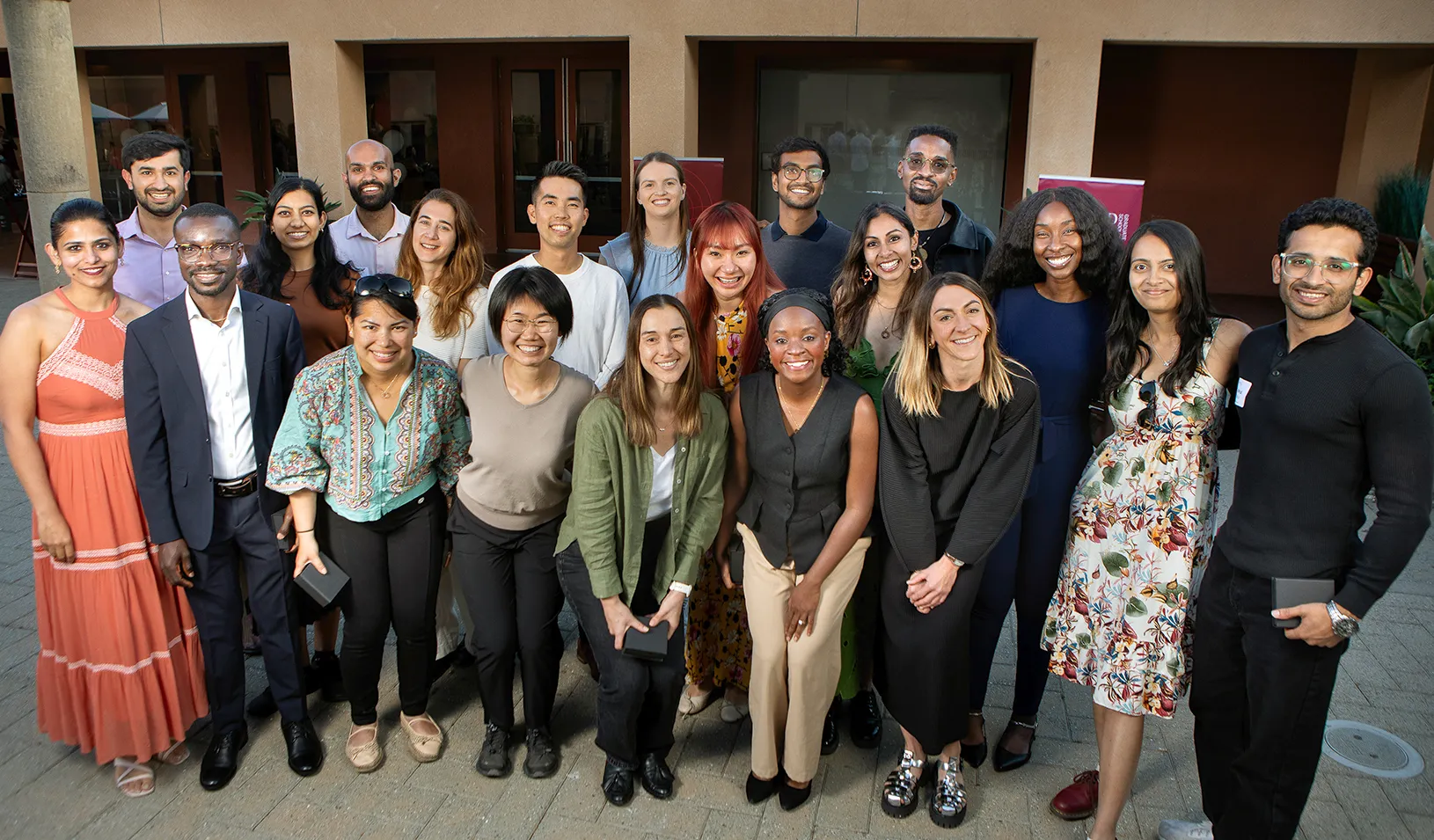
The Miller Social Change Leadership Award honors graduating MBA and MSx students who have made outstanding contributions to the impact community while at Stanford GSB and are committed to social and environmental action. Recipients, selected from those who have earned the Certificate in Public Management and Social Innovation, are nominated by peers, faculty, and staff. This year, a record number of nominations — over 300 — were received.
“The Miller Social Change Leadership Award winners play an important role in the GSB’s social impact community,” says Anne Beyer, the Staehelin Family Professor of Accounting and senior associate dean for academic affairs. “Through their commitment to social and environmental change, they contribute to our learning environment, foster a collaborative culture of social innovation at the GSB, and help strengthen the broader impact ecosystem on campus.”
This year’s Miller Social Change Leadership Award winners:
-
Evans Adanya, MBA
-
Rohan Angadi, MBA/MA Education
-
Antonia Benzanilla, MBA/MA Education
-
Mehul Bhatia, MBA
-
Helen Cashman, MBA
-
Anshul Dhingra, MBA
-
Nazlican Goksu, MSx
-
Kelly Hyles, MBA/MD
-
Thresa Skeslien Jenkins, MBA/MA Education
-
Nishi Kelkar, MBA
-
Isha Kulkarni, MBA/MS Environment and Resources
-
Simran Mohnani, MBA
-
Dumisile Mphamba, MBA/MA Education
-
Arinze Obiezue, MBA
-
Shubhankar Mihir Seth, MBA/MS Environment and Resources
-
Aditi Singh, MBA/MA Education
-
Natasha Su Sivarajah, MSx
-
Eléonore Windisch, MSx
-
Jeffrey Xia, MBA/MS Environment and Resources
-
Musia Yu, MBA
-
Linda Zhang, MBA
For media inquiries, visit the Newsroom.
![]Marcus_Wandt_in_Cupola Key Image](https://www.gsb.stanford.edu/sites/default/files/2026-10/key-Marcus_Wandt_in_Cupola%20credit%20ESA%201.jpeg)