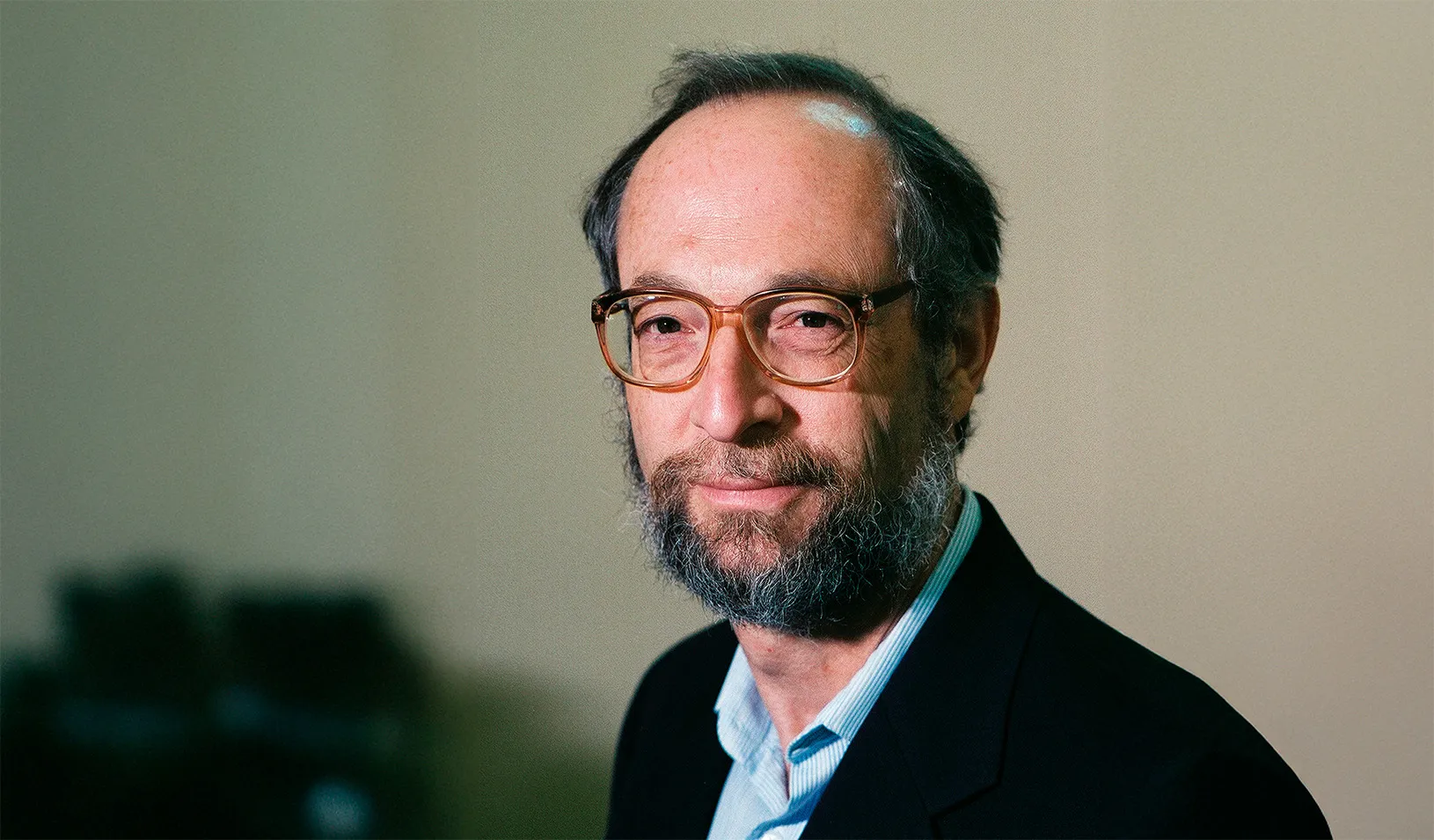
Over his 45-year tenure at Stanford Graduate School of Business, Jonathan Bendor’s boundless sense of academic enthusiasm and scholarly rigor, paired with a generosity of spirit, came to define him.
Terry M. Moe, a close friend and colleague to Bendor for over four decades, remembers puzzling through a new project together as young assistant professors. To develop their theory, they decided to create a computer simulation. “The twist was we didn’t know how to program a computer,” Moe says with a chuckle. “So we taught ourselves Pascal [the computer language]. It was typical of Jon to move into unfamiliar terrain just for the intellectual fun of it.” That simulation served as the basis for two articles published in the prestigious American Political Science Review — and exemplified Bendor’s approach.
“Jon was one of the smartest people I’ve ever known,” continues Moe, the William Bennett Munro Professor in Political Science, Emeritus, in the School of Humanities and Sciences and a senior fellow emeritus at the Hoover Institution. “He loved the life of the mind. He would, if it were up to him, spend all day debating ideas, mentoring students, or going to seminars. Doing the work, reading, learning — that’s what gave him joy. He was the perfect academic.”
Bendor, the Walter and Elise Haas Professor of Political Economics and Organizations, Emeritus, died on November 6 at age 75.
“He was an extraordinary member of our faculty — present, generous, kind, and intellectually fearless,” wrote Dean Sarah A. Soule, Philip H. Knight Professor and Dean at Stanford Graduate School of Business and Morgridge Professor of Organizational Behavior, in a message to faculty and staff. “A valued colleague and cherished friend, Jon will be deeply missed.”
An “Intellectual Omnivore”
Bendor joined Stanford GSB in 1979 directly from the University of California, Berkeley, where he had earned both his BA and PhD in political science. At the time, the business school was expanding the areas of political economy and organizations, and Bendor was hired as part of the effort to build out its stable of scholars.
A traditional political scientist by training, Bendor quickly identified the gap in his knowledge regarding mathematical modeling and worked with a tutor to learn what he needed to know. “From that point on, he became a formal modeler,” explains Moe. “Most of his thinking about organizations and bureaucracy was heavily influenced by formal theory.”
“Investing in learning and developing this whole new set of methodology as a young professor — that’s a really high-risk thing to do. He reshaped the direction of his research as a young professor and then again over the course of his career. It was amazing,” says Ken Shotts, PhD ’99, the David S. and Ann M. Barlow Professor of Political Economy.
Some of Bendor’s most noteworthy contributions include his highly original theoretical works on organizational norms, design, and performance, as well as his essential critiques of others’ influential theories. In addition, “Jon also did important empirical work, including extending Robert Axelrod’s major theory and empirical work on the evolution of cooperation,” says his colleague Roderick Kramer, the William R. Kimball Professor of Organizational Behavior, Emeritus. “Relatedly, his work on the evolution of norms, delegation, logics of collective action, and adaptive behavior in bureaucracies and institutions stood out as major contributions to the field.”
Shotts points to Bendor’s use of psychologically grounded models of human behavior to understand how organizations and institutions function as a significant contribution to the field. “It was a fundamental shift in thinking,” Shotts says, crediting that work with Bendor being elected a fellow of the American Academy of Arts and Sciences. “He was an intellectual omnivore. He read psychology, anthropology, history. So he had this wealth of knowledge on which to draw.”
Over the course of his career, Bendor published two influential books and numerous scholarly articles and was actively involved with academic journals, including the American Journal of Political Science and the American Political Science Review.
Guiding the Next Generation
Bendor’s courses were as varied as his interests and covered political analysis, creativity, business-government relations, ethics, bounded rationality, and negotiations.
“Jon seamlessly wove together research from cognitive psychology, evolutionary biology, economics, and political science,” says Cecilia Hyunjung Mo, PhD ’12. “His classes were stimulating and generous spaces — rooted in intellectual breadth, but always tied to precise theoretical insight.” Mo, an associate professor of political science at UC Berkeley, stayed in close touch with Bendor after he co-chaired her dissertation committee. “His course changed the trajectory of my research interests,” she says. “I still draw deeply on the ideas he introduced — both in my scholarship and in the courses I teach.”
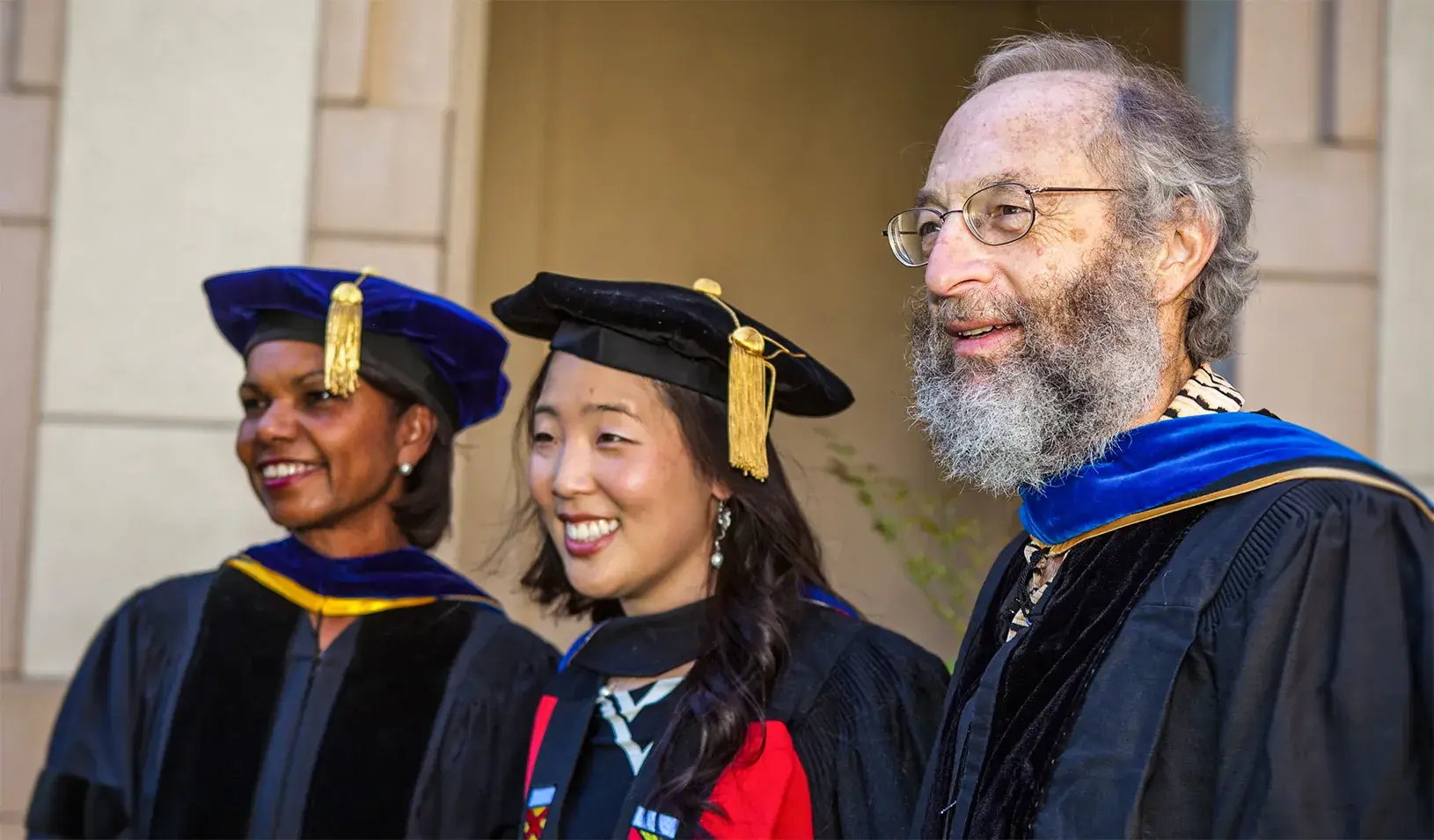
Condoleezza Rice, Cecilia Mo, and Jonathan Bendor at a graduation ceremony. | GSB Archives
A professor to undergraduate, MBA, and PhD students, Bendor taught both at Stanford GSB and in Stanford’s Public Policy Program. He was faculty director of the Stanford GSB PhD program from 1995 to 1999 and was a fellow at the Center for Advanced Study in the Behavioral Sciences (CASBS) on two occasions. He joined the Stanford Doerr School of Sustainability and was one of the founding faculty members of the Department of Environmental Social Sciences, where he helped create its PhD program.
“He took students on an intellectual journey,” says Shotts, who enrolled in Bendor’s political analysis class as an undergraduate and was inspired to get his doctorate as a result. “He had his way of thinking, but he was incredibly good at understanding other people’s ways of thinking and presenting them as compellingly as possible before critiquing them. He made it really engaging.”
Bendor’s desire to foster the exploration of ideas was also expressed through mentorship. “He loved giving someone a puzzle or challenge that’s part of a paper and helping them develop it, then training them in all of the things to get the paper published,” says Shotts, one of the many students who co-authored articles with Bendor. “He was very generous to his students with his time and feedback.”
That mentorship extended to faculty. “Talking with Jon was inspiring. He was deeply curious and insightful, passionate about the school’s missions of research and teaching, and dedicated to supporting his colleagues, especially junior colleagues and doctoral students,” says Maureen McNichols, the Marriner S. Eccles Professor of Accounting and Public and Private Management. “He was also deeply principled, about his scholarship and about integrity in academic institutions. This commitment shone through his every act.”
A Generosity of Spirit
Bendor’s colleagues, students, and friends laud his unflagging optimism and good nature. “Jon was not only an extraordinary scholar but also an extraordinary human being,” Mo says. “His mind was formidable, but his kindness was what set him apart. He shaped generations of students through his brilliance, but also through the care, humility, and humor he brought to mentorship. His legacy is both intellectual and personal.”
Known for his indifference to fashion — “he was the most likely faculty member to be wearing worn-out Birkenstocks,” says Shotts affectionately — Bendor instead focused his attention on the people and ideas around him. “I will always remember Jon’s keen insights, and the easy smile and laugh that accompanied his constant search for the truth,” says William Barnett, the Thomas M. Siebel Professor of Business Leadership, Strategy, and Organizations at Stanford GSB and chair of the Department of Environmental Social Sciences at the Doerr School.
“Jon was the consummate intellectual whose independence and creativity were an inspiration to all those around him,” says David Baron, the David S. and Ann M. Barlow Professor of Political Economy and Strategy, Emeritus.
Indeed, academia was the ideal home for Bendor. “For Jon, using his mind and exploring things was both serious work and seriously fun recreation. He felt very lucky that he could think for a living,” says Shotts.
“He would say, ‘I can’t believe they pay me to do this,’” his son Josh remembers of his father coming in the door after biking home from a day at Stanford GSB. “He loved learning so many of the different things that tell us about human societies, and how they work, and how they solve complex problems.” In his last couple of years, as just an example of the breadth of his scholarly interests, Bendor dove into readings about scurvy in the pre-industrial British navy and Chinese history and politics. Even in his final months, he continued to work on academic papers, preparing them for publication.
“I think he’d want to be remembered for continuing to notice, explore, and probe — sometimes in newer ways, or from fresher angles — to get closer to important realities,” says Linda, his wife of 44 years. “To continue questioning, to better put pieces or ideas together, to wed curiosity with truth-seeking.”
Beyond his deep intellectualism, he will also be remembered equally for his many attributes. “My father was a person of deep convictions, but also a lack of pretense; of warmth and love … and he had a wacky sense of humor and a great capacity for gratitude. He also had a great, great love of family,” says Josh. “We need more people like him in the world.”
Professor Bendor is survived by his wife, Linda; his brother, Dan; his sons, Josh and Ben; his daughter-in-law, Erin; and his grandchildren, Phillip, Daniel, Ruth, and Gideon.
For media inquiries, visit the Newsroom.