
The global reputation of the Stanford MBA Program begins with our accomplished faculty members — each individually committed to developing the next generation of organizational leaders.
Featuring multiple Nobel laureates, members of the National Academy of Sciences, and many other impressive academic leaders, Stanford GSB faculty will share their expansive range of experience, expertise, and insight. With a six-to-one student-to-faculty ratio, you will have direct access to these world-renowned business experts.
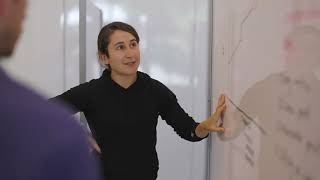
00:03:21
Who Teaches You Really Matters
At Stanford Graduate School of Business, you are taught by world-class researchers and successful business leaders. Meet some of our faculty members and lecturers as they share what and how they teach in their classrooms — and why it matters.


Quick Look: MBA Faculty

Jennifer Aaker
Professor
Marketing
Aaker is a behavioral psychologist and author. Her research focuses on the psychology of time, money, and happiness: specifically, how people choose to spend their time and money and how those choices drive lasting happiness.

Susan Athey
Professor
Economics
Athey’s current research focuses on the economics of digitization, marketplace design, and the intersection of econometrics and machine learning.

Guido Imbens
Professor
Economics
Guido Imbens does research in econometrics and statistics. His research focuses on developing methods for drawing causal inferences in observational studies, using matching, instrumental variables, and regression discontinuity designs.

Neil Malhotra
Professor
Political Economy
Malhotra has authored over 60 articles on numerous topics including American politics, political behavior, and survey methodology. He currently serves as an associate editor of Public Opinion Quarterly and the Journal of Experimental Political Science.

Baba Shiv
Professor
Marketing
Shiv has done extensive work on the emotional brain, documenting its powerful role in shaping decisions and experiences. His work includes the application of neuroeconomics to the study and practice of innovation and entrepreneurial leadership in companies from Silicon Valley startups to Fortune 500 companies.

Jennifer Eberhardt
Professor
Organizational Behavior
A social psychologist, Eberhardt conducts research on race and inequality. Through interdisciplinary collaborations and a wide-ranging array of methods — from laboratory studies to novel field experiments — Eberhardt has revealed the startling, and often dispiriting, extent to which racial imagery and judgments shape actions and outcomes in our criminal justice system and in our neighborhoods, schools, and workplaces.

Anne Beyer
Professor
Accounting
Beyer is a Michelle R. Clayman Faculty Scholar and her research focuses on corporate disclosure, information economics, and corporate governance. She teaches the introductory class in financial accounting for which she has received the MBA Distinguished Teaching Award.

Ilya Strebulaev
Professor
Finance
Strebulaev is an expert in corporate finance, venture capital, private equity, corporate innovation, innovation ecosystems, and financial decision-making. His recent work has examined the valuation of VC-backed companies, decision making by venture capital and private equity investors, corporate venture capital, and impact of venture capital.