In Brief
- Technical solutions alone cannot address climate change; progress also depends on behavior, trust, institutions, and implementation.
- Changemakers showed how sustainability challenges unfold in real communities, from renewable energy forecasting and wartime health care, to Indigenous rights, climate adaptation, and restoration finance.
- Durable solutions must be technically effective, behaviorally feasible, and morally just.
Near the end of the first day of Stanford’s Sustainability Summit, two participants provided revealing perspectives about what the future requires. One of the Summit’s participants, Brad Ack of Ocean Visions, argued that existing technologies may not be enough to prevent climate tipping points. The world, he suggested, will need new approaches to carbon removal, ocean intervention, and the restoration of ice systems.
Clare Westwood, who works on environmental justice in Southeast Asia, pushed back. She contended that existing pathways such as Indigenous land rights, agroecology, and changes in food systems could deliver substantial benefits already. She warned that enthusiasm for futuristic technologies might distract from solutions that are available now.
The exchange demonstrated why a bottom-up approach to tackling climate change matters. Both Ack and Westwood were Changemakers, the Summit’s name for its participants working on sustainability in real-world communities, organizations, and institutions.
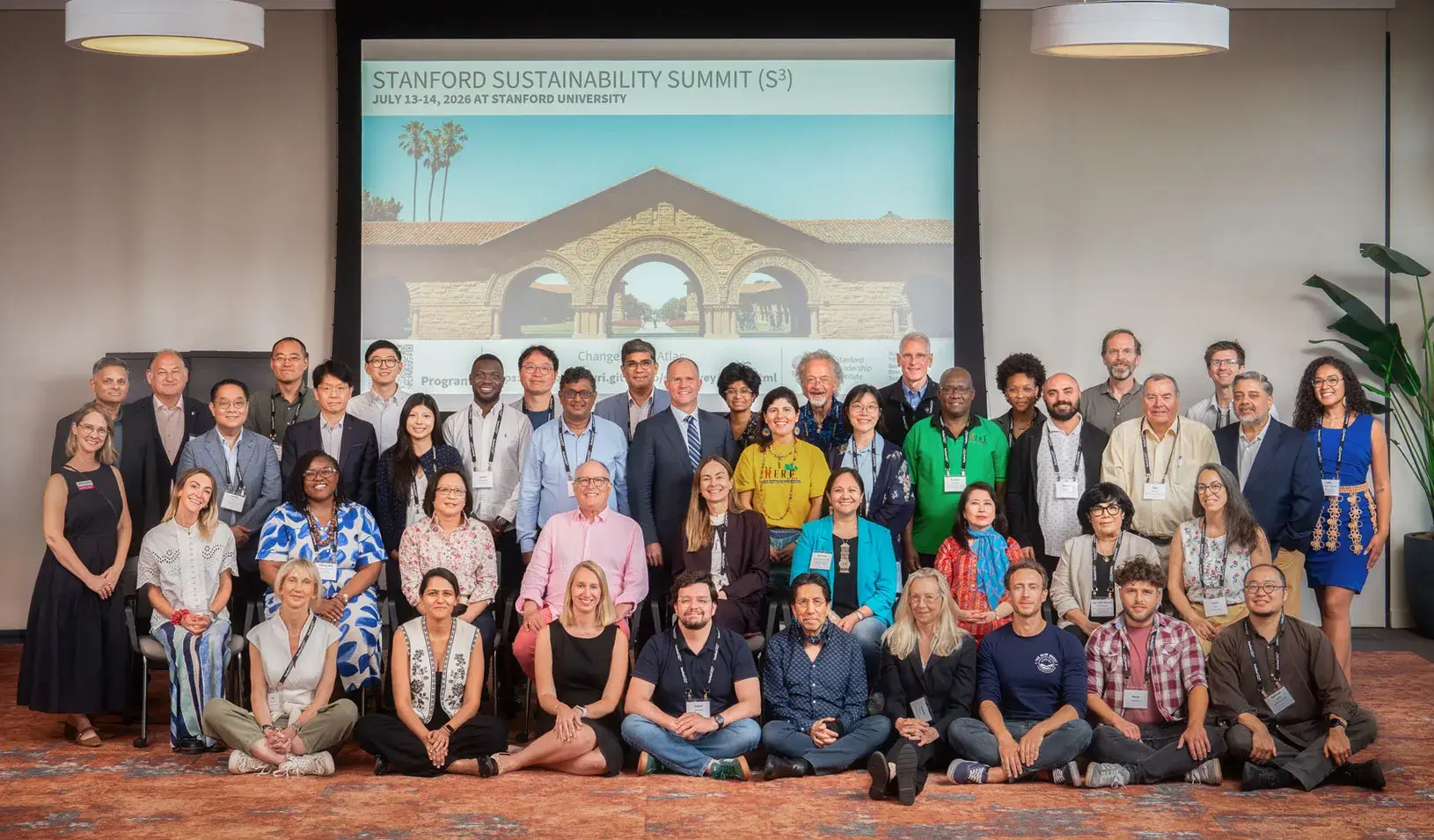
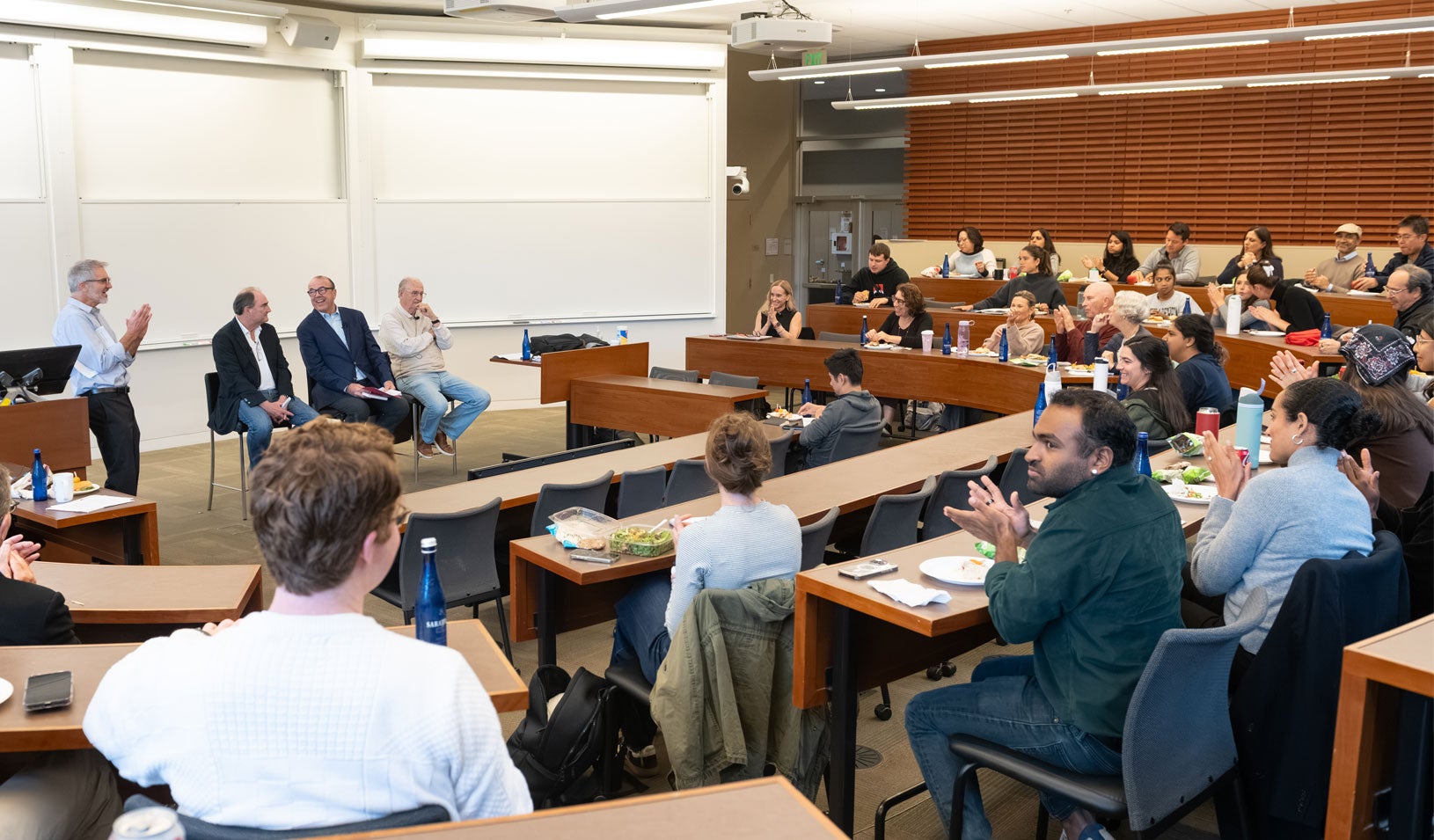
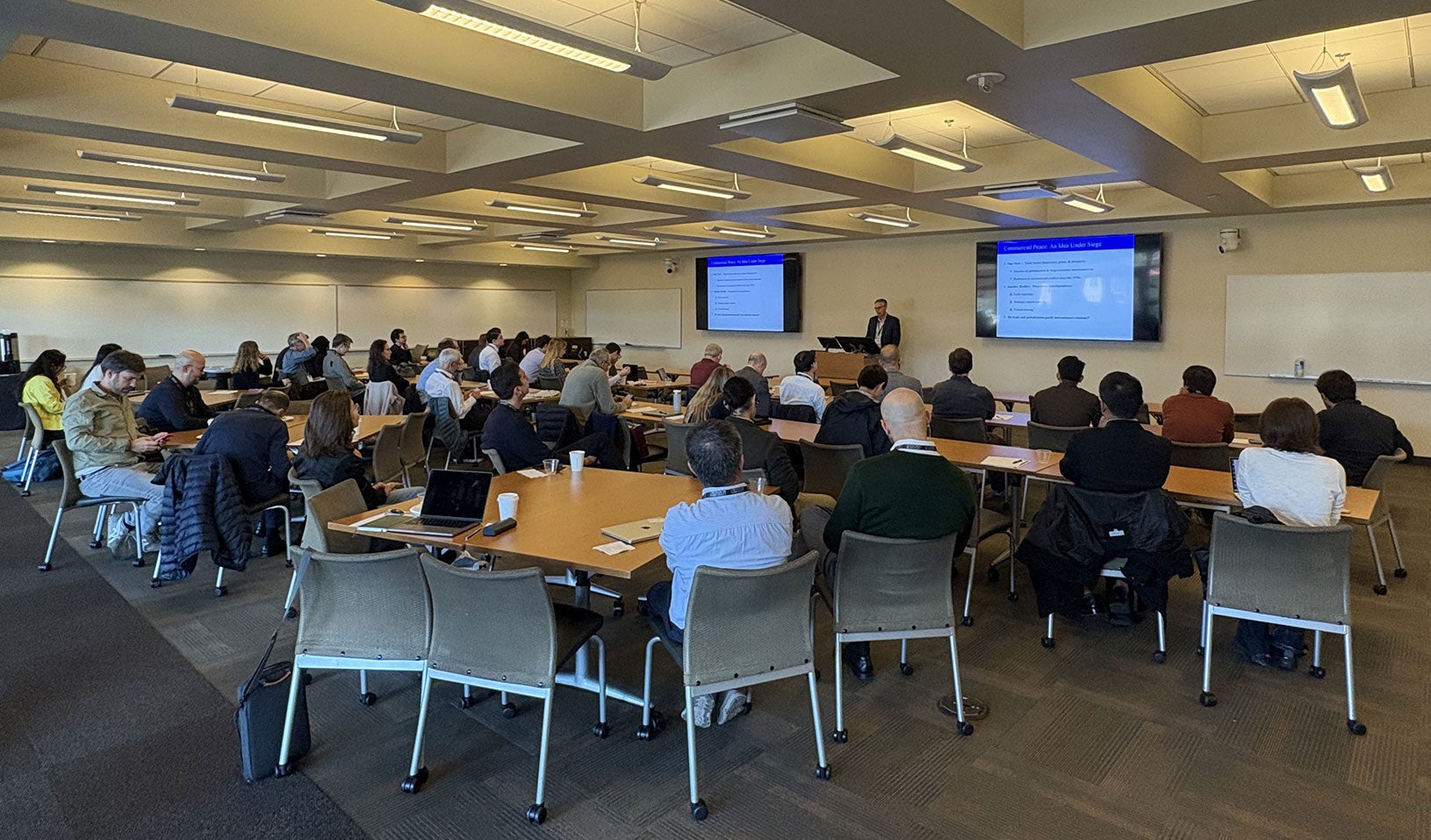
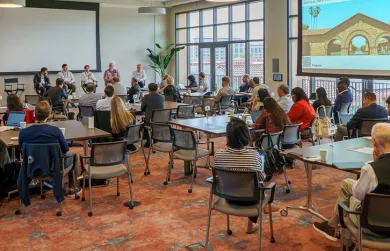
Occurring over two days in July, the Stanford Sustainability Summit, organized by Stanford Leadership Institute, brought together Changemakers with academics from Stanford and other leading universities. Professor William Barnett, one of the Summit’s organizers, explained that the Changemakers invited to the Summit are often not the individuals who typically take the stage at academic conferences. They are working in context, dealing with political conflict, inadequate infrastructure, limited finance and the consequences of environmental change. The Summit aimed to bring different perspectives, and people of different backgrounds, together. Barnett contended, “Sustainability has technical, behavioral and moral dimensions. When we bring together these perspectives, we can make change happen.”
The technical case
The faculty panel that opened the Summit established scientific stakes.
Noah Diffenbaugh, a climate scientist and professor at the Stanford Doerr School of Sustainability, argued that societies are investing far less in adaptation than the accelerating risks require. Even if the world succeeds in reducing emissions, extreme heat, precipitation and other hazards will continue to intensify. The result is a widening gap between what communities are prepared for and what they are likely to experience.
Professor and conservationist Rodolfo Dirzo widened the discussion. New monitoring technologies are revealing declines in animal populations and improving scientists’ understanding of the relationship between biodiversity and disease. The loss of species, he argued, is also connected to the loss of cultural knowledge and language. When species and ecosystems disappear, communities can also lose the knowledge, practices, worldviews, and languages through which they understand and care for the natural world.
Economist Stefan Reichelstein focused on a different kind of measurement problem. Companies make net-zero promises, but their carbon figures are often difficult to verify. His work seeks to create more rigorous carbon ledgers and reporting standards, making corporate environmental claims more comparable and accountable.
The Changemakers brought their real-life experience to discuss what technical challenges look like in practice. Mohak Mangal, an entrepreneur working with electric utilities, described how inaccurate weather forecasts cause renewable energy to be curtailed in parts of India. Better forecasting can help utilities use more wind and solar power, but only if data from satellites, weather stations and private sources can be combined and maintained.
Yash Kaman, an investor, offered a different lesson. His firm invested in a company that used sustainable aviation fuel derived from waste-based biomass feedstock. He argued it was not the perfect solution, as the fuel’s production needed to scale, but it could significantly reduce greenhouse gas emissions compared to traditional aviation fuel sources.
Olga Rudnieva’s work in Ukraine made the adaptation challenge more urgent. Her organization, Superhumans Center, provides advanced medical care to people injured in the war while trying to build a model that can be shared with countries facing other emergencies. Ukraine is not simply repairing its health system, she explained; it is attempting to rebuild it for the future while the war continues.
Adoption: A problem of behavior and trust?
James H. Jones, a professor of environmental social science, challenged the tendency to treat behavior as an afterthought. Engineering solutions do little good if people do not use them, he argued. The central sustainability problems may therefore be behavior change and collective action. Jones used familiar examples: doctors resisted handwashing despite evidence that it reduced infections; political interests blocked a safer railway gauge; and the more efficient Dvorak keyboard never displaced the established QWERTY layout. In each case, a technically superior approach struggled against habit, political interests or institutional inertia.
Changemaker Dana Lev described a coordination challenge. Her organization, EcoPeace Middle East, brings Israelis, Palestinians and Jordanians together to work on shared water and climate problems. One practical method is to begin with professional identities. Engineers meet as engineers; teachers meet as teachers. That can create trust for collaboration even when national and political identities make it difficult.
Angela Pinhati of the Brazilian cosmetics company Natura described how relationships can become a form of climate infrastructure. The company’s network of millions of beauty consultants is part of its commercial model, but it is also embedded in local communities. Natura is working with Brazil’s civil defense agency to identify where consultants may face floods, droughts or other hazards, and to train them as first points of contact during emergencies.
Tapas Ranjan Chakraborty of BRAC identified another barrier: scientific information does not automatically become trusted community knowledge. Climate projections may be persuasive to scientists, he said, but rural communities may not believe them or understand how they relate to daily decisions.
The moral question: Sustainable for whom?
The Summit’s technical and behavioral discussions were repeatedly tested by questions of morality.
Verónica Figueroa Huencho, a Mapuche scholar and professor at the University of Chile, argued that the green transition could reproduce injustice if it proceeded without Indigenous self-determination. Lithium, copper, and other minerals are essential to many low-carbon technologies, but deposits often lie on Indigenous territory. Consultation that is symbolic, slow or non-binding does not amount to shared decision-making. Her point extended the Summit’s discussion of sustainability: sustainability efforts must also ask who has power, whose knowledge counts, and who benefits from the changes being made.
Sydney Spiezman of EarthRights International described what happens when questions of power, rights and distribution are left out of sustainability planning. In Mossville, Louisiana, a historically Black community has been reduced to fewer than 50 families after decades of exposure to nearby petrochemical facilities and displacement associated with industrial expansion. Speizman presented Mossville as a warning about what can happen when communities have limited influence over decisions that shape their health, land and future. The legal avenues available to communities seeking protection, she said, are narrowing even as new industrial projects proceed.
The moral perspective does not reject technical solutions. It asks who controls them, who benefits from them, and who bears their costs. That question also appeared in the work of Badruun Gardi, whose New Nomad Institute connects Mongolia’s nomadic culture with contemporary sustainability debates. Gardi described mining as both economically important and destructive to the land on which herder communities depend.
Daniel Jimenez made the same issue more concrete in Brazil. His company, Silva Brasil Bio, is building a network of community nurseries to supply native seedlings for large-scale restoration. Reaching meaningful scale will require credit, reliable buyers, and basic infrastructure, but the benefits could include more stable incomes for seed collectors and nursery owners.
Manoj Kumar of Social Alpha argued that sustainability is often described as a lifestyle choice when, for millions of smallholder farmers and informal workers, it is a livelihood crisis. His organization uses philanthropic capital to test and de-risk technologies before commercial investors enter.
Each of the Changemakers’ work demonstrates the interconnectivity of the three-part sustainability framework. A solution must be technically effective, behaviorally feasible, and morally just. A project that lowers emissions but removes people from their land may be technically effective and morally unacceptable. A technology that is fair but impossible to adopt will not last. A profitable innovation that communities do not trust may never leave the pilot stage.
The Summit’s importance lay in bringing these perspectives into the same room. Climate science, biodiversity, corporate accounting, Indigenous rights, disaster response and finance are often treated as separate fields. At Stanford they were presented as parts of the same problem and potential solution.