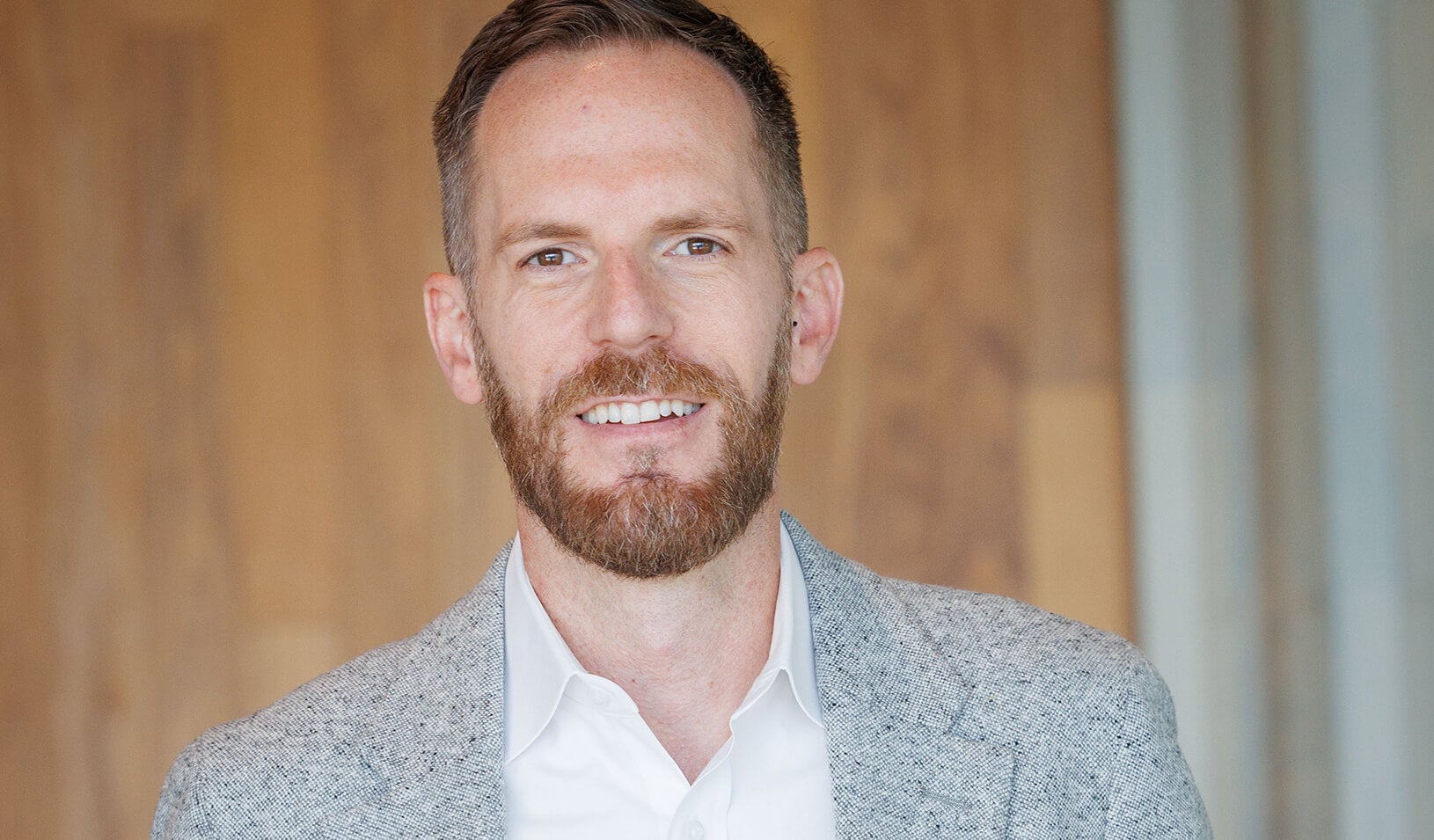
Nini Hamrick, MBA ’20, initially wasn’t one of the roughly 70% of incoming Stanford GSB students who profess an interest in entrepreneurship. But entrepreneurial inspiration struck early in the program for Hamrick, a former counterterrorism analyst in the U.S. intelligence community.
During MBA orientation, she connected with fellow student Brett Granberg, a former investor at a firm that supports intelligence technology. Separately, both had witnessed the need for software innovation within the U.S. Department of Defense. Together, they decided to launch a company to address that gap. With a plan for her new company in mind, Hamrick shifted her MBA course load to focus on entrepreneurship — selecting from the school’s roughly 50 class offerings on the topic — and joined StartX, the Stanford-affiliated accelerator.

Nini Hamrick, MBA ’20
In 2019, while still enrolled at Stanford GSB, Hamrick co-launched Vannevar Labs, officially joining the 38% of GSB alumni from the past three decades who have founded their own company. Already, Vannevar Labs has scaled to $80 million in annual revenue and achieved unicorn status, with the founders’ sights now set on taking the company public.
A new report, published by Stanford GSB’s Center for Entrepreneurial Studies (CES), sheds fresh light on the substantial group of Stanford GSB entrepreneurs — which now includes Hamrick. Drawing on LinkedIn and PitchBook data, the GSB Alumni Entrepreneurs 2025 Report examines the MBA and MSx classes of 1997 to 2021 and offers the most detailed look yet at Stanford GSB founders and the companies they build.
Mapping the GSB Entrepreneurial Landscape
Stefanos Zenios, the Investment Group of Santa Barbara Professor of Entrepreneurship and Professor of Operations, Information & Technology, says he often fields questions from students such as: How many Stanford GSB alums have launched companies? How many of those are successful? How well do alums fundraise compared to their peers? Zenios admits he, too, has nursed a similar curiosity over the years.
“This report is an attempt to fill that gap,” Zenios says.
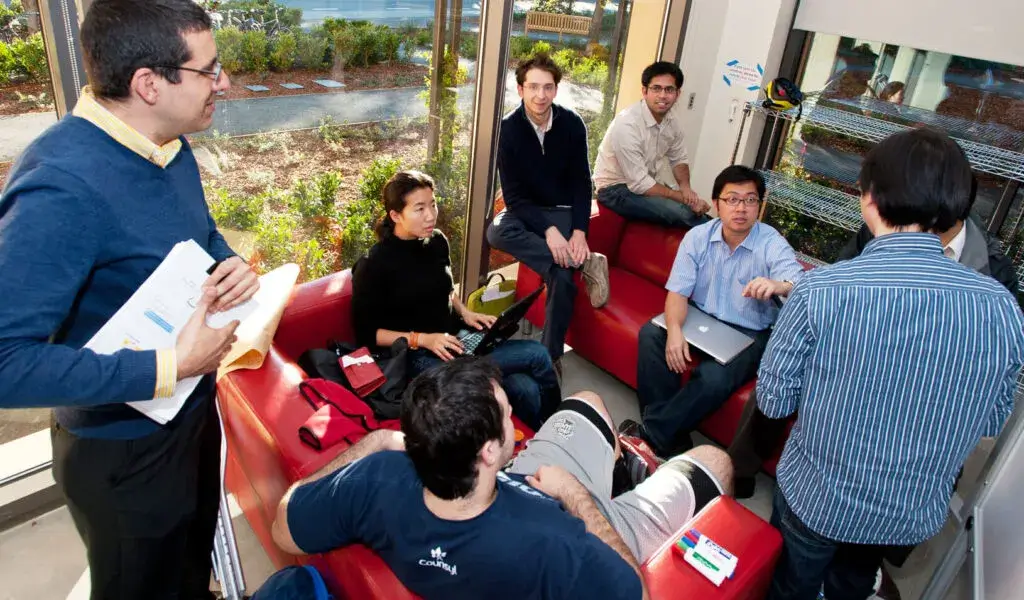
The hands-on Startup Garage class is considered to be Stanford GSB’s flagship entrepreneurship course. | GSB Archive
The report reveals that Stanford GSB alumni collectively launch about 350 new companies each year. Beyond the 38% who have founded a company, one-third are serial entrepreneurs, meaning they have started at least two ventures. Industry concentration of founded companies has remained consistent over time, with roughly 70% of GSB-founded companies clustered in five sectors: finance and investment, technology, consumer, professional services, and healthcare.
The data debunks the myth that founders must launch while still enrolled at Stanford, or as soon as possible thereafter. In fact, 52% of MBA-founded companies are launched three or more years after graduation.
“We often hear students saying they feel this sense of urgency to start a company — and they fear that if they wait, it’ll be too late,” says Deb Whitman, director of CES. “The data says that’s not the case. More than half of our founders launch later.” That said, she adds, the data does indicate a small shift toward earlier starts among more recent graduates.
Beyond the patterns it unearths, the report’s timing carries weight, too. CES — founded in 1996 by Charles A. Holloway, the Kleiner Perkins Caufield & Byers Professor of Management, Emeritus, and H. Irving Grousbeck, the MBA Class of 1980 Adjunct Professor of Management — turns 30 in 2026. From the beginning, the center’s mission has been to bring academic rigor to the study and practice of entrepreneurship.
As Grousbeck said when CES launched, “We’re demystifying the old stereotype of the entrepreneur as a circus barker. We’re saying that this is a career track that lends itself to rational analysis.”
Inside the Stanford GSB Flywheel of Entrepreneurial Learning
Jorge Heraud, MS ’11, says that the school’s approach to teaching the art and science of entrepreneurship helped him turn a hazy idea into a high-impact company.
Heraud earned his master’s in engineering at Stanford in 1996. During his time in that program, he took one class at the business school — a management course that he says helped him in the next stage of his career, at Trimble Navigation, a technology firm that was developing GPS technology.
“For a while, my career was technical,” Heraud says. “But as I was getting more and more involved in the business side of things, I felt I wanted more education in that area.” He ultimately chose to attend Stanford GSB in part because of its strong focus on entrepreneurship.

Jorge Heraud, MS ’11
While at the business school, he came up with the idea for his future company in one of his courses, Lean Launchpad. That idea would eventually become Blue River Technology, which he co-founded with Lee Redden, a Stanford PhD student in robotics. Blue River, which launched in 2011, sold a computer-vision platform that could automatically identify and thin lettuce plants to increase crop yields while reducing pesticide use. Less than two years later, Heraud sold the company to John Deere for $305 million.
Now, Heraud is launching his next venture, TerraBlaster, which will help farmers minimize fertilizer waste and environmental runoff — making him one of the 33% of GSB alumni who become serial entrepreneurs.
Heraud credits Stanford GSB’s entrepreneurial curriculum for shaping how he thinks.
“Coming into Lean Launchpad, I had a nebulous idea that I wanted to do something in the area of automation and agriculture,” Heraud says. “I couldn’t have created the company without the framework and investigation that the class encouraged from us, and the methodology we followed.”

That methodology is the cornerstone of Stanford’s approach, says Zenios. “We have two years to help our students develop an entrepreneurial mindset; that means identifying problems and transforming them into opportunities,” he says. “Entrepreneurs behave a little like scientists: They observe, form hypotheses, test, and iterate.”
The school’s flagship entrepreneurship course, Startup Garage, exemplifies this philosophy. Structured and designed by Zenios with the assistance of many collaborators, the two-quarter course gives students a rigorous framework for discovering and testing opportunities. “The goal isn’t necessarily to launch a company,” Zenios says. “It’s to master a repeatable methodology you can apply any time you face a challenge that needs a solution.”
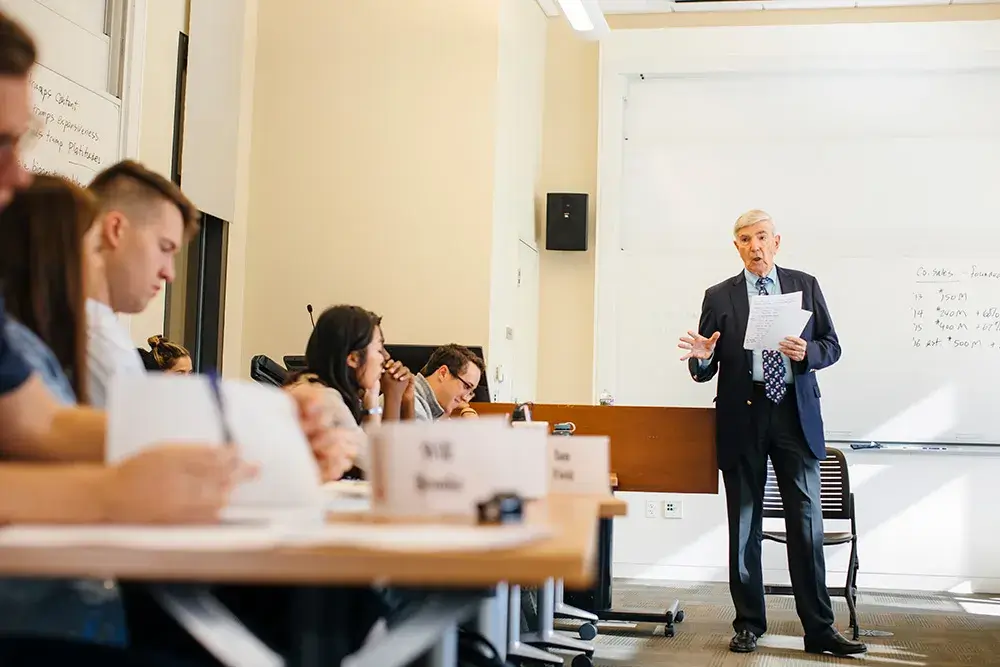
Professors H. Irving Grousbeck (shown here) and Charles A. Holloway founded the Center for Entrepreneurial Studies (CES) at Stanford GSB in 1996. | Elena Zhukova
The class has already seeded major successes: DoorDash, Zum, and Gold Leaf Farming all began in Startup Garage. Collectively, course alumni have secured over $3 billion in venture funding.
Complementary course offerings — like Formation of New Ventures, Managing Growing Enterprises, and dozens more — extend that education from strategy to interpersonal leadership.
“Most of the courses were co-developed by tenure-line faculty and practitioner lecturers, which is a powerful combination,” Zenios says. “It brings together research-based frameworks and the lived experience of founders and investors.”

Outside the classroom, Stanford GSB sustains a dense network of experiential programs. The Entrepreneurial Summer Internship Program places students in early-stage startups, giving those from corporate or consulting backgrounds a trial run in the scrappy startup world. Two newer offerings — the Botha Chan Innovation Program and the EcoSprint Program — allow students to spend eight weeks testing new venture ideas, with the latter focused on climate and sustainability challenges.
Whitman calls the alumni engagement that powers these programs the school’s “flywheel.” Over a hundred alumni return to Stanford GSB classrooms each year as mentors, case protagonists, lecturers, or judges in various classes.
“This is one key way in which entrepreneurial enrichment happens within the GSB,” Whitman says.
By the Numbers: Funding and Staying Power
The new report also takes a first look at how Stanford GSB-founded companies perform in the venture landscape. Of the 1,390 alumni businesses examined that are both scalable and non-investment enterprises, 35% completed a venture capital round between 1995 and 2023, collectively raising more than $162 billion.
On average, those ventures raised larger first-round investments than their non-Stanford GSB peers, advanced through later-stage funding rounds at higher rates, and were acquired more often while failing less often.
What might explain these differences between Stanford GSB founders and their counterparts? Zenios points to several possible factors. A “selection effect” explanation would attribute company success to the high caliber of students admitted by Stanford GSB. A “treatment effect” explanation would suggest that the program’s educational and networking offerings help the school’s future founders to outperform.
“I hope — and I believe — it’s a combination of both,” Zenios says. “We have a very competitive admission process, and we also excel at teaching our students about entrepreneurship.”
For media inquiries, visit the Newsroom.