Quote
One of the things I’ve learned throughout my entrepreneurial journey is that you need some amount of irrational optimism.
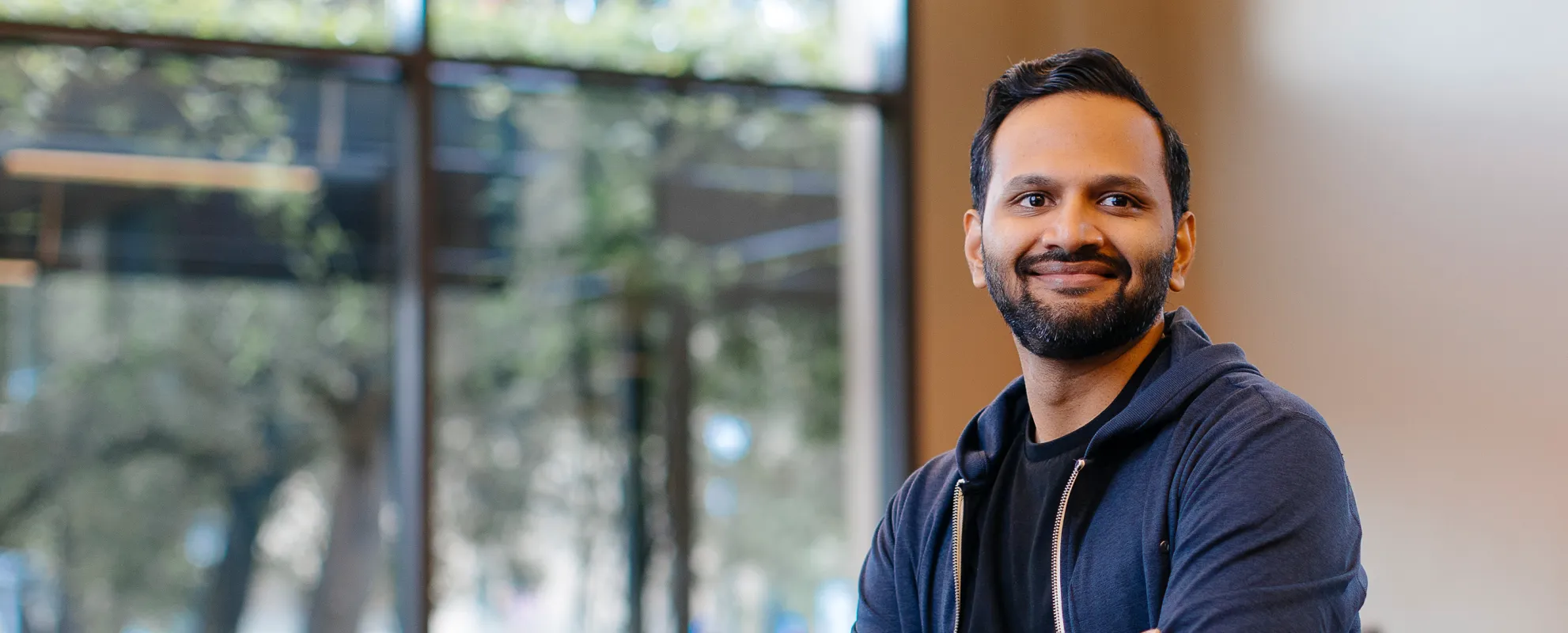
When Shekhar Bhende was 15, his parents encouraged him to apply to an international boarding school in his native India where he attended classes with students from more than 60 countries. “It was a phenomenal experience,” says Bhende.
He came to the United States to do his undergraduate work at Northwestern. With a classmate, he co-founded LYNK, a tech-driven retail distribution platform in India. “At Northwestern, I was surrounded by super smart and very ambitious people. That’s where I got the confidence to dream big.”
After selling the company to a much larger enterprise, Bhende considered his options. “I wanted to replicate that experience to bring out the best in me.” He returned to the U.S. with his wife, an attorney, and their young son to enroll in the Stanford MSx Program.
I was working at Deloitte in Chicago but was back in India for a wedding, staying with my parents in Pune. They were renovating our house, and asked me to move some old beds to my grandmother’s house. I didn’t know how to find a truck. My mother told me to go out in the street and find one that was available. So, I walked down the street, found a truck driver, and negotiated the move.
I was inspired by the ease of using Uber, and the challenge of finding a moving truck. Why doesn’t something like Uber exist in goods transportation? That was the genesis of the idea. I went back to the U.S. and discussed it with a close friend from Northwestern, and those discussions evolved into us going back to India and starting LYNK.
We share the same values. We believe in being fair and ethical. We don’t take shortcuts, and we’re both ambitious. When other people were thinking about how to get their next job, we were thinking about how we could transform India and make an impact. Entrepreneurship is full of ups and downs. Through the entire decade we worked together, we both had moments when our ambition wavered, but we pulled each other up. That helped build resilience for both of us.
We thought we had this genius idea, but there were other startups with the same idea. That was the first time that reality struck us as young entrepreneurs. It helps to be naive in entrepreneurship sometimes. We decided to just be the best and win.
Many competitors gave up because the space is tough, and 12 months later there were just two of us left. When we started out, we didn’t even have an app. We actually just had customers call us, and we would in turn call truck drivers. We only later transitioned to an app. One of the other challenges was that most truck drivers didn’t have smartphones in 2015. So the company had to first buy 300 or 400 smartphones and lease them to these drivers and deduct it from their payments. Uber didn’t have that problem. So we were asking, are we too early? How are we going to scale? But by 2016, everybody had smartphones. That’s how quickly things were changing.
Because of the lockdown, the only things moving were consumer products and groceries. So we started reaching out to many of these companies and started using our fleet of truckers to help them get their products to retailers. We realized that the problem some of these companies had was not just because of Covid, but was actually something that had been brewing for the last couple of decades. The distribution partners they had been relying on all that time had started to churn. We saw that as an opportunity to leverage our expertise and build a tech-driven operating system that any consumer company could use to get their products on store shelves. We were going from a services business to an inventory-led business, which is a huge change in every way.
Return the remaining money to investors, or sell the company and walk away. Somehow neither of those options agreed with us. We really believed in the team we had built. We believed in our ability to build technology. We had great investors who believed in us. It would be a disservice to just give up. We had the resilience to see if there were any adjacent opportunities to make this work.
The road wasn’t smooth. Eventually we became one of the fastest growing B2B commerce companies in India. From 2020 to 2022, we went from serving zero stores to serving 110,000 retail stores across the top cities in India. We also invested the least amount of capital to get there compared to other B2B models in the country. That eventually led to the acquisition by Swiggy.
We weren’t coming from a position of strength or success. We were coming from a position of self-doubt. Was it the market? Did we not execute? We were about to take our team and investors into an industry which we had zero idea about. We just said, hey, we’ll make it work. Every part of that decision was irrational. But honestly, one of the things I’ve learned throughout my entrepreneurial journey is that you need some amount of irrational optimism.
One of the things we really loved about Swiggy is that we were fanboys as consumers well before this partnership happened. We loved the business, product, and amazing user experience. They also had the scale, size, and resources to change big categories in India. Swiggy had transformed multiple big categories, including food delivery and groceries, so it was tackling large problems and using technology to redefine them. Lastly, we just really enjoyed our interactions with the Swiggy leadership and management. There was a lot of alignment of values, which was important to us.
When I told people I was applying to the MSx Program, they were surprised because I had built a business over 10 years and had exited as an entrepreneur. But because I became an entrepreneur at age 23, I often was put in extremely difficult situations and had to figure out how to react. When I took a step back after 10 years, I wanted to see if there were better frameworks for the next time I built a company. The second thing I wanted to learn was how to be a better leader. I’d discovered that self-awareness is a prerequisite for being a great leader. Often we don’t get an opportunity to step back and recognize our weaknesses and strengths. I knew that understanding myself better would make me a better leader.
We think about learning as what you know coming out of education. We don’t think about how it makes us feel. When I come out of certain classes or meetings with professors at the GSB, I feel far more ambitious and optimistic. That’s a substantial value-add at Stanford GSB because if you come into Stanford with “x” level of ambition, I can guarantee that you will leave Stanford with 3x ambition. You can’t put a value on that.
As strange as it sounds, accounting was one of my favorite classes. I’ve always known that it’s the subject where I have the least expertise, so the opportunity for learning was exponential. Thanks to my professor, it’s now a subject that I’ve come to really appreciate when it comes to running a business.
Photos by Elena Zhukova