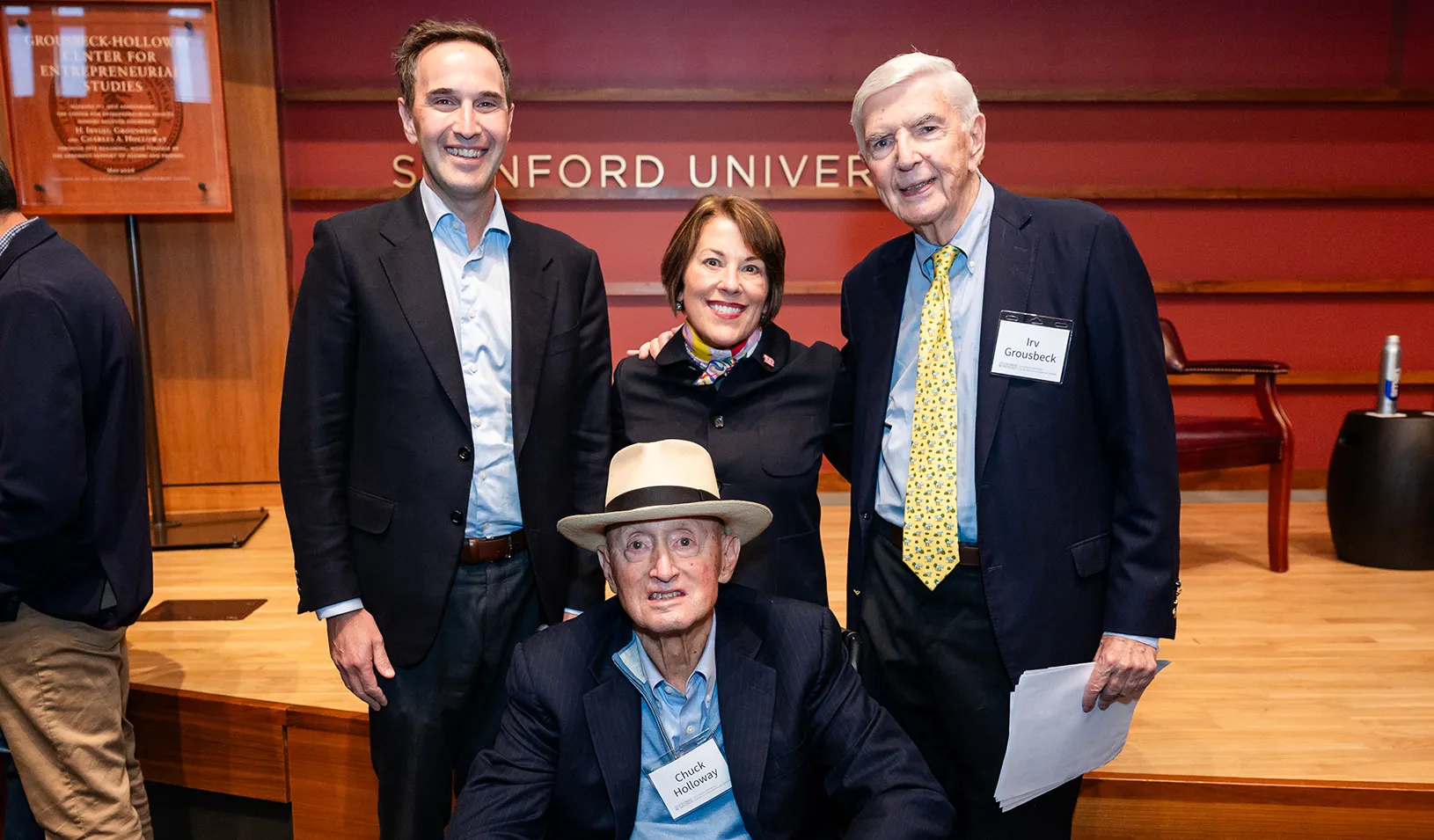
On May 13, Stanford Graduate School of Business’s hub for entrepreneurship became the Grousbeck-Holloway Center for Entrepreneurial Studies (GHCES). The new name honors the center’s visionary founders, H. Irving Grousbeck, the MBA Class of 1980 Adjunct Professor of Management, Emeritus, and Charles A. Holloway, the Kleiner Perkins Caufield & Byers Professor of Management, Emeritus, who have each taught and mentored generations of students since the center first opened its doors in 1996.
More than 100 alumni and friends came together to raise the funds to not only name GHCES, but support its core teaching and research mission, in a tribute that reflects their commitment to its growth and evolution. “They did it because they believe in what the center is doing and because they want to make sure that it will continue to do it,” said Sarah A. Soule, the Philip H. Knight Professor and Dean of the Stanford Graduate School of Business and the Morgridge Professor of Organizational Behavior.
‘One of the Most Entrepreneurial Places on the Planet’
The new name was formally announced at a memorable celebration. Champagne, crab cakes, speeches, and a sublime Palo Alto afternoon greeted a full house, as hundreds of guests gathered to celebrate the center’s thirtieth anniversary and the legacy of two of Stanford GSB’s great teachers.
“It is terrific to see so many founders, investors, and faculty with us today to demonstrate what thirty years of hard work looks like,” Soule said.
Not so long ago, Stanford GSB offered exactly three courses in entrepreneurship. “Irv has used the word ‘desert’ to describe the situation,” Soule joked. The business school now offers more than 50 courses in entrepreneurship and innovation, and supports research on startups and venture investing. Led by Stefanos Zenios, the Investment Group of Santa Barbara Professor of Entrepreneurship and Professor of Operations, Information & Technology, and Deborah Whitman, MBA ’86, the GHCES has influenced thousands of Stanford GSB alumni who have founded companies, contributing to a broader Stanford entrepreneurial ecosystem valued — according to Stanford University President Jonathan Levin’s estimate — in the tens of trillions of dollars.
“Stanford is, I think, by any metric, one of the most entrepreneurial places on the planet,” Levin said. “The GSB has played an incredible role in that culture of entrepreneurship, in the education of entrepreneurs, and the arc of its growth is really central to the GSB’s ascent to be the leading business school in the world. But it wasn’t really until the 1990s, when Dean Mike Spence asked Irv, who was already an iconic teacher of entrepreneurship, and Chuck Holloway, one of the faculty leaders of the school, if they would work together to figure out how to deepen the GSB’s investment in entrepreneurship.”
Grousbeck and Holloway “got a couple of things just really, really right,” Levin continued. Pairing research faculty with practitioners, and in doing so, marrying academic thinking about management, business, strategy, operations, and organizations with the insights of those who have lived it, for one. But the two also set up CES to teach general management using small entrepreneurial companies as a classroom — because in a small organization, you can see all of the moving parts of a business more clearly than in a large enterprise. “I’ve never gotten over what a brilliant insight that was,” Levin said.
‘Maybe We Can Touch Their Souls’
Soule officially announced the institution’s new name. “Every student who walks through this center from this day forward will know whose shoulders it is that they are standing on,” she said, as the crowd rose for a standing ovation.
“One of the most fulfilling aspects of starting and growing CES has been seeing the remarkable impact our students and their companies have had in the world,” said Holloway, surrounded by family, colleagues, friends, and well-wishers. “It’s wonderful to be here today.”
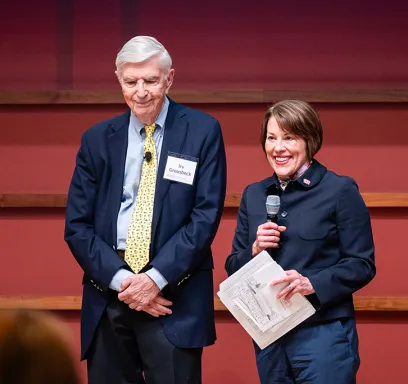
“Every student who walks through this center from this day forward will know whose shoulders it is that they are standing on,” said Dean Soule of H. Irving Grousbeck (at left) and Charles A. Holloway, for whom the center is now named.
Grousbeck took the stage, beginning his speech with a heartfelt tribute to his longtime collaborator. “Chuck, this is my opportunity to express what a privilege it was for me to partner with you for over 20 years. You’ve made so many contributions to the GSB and to the broader Stanford community over many decades,” he said. “We were able to get some things done and maybe have a little fun along the way.”
The remarks that followed were a meditation on Grousbeck’s growth as an educator and the nature of teaching itself, and included references to philosopher Immanuel Kant, poet Maya Angelou, and psychiatrist Carl Jung.
“While we strive to touch the intellects, and perhaps the emotions, of our students, as they invite us into their lives for only a fleeting moment, maybe we can help them discover their own paths to winning from the high road, to leading lives that are rewarding and even remarkable,” Grousbeck reflected. “In so doing, just maybe, we can touch their souls.”
An Innovative Spirit
Four alumni entrepreneurs followed Grousbeck, sharing their stories, and the stories of the companies they’d built, in a series of flash talks. Jennifer Xia Spradling, MBA ’18, and Patrick Schmitt, MBA ’18, co-CEOs of FreeWill, described building the world’s largest estate planning platform, which has generated close to $15 billion in charitable commitments to date. William Ross, MBA ’21, co-founder and CEO of Federato, sketched the inefficient underwriting process at the heart of the property and casualty insurance industry — and his company’s efforts to upend it using AI. Theresa Yu, MBA ’25, founding strategy and operations lead at ReadyOn AI, spoke about her company’s challenges and opportunities of using AI to match labor supply with enterprise demand for large enterprises managing frontline workforces. Lastly, Joseph Kao, MS ’24, co-founder and CEO of Magnefy, explained how his company’s technology could prevent power outages and maximize grid efficiency and resiliency as the nation’s aging energy infrastructure faces heightening demand.
These stories point to the diversity and innovative spirit of Stanford GSB-founded companies, noted Zenios and Whitman. “How many of you who are here today are GSB alums who have founded a company?” Zenios asked. A majority of hands shot up. “Okay, there’s a couple,” Whitman joked.
‘Thousands of Entrepreneurs’
At a lively reception, lecturers Jim Ellis, MBA ’93, and Kevin Taweel, MBA ’92 — both former students, later co-founders of Asurion, and today teachers of their mentors’ courses — offered a toast.
“ ‘Education is the kindling of a flame, not the filling of a vessel,’” Taweel said, quoting Socrates. “There’s no better place to see the fire come alive than at CES.”
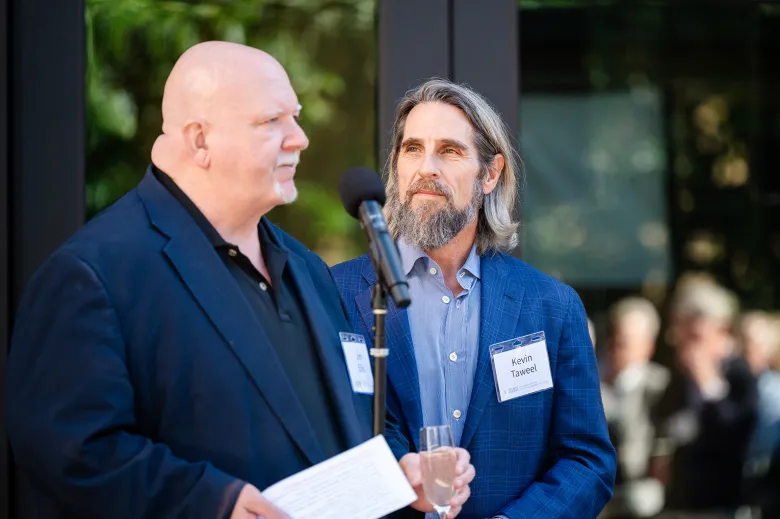
Stanford GSB alumni and lecturers Jim Ellis (at left) and Kevin Taweel toasted their former teachers.
“Chuck and Irv, you did far more than kindle a flame,” Ellis added. “You started a bonfire. And from this place, students will carry those embers into the world, igniting new ideas, new ventures, creating new opportunities and possibilities for generations to come.”
“ We can think of no greater example of people who’ve truly changed lives, changed organizations, and changed the world,” Taweel said. “Your legacy is not the center, although it does carry your names. Your legacy is here: the people here, thousands of entrepreneurs, leaders, teachers that you’ve shaped, and the countless lives that they, in turn, have impacted. We have not all started companies, but we are all your entrepreneurs. On behalf of those who’ve come before us, those who still benefit today, and for the generations to come, we thank you.”
Asked if he would have done anything differently, “I think I would have pushed the ‘more’ button,” Grousbeck said.
For media inquiries, visit the Newsroom.