To understand what artificial intelligence means for the future of frontline workers and their organizations, there is plenty to learn from history. Consider the invention of electricity. While electric motors first became available to replace steam driven ones in the 1880s, companies did not see major productivity gains until two decades later when factories were redesigned.
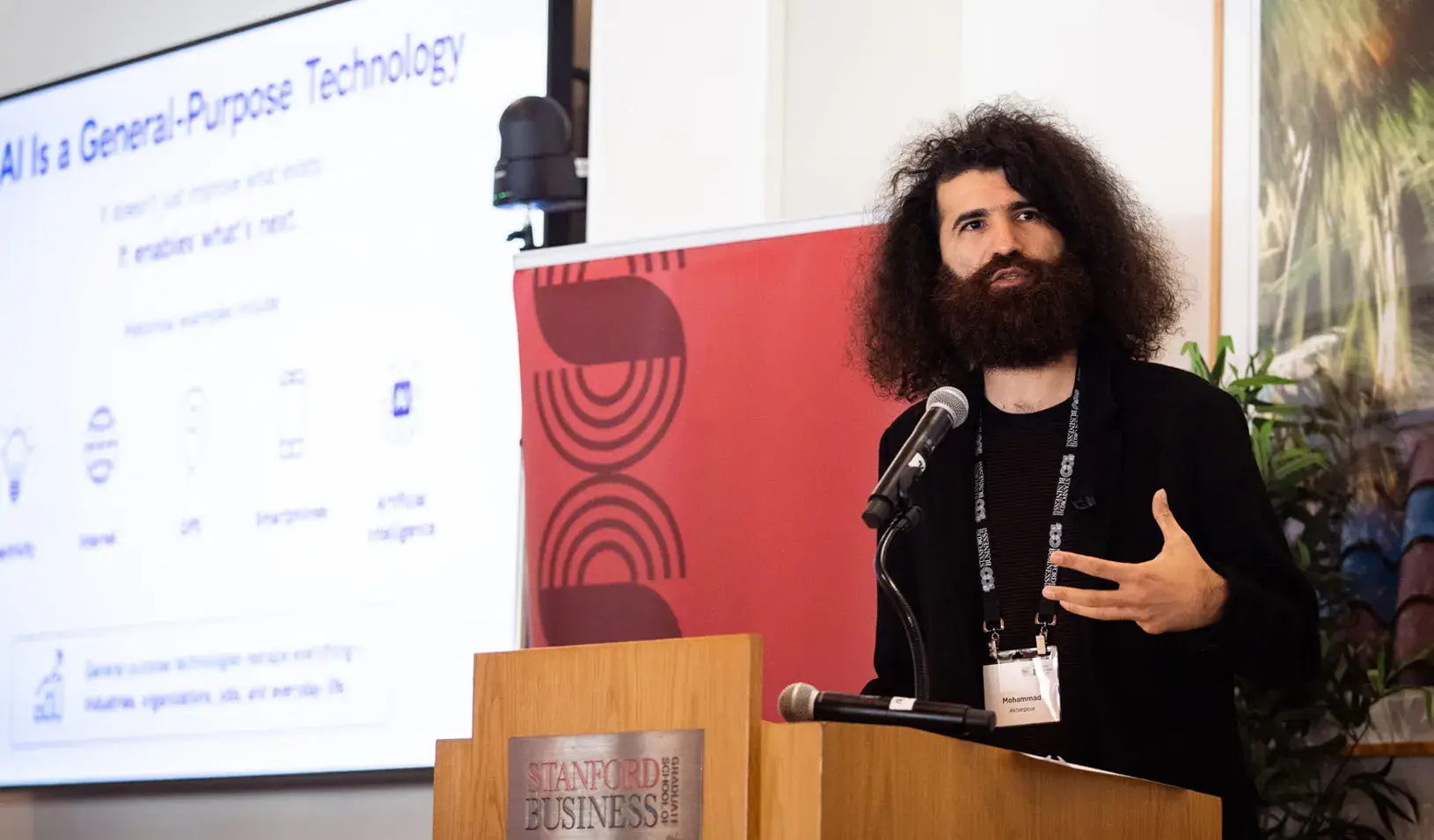
“The real value did not come from better engines. It came from redesigning the whole system,” Mohammad Akbarpour, The Walter and Elise Haas Professor and professor of economics at Stanford Graduate School of Business told a group of executives gathered on campus recently. “Technology changes faster than organizations.”
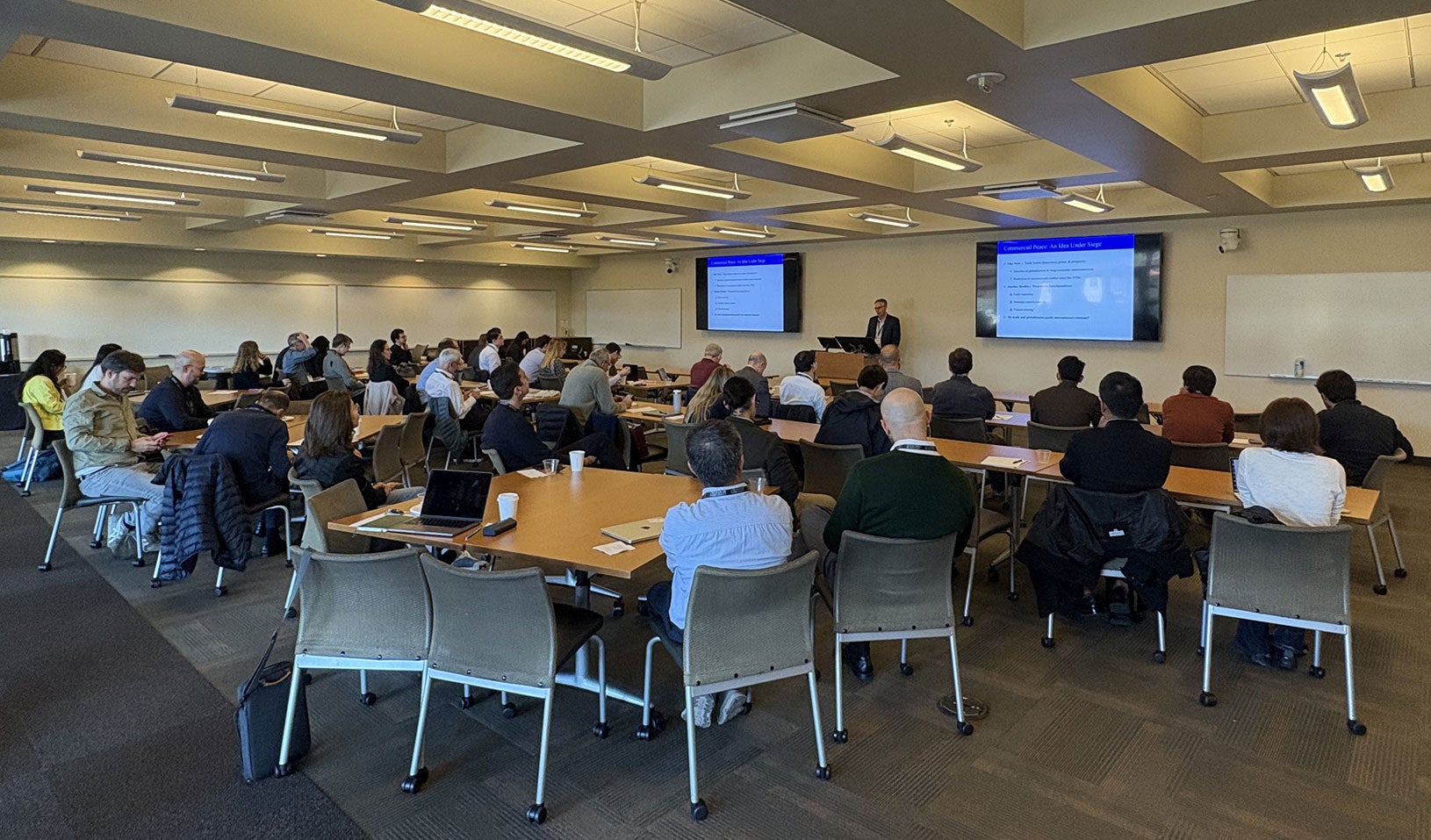
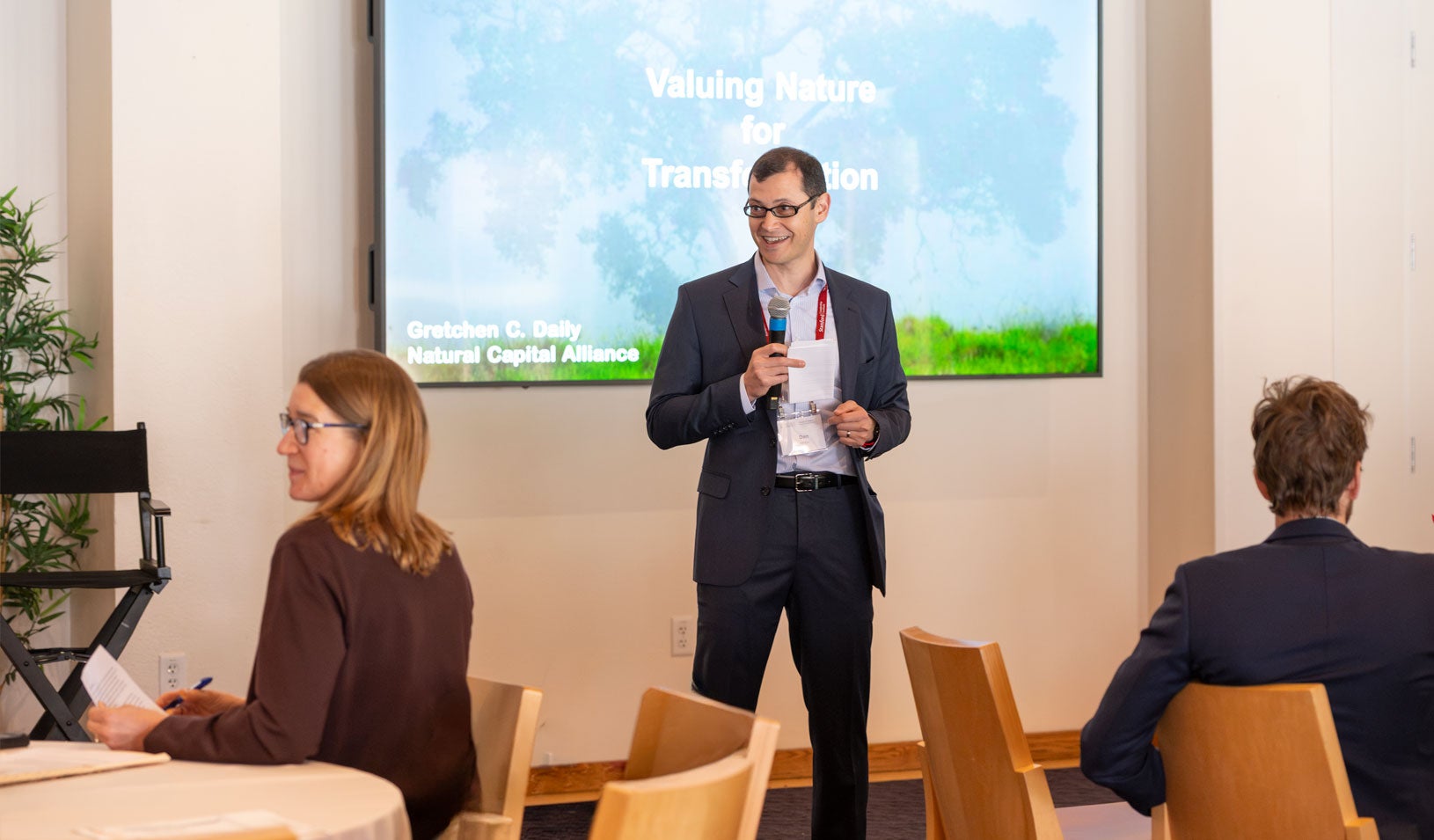
Adopting an AI strategy that considers the big picture of your organization was a key message from AI@Work: The Executive Forum for Frontline Workforce Innovation Akbarpour co-led with Susan Athey, economics of technology professor at Stanford GSB. Sponsored by the Stanford Leadership Institute, the executive forum featured Stanford faculty researching AI transformations, corporate leaders facing the realities of the AI revolution in their workplaces, and tech companies devising solutions for organizations seeking to capture the rapid advancements in AI capabilities.
Leading Through Disruption
Staying ahead of technological disruptions such as AI is in Stanford’s DNA.
“At Stanford GSB, we instill curiosity and an entrepreneurial mindset that stays with our graduates for life,” said Sarah Soule, Philip H. Knight Professor and Dean at the Stanford Graduate School of Business. “The true hallmarks of a GSB-trained leader are humility and the courage to learn from mistakes. These attributes are vital as our community experiments to unlock the full potential of AI. In a world increasingly driven by technology, strong technical skills are no longer enough. The most successful leaders will be those who match technical precision with deep humanity.”
Presenters discussed the practical barriers organizations face when deploying AI at scale, gave real world examples of how AI is improving both efficiency and effectiveness in their workplaces, and shared the nuances of training AI agents. They noted the importance of differentiating applications that completely automate tasks versus augmenting work, addressed fears that AI will make human labor obsolete, and suggested guard rails to manage the risks of this powerful technology.
AI Enables What Comes Next for All Industries
There is no doubt that the urgency of the AI revolution is reverberating in every company. “Ultimately, AI does not merely improve organizations, it will determine which organizations survive,” Akbarpour noted.
AI is a “General Purpose” technology that does not just change the moment, but enables what comes next, he said. Think electricity, the internet, GPS and smart phones. These types of innovations reshape everything: industries, organizations, everyday life and jobs.
However, that does not mean organizations and their employees are going away tomorrow. In her remarks Athey asked the group to imagine Stanford University disappearing in a year, or the government, or banks. “Is everyone going to lose jobs in 12 months or will it happen more slowly? The answer is not about how great the technology is. The pace of change is throttled by constraints, - organizational, regulatory, infrastructural,” she said. Everyone is experiencing the transition. “This is the world we are living in. Everything is adjusting,” said Athey, a former chief economist at Microsoft whose research focuses on the intersection of artificial intelligence and economics.
Still, that transition is not an even one.
Athey noted that most companies in the world are small businesses. Ninety percent of workers in low- and middle-income countries are in companies of 10 people or less. Half of them are one-person or one-family companies such as farmers or retailers. The owner-workers in these firms are not firing themselves, even as these one-person organizations can benefit from AI advances to make better decisions, get relevant information about weather or prices for supplies, or manage customer orders, she said. The profound changes brought on by AI require a macro point of view. In the longer term, some workers may shift out of small farming and retail, and the interesting question for these workers is where they will go. AI adoption has direct effects on some industries, but indirect effects on all industries through changes in the supply and demand for workers, goods and services. A slow pace of change is usually not too disruptive for a country, but the sudden loss of an export sector can create substantial problems.
Keeping Apace with an Eye on Strategy

“The beauty of AI is that it makes it easy to design applications to meet people where they are,” Athey said. AI-powered applications and services can interact with workers through voice or text, at a time of their convenience. It can provide them relevant opportunities and information, whether it is the opportunity to pick up a shift or to take a training course over their phone.
With companies being pressured to take full advantage of AI solutions quickly, and well-intentioned employees bringing their managers ideas and writing software to automate tasks, many organizations and their leaders are overloaded with information and proposals. They risk making rapid-fire changes that lack context within the entire organization. Athey highlighted the challenges organizations face in incorporating a large volume of vibe-coded applications while maintaining safety and security. Organizations need to set up new systems to adapt to the new environment of low-cost coding.
Examples from the Frontline
During the forum, senior leaders from the entertainment, hospitality and real estate industry shared case studies on ways they are using AI platforms at scale to reshape their frontline workforce in real time. Presenters cited successes in using AI to optimize scheduling, recruit workers even in challenging scenarios such as seasonal, part-time positions; and upscaling employees on the opportunities AI presents.

Disruptions such as AI are an inevitable part of running a company, Hamid Moghadam, founder and executive chairman of Prologis told the group in his discussion of Leading Through Disruption moderated by Dean Soule. “There are two ways to deal with change. One is trying to stop it. That never works. The other is to deal with it, ” he said. Sharing his lessons from building the world’s largest logistics real estate company, Moghadam gave the audience examples of ideas his company pursued that succeeded and those that did not.
Either outcome requires fortitude to thrive over time. “You have to have courage and belief in what you do and not worry about what happens in the next quarter’s earnings call,” he said. And, it means listening to those you are serving. “Pay attention to your customer and you will get it right.”
Working in a labor intensive business requires maximizing your workforce, and expanding the pool of potential workers, speaker Alison Birdwell, CEO of Aramark Sports + Entertainment said. Her company turned to AI and it ended up solving more than its hiring challenges. “What started as seeking ways to hire more people evolved into a holistic end to end solution,” she said. “We are using AI to make our people faster and our operations more efficient – with governance and support built in.”
The Human Factor
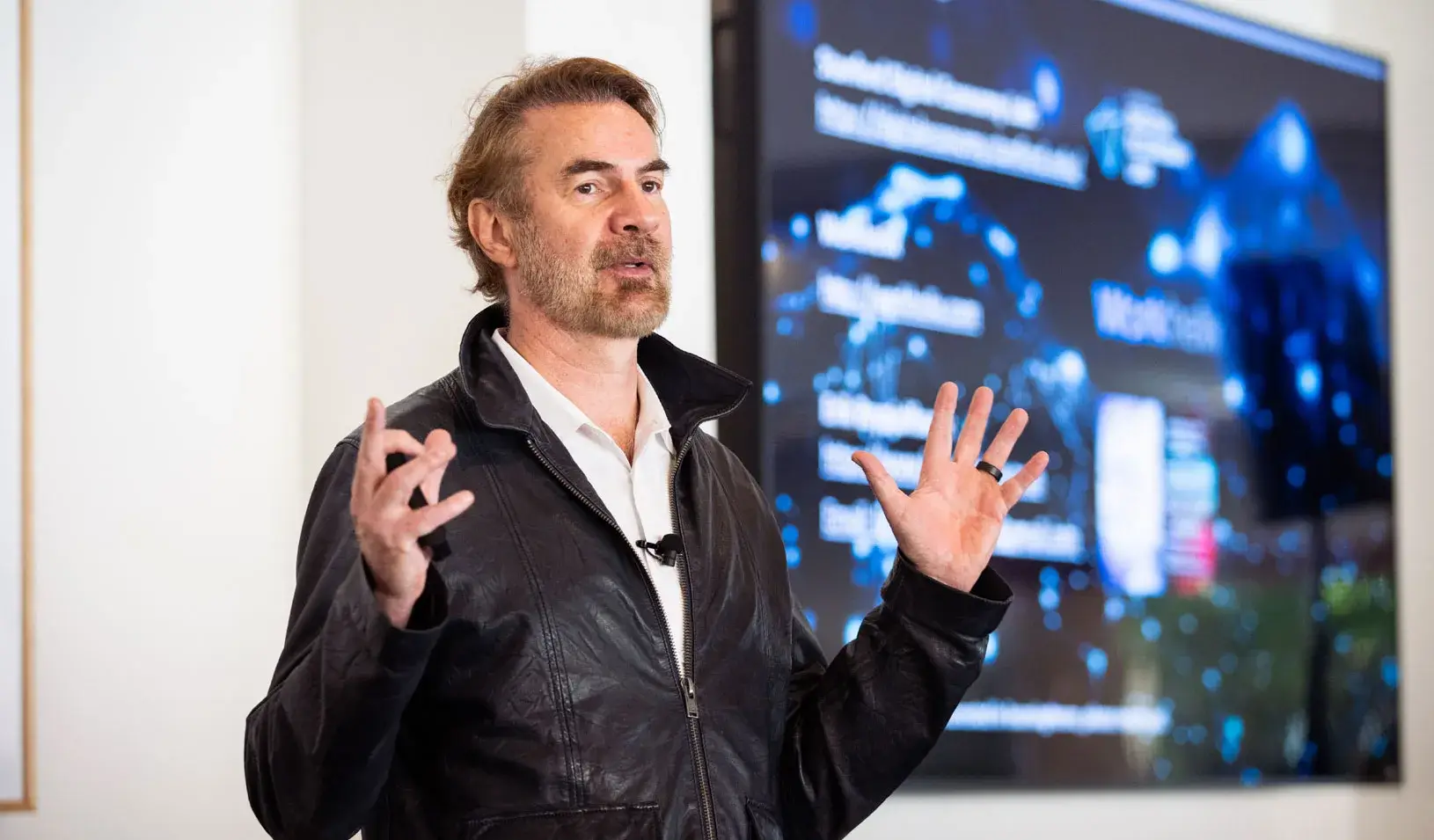
In his address, Stanford Professor Erik Brynjolfsson urged leaders to harness AI to create true innovation, not just automation.
“My mission is to change the way you think about AI.” Complete automation is not the right approach, he told the group. The researcher and author who examines the effects of information technologies on business strategy, productivity and performance sees many of the companies he visits falling into a common trap of focusing only on how to use AI to automate human tasks.
“I call it The Turing Trap and I want you to avoid this trap,” said Brynjolfsson, director of the Stanford Digital Economy Lab and a senior fellow at the Stanford Institute for Human-Centered AI, which recently released its annual AI Index Report.
Coined by Brynjolfsson, The Turing Trap refers to the dangers of aspiring to use AI solely to mimic human behavior. Alan Turing was an English mathematician and computer scientist who developed what became known as the Turing Test to evaluate the intelligence of machines and answer the question of whether machines could think. He introduced the test in a 1950 paper Computing Machinery and Intelligence. “The idea was if you could make a machine that imitated humans and can’t tell which is which, that would be the ultimate test of success,” Brynjolfsson said.
“The myths are becoming reality. Machines can do more and more of what humans do. We are experiencing this and it has profound implications for work,” Brynjolfsson said. But imitating humans should not be the ultimate goal, he said. Doing so would lead to tremendous concentration of wealth, and ultimately, a concentration of political power.
Nor is it the highest aspiration organizations should have. “Simply mimicking what humans are doing at a moment in time is not really that ambitious of a goal. What if Ford aspired to create a vehicle that could crawl, walk or run?” To create real innovation, he suggests focusing on what neither a human nor machine can do. “That’s where the real value is.”
Keeping People in the Mix
Brynjolfsson advocated directing AI development toward augmentation, not only automation that replaces work. “Both automation and augmentation can create value and there are going to be places where you want to do either one of them,” he said. “What I am saying is that automation is overemphasized in the companies I visit,” he said.
A year or two ago, CEOs were sending memos to employees imploring them to use more AI, but he said focusing on quantity was too simplistic. “The smart managers are saying here are some opportunities of what you can use AI for.”
He noted the advantages of keeping people in the mix instead of turning complete agency over to AI. While AI is good at execution, humans are still better at defining the right questions and evaluating the tasks AI performs. “I try to be cute. I call it the chief question officer,” said Brynjolfsson, who helps companies set benchmarks around augmentation and automation.
Today, benchmarks and guardrails matter more than ever. “Our decisions are much more consequential now because our tools are much more powerful so our values matter so much more,” Brynjolfsson said.