April 30, 2026
| by Dylan WalshIn Brief
- A new research tool finds room for significant carbon emissions reductions in the cement industry with relatively modest cost increases.
- If European carbon prices rise, cement producers could be incentivized to cut emissions by 96%, while production costs would rise about 12%.
- The methodology can be applied to iron, steel, and aluminum industries, which produce more than 20% of global carbon emissions from manufacturing.
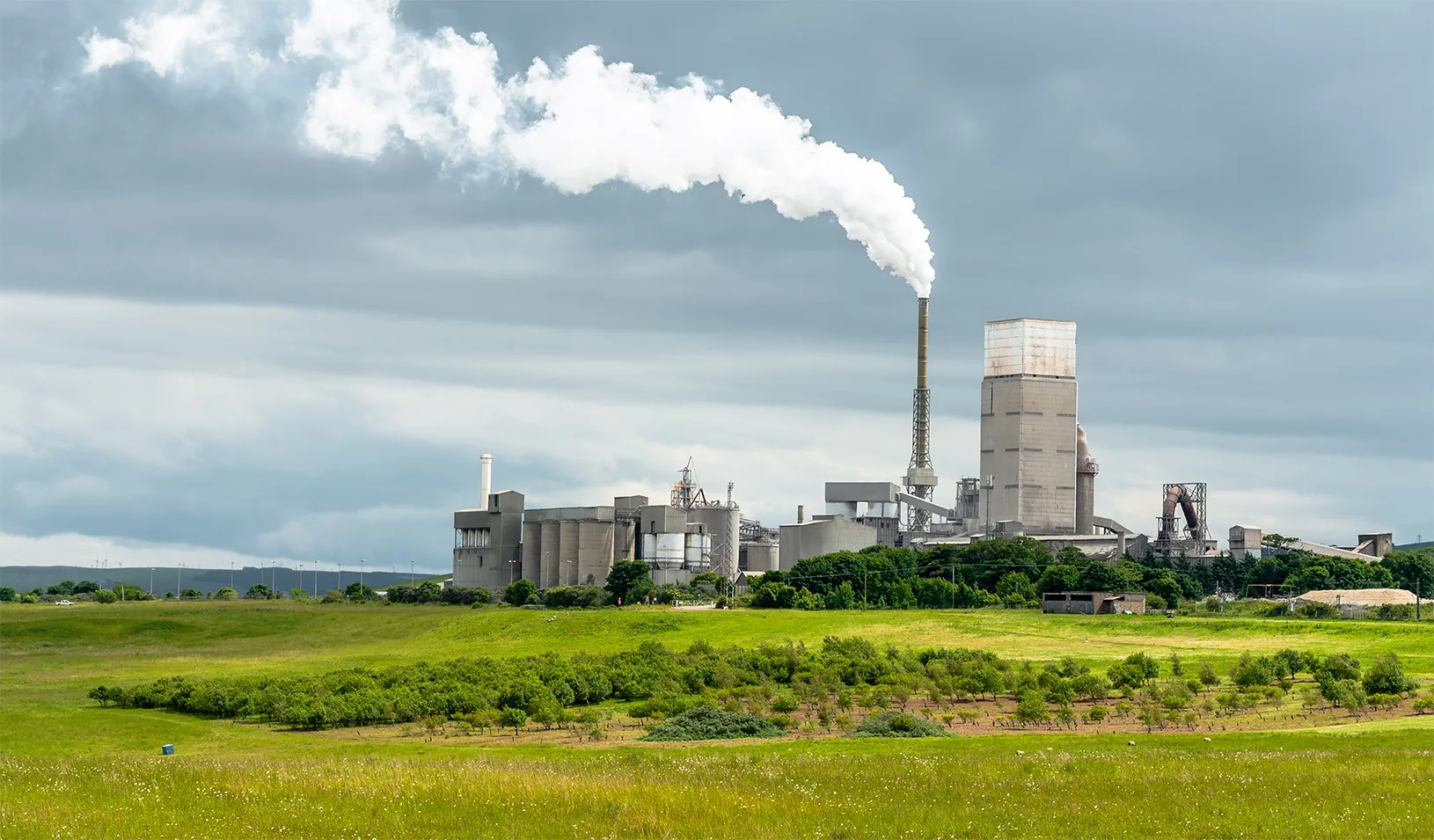
Besides water, cement is used more than any other material on Earth. Its manufacture begins by combining limestone with ingredients such as shale, clay, or sand. This mixture is ground into a powder, heated to 1,400 degrees Celsius, cooled, blended with additives, then further pulverized to become cement.
This is a carbon-intensive process, representing roughly 8% of all CO2 emissions worldwide. Yet reducing these emissions at a reasonable cost has long appeared out of reach.
The standard tool for estimating these costs is the marginal abatement cost curve, explains Stefan Reichelstein, a professor emeritus of accounting at Stanford Graduate School of Business and a senior fellow at the Stanford Institute for Economic Policy Research. This method, popularized by McKinsey & Company, visualizes how different levels of investment convert to emissions reductions. “This basically says, look, you have different levers to choose from when reducing emissions,” Reichelstein says. “Let’s look at the costs associated with each one and then put them in order, starting with the lowest cost, the low-hanging fruit, all the way to the highest cost.”
But this approach offers an incomplete picture, Reichelstein explains, as the emissions-reduction tools and technologies plotted on a marginal abatement cost curve aren’t always implemented independently. They also interact with each other — the combination of two measures may improve or reduce their overall efficiency. “The abatement impact of a particular measure depends on what else you’re doing. You need to look at these jointly.” The return on investment from carbon capture technologies, for instance, is contingent on the efficiency of a cement kiln and the relative emissions profiles of the ingredients being cooked in the kiln.
In a paper forthcoming in The Accounting Review, Reichelstein and University of Mannheim colleagues Gunther Glenk and Rebecca Meier compute the interactive effects of technological upgrades in the cement sector. They find room for significant emissions reductions at relatively low prices. Their analysis also demonstrates a more nuanced approach to measuring the abatement costs for other heavy industries with massive carbon footprints.
Ahead of the Curve
Reichelstein and his coauthors apply their methodology to the European cement industry, home to the world’s largest market exchange for emissions permits. The European Emissions Trading System requires industrial producers to purchase permits for each ton of CO2 they emit.
In 2023, those permits traded at roughly €85 per ton (around $92 at the time). At that price, the researchers found that cement producers could be incentivized to cut their annual carbon emissions by about one-third. They arrived at this result by considering nine core technologies for reducing emissions in concrete manufacturing. Of 512 possible combinations of these technologies, only 18 proved cost-efficient, and of those, only 9 were deployed at the contemporary carbon prices.
Looking next at a potential increase in carbon prices, the researchers found that deep decarbonization of cement manufacturing is achievable without catastrophic increases in consumer costs. If carbon prices on the European market rose to €141 per ton — not implausible — cement producers would be incentivized to cut their annual emissions by 96%. Yet such a drop in emissions would only raise the production cost of cement by about 12%. This finding stands in sharp contrast to previous research estimating that comprehensive decarbonization would double the cost of cement production.
“Our counterintuitive finding is that within a certain range of carbon prices you’re getting a lot of bang for your buck,” Reichelstein says. “You’re getting very significant reductions, and prices for cement, meanwhile, don’t go up that much.”
He and his coauthors also note a practical application of this approach for companies that have pledged to voluntarily reduce emissions. By more precisely calculating the incremental costs of various reduction levels, firms can determine exactly what price increase, or “green premium,” they would need to charge to recover those costs.
Cutting the Cost of Decarbonizing
This method holds broader promise beyond cement and concrete. The researchers designed their framework to be applicable to other manufacturing sectors, such as iron, steel, and aluminum. Collectively, these and other heavy industries are responsible for 20–30% of annual global carbon emissions; and, as with concrete, most of their emissions originate with the manufacturing processes themselves.
“In many industries, you find most of the abatement potential by moving away from fossil fuels like gas, oil, coal, and natural gas,” Reichelstein explains. “But when the emissions are so-called process emissions, as with CO2 released in the chemical reactions behind steelmaking or the cooking of cement, then to reduce those emissions you need to deploy the types of levers we’re considering here.”
The findings arrive at an important moment for climate policy. Concern that decarbonizing essential industries will impose unacceptable costs on consumers and economies has been a persistent argument against carbon pricing.
“Our research suggests that such worries may be significantly overstated, at least for cement, and potentially for other hard-to-abate industries,” Glenk explains. “The point to recognize is that firms can avoid paying higher carbon charges by investing in carbon abatement technologies, and for a substantial level of abatement, these investments can be made at a relatively moderate cost.”
For media inquiries, visit the Newsroom.