January 07, 2026
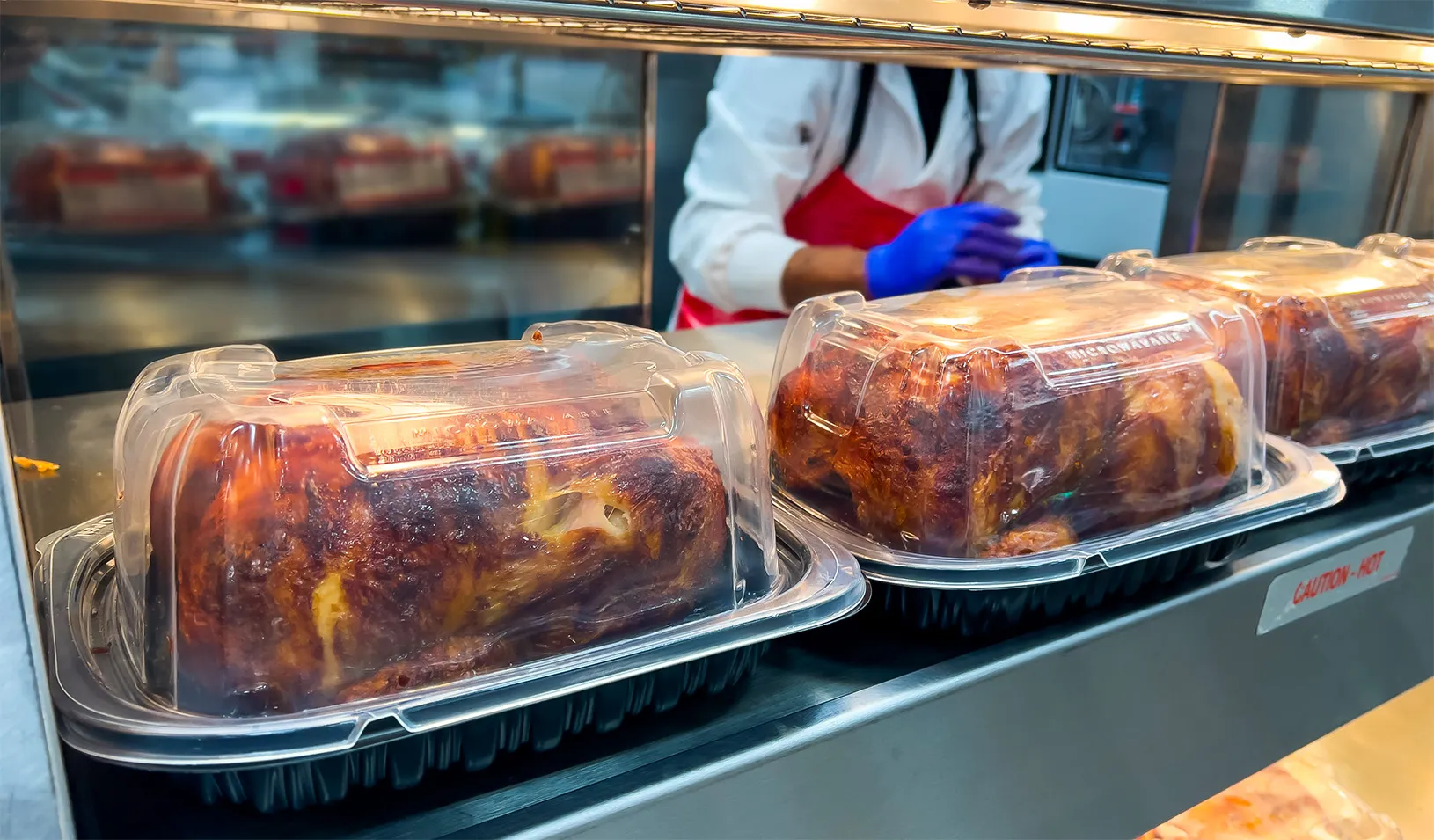
| by Lee SimmonsYou did it — you got the weekly grocery shopping done. As a reward, you grab a juicy, fresh-roasted chicken on the way to the checkout. You don’t have to cook dinner tonight!
For busy families, premade foods are a big draw in deciding where to shop, and retailers have responded with ever more options to entice customers. Safeway has its ready-to-eat section right up front so you pass it on the way in. Costco puts its famous $4.99 rotisserie chickens in back, hoping you’ll add things to your cart along the way to grab one.
In fact, premade foods are the fastest-growing category in the grocery business. But they are a devil to manage. Cooked food degrades quickly, and a lot of it goes to waste. One giant retailer — known for its efficiency — found that it was tossing out 9% of its prepared food.
So that retailer approached Dan Iancu and Erica Plambeck, professors of operations, information, and technology at Stanford Graduate School of Business, for advice. They teamed up with Jae-Hyuck Park, PhD ’21, an assistant professor of decision science and business analytics at the New Jersey Institute of Technology, to build a model that could answer the key questions facing retailers: Should the oldest items be sold first so they don’t go to waste? How long should fresh food stay on the shelf? And should customers be told when food was prepared?
The model, which incorporated more real-world decision levers than previous research, led to some surprising results. Grocers typically use a first-in, first-out (FIFO) inventory rule, meaning the oldest items are moved to the front of the shelf. It’s an article of faith that this minimizes waste, and it seems like common sense: Sell the oldest stock first and you won’t end up with a glut of unsalable packages.
But the team discovered that when it comes to premade foods, the opposite approach works best: A last-in, first-out (LIFO) rule — selling the freshest items first — combined with keeping products on the shelf longer increases sales and reduces waste. “It’s true that some portion on the back of the shelf may expire,” says Plambeck, a senior fellow at the Stanford Woods Institute for the Environment. “But LIFO increases the average quality of items sold. That leads to increased demand and, paradoxically, less gets thrown out.”
To Time-Stamp or Not?
Another counterintuitive finding: Iancu and Plambeck’s model showed that retailers can benefit by not time-stamping prepared food, even though shoppers like to see this information. “If you show when the food was prepared, everyone picks the freshest items on the shelf,” Plambeck explains. “If the latest batch came out an hour ago, customers turn up their noses at two-hour chickens, even if they’re nearly as good. That effectively shortens the shelf life and increases waste.”
Without time stamps, she says, consumers can’t distinguish between products on the shelf, so they base their buying decisions on the average quality of their purchases over time. “Sometimes you’ll get a dry bird and think, ‘That wasn’t worth the price.’ But most of your purchases were excellent, especially with LIFO issuance, so your expected value is high.”
That means stores can leave products on the shelf longer to increase sales and reduce waste. As long as the quality is high enough that shoppers’ expected value exceeds the price, they’ll buy even if they don’t know the preparation time.
Of course, stores still need to know when a product’s time is up. Instead of using obvious time stamps, they can use coding systems that are opaque to consumers. (For example: Those plastic tabs that seal bread bags — ever notice how they come in different colors? It’s not random; the color tells employees the age of each loaf.)
Time stamps aren’t necessarily bad for business. The model shows they can be beneficial when some customers care much more about freshness than others. In the real world, though, pretty much everyone likes fresher food.
The combination of LIFO issuance and longer shelf life is the real key here. “If you do one without the other, it doesn’t work,” Plambeck says. And that, she says, is why earlier research came to the wrong conclusion and supported the FIFO approach.
Last In, First Out, Less Waste
Stores lose money on discarded food. But Iancu and Plambeck say the cost of unsold food is much higher when you factor in wasted resources and environmental impacts such as greenhouse gas emissions from landfills. Plus, uneaten food could be diverted to help people facing hunger.
That’s why California has begun requiring supermarkets to donate unsold yet still edible food to food banks and other charities. But well-meaning policies can have confounding effects. In France, where a similar law has been in place since 2016, an audit found that the quality of donated food declined, as did the quantity donated per store.
Iancu and Plambeck’s model explains why. “Distributing unsold food is costly — it’s a whole extra set of logistics to manage — and that creates an incentive to draw out the sell-by date,” Plambeck says. “So by the time perishable items do arrive at food banks, they’re often in poor shape.” That food then gets tossed out, shifting the waste problem downstream.
Based on their model, Iancu and Plambeck believe that better management can make a big difference in reducing waste throughout the retail cycle.
Plambeck says the project has given her a real appreciation of what it takes to run a grocery store — all the logistics and moving parts and decisions behind the scenes. “We take it for granted, but it’s pretty cool. Next time you’re in a supermarket, stop and look around. It’s a complex operation, and the details really matter for the cost and quality of the food we eat — and for what we don’t eat.”
For media inquiries, visit the Newsroom.