March 19, 2026
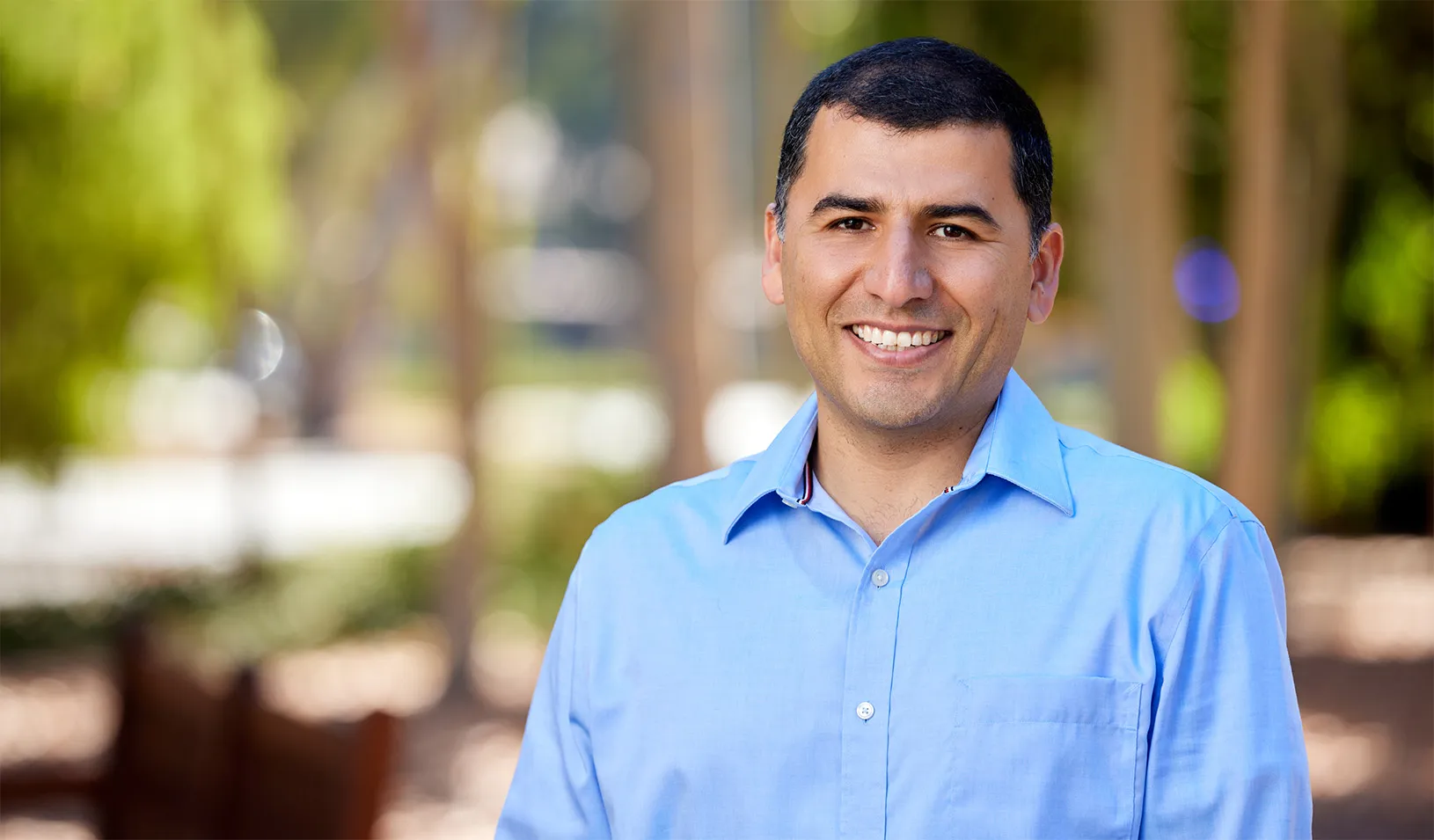
| by Stephanie BlendermanIn a world overflowing with information, having data isn’t the competitive advantage — knowing what to do with it is. “The ability to turn raw data into better decisions is a superpower,” says Mohsen Bayati, professor of operations, information & technology at Stanford Graduate School of Business.
In his course Business Intelligence from Big Data, Bayati teaches students how to harness data and new technologies to make smarter decisions. In this short video, he shares five principles for leading in an AI-driven world.
Full Transcript
Note: Transcripts are generated by machine and lightly edited by humans. They may contain errors.
Mohsen Bayati: Hi, my name is Mohsen Bayati and I’m a professor of operation information and technology at Stanford Graduate School of Business. In a world with a ton of information, the ability to turn raw data into better decisions is a superpower. Today, I will be sharing five key takeaways from my course, Business Intelligence from Big Data.
First, guide your decisions by data. Human intuition is powerful, but when it comes to assessing uncertainty, it’s sometimes pretty flawed. We naturally see patterns when there is no pattern or we overreact to noise. Let me give you an example. Consider a hospital VP in charge of quality of care, who sees a drop in infection rates and assumes a new protocol is working. But often it’s just a lucky streak. Random noise shows up as a trend. By grounding your decisions in diverse data rather than a single perspective or AI tool, you can tease out the true signal from the noise and manage uncertainty with better precision.
Second, invest in your technical capabilities by getting your hands dirty. The philosophy of this course is that the best way to learn is by doing. You can’t just read about AI and data science, you have to use the tools yourself. To truly lead, you need to understand the capabilities and limitations of these technologies. In this class, we dive into writing code using AI APIs, and it’s the beauty of these hands-on experiences that demystifies the technology for us, forcing you to understand it better and empowers you to build quick proof of concepts that can transform your business.
Third, formulate the right questions. We often rush to find answers, but the hardest part of using data for decisions is asking the right questions. A sophisticated AI agent or model is often useless if it solves the wrong problem. An important skill we work on in this course is to learn to translate a business challenge into a concrete model where you can identify the right AI-based method to solve it. Before using any technology, ask yourself, what exactly are we trying to solve and how will data and AI tell us if we have succeeded?
Fourth, augment technology with expert human judgment. We often see two extremes, those who avoid AI because it makes mistakes, and those who over rely on it. Both are suboptimal and the latter is even dangerous. These technologies often have blind spots, nuanced issues of bias that won’t go away easily. Your goal shouldn’t be cognitive offloading or letting the machine do all the thinking. Instead, use your expert judgment to verify the output, understand the limitations, and layer your reasoning on top of the technology.
Finally, lead through collaboration. Decision-making with data is a team sport. An individual contributor style of work that happens in a silo often has limited impact because it lacks business context. As a leader, your competitive advantage comes from bridging that gap. Cross-functional teamwork is key. By enabling deep collaboration between domain experts, AI scientists and engineers, you make sure the technical solutions are aligned with real business value. Don’t just consume the analysis, actively shape it. So what does this all add up? By guiding decisions with data, investing in your capabilities, and balancing AI power with human wisdom, you don’t just become a user of technology. You become a leader who can navigate uncertainty with more clarity. Implementing these principles will help you lead your teams effectively in a world that is becoming more AI-driven.
Teaching is beautiful because it helps you learn better. At the same time, sometimes I just get excited. I want to learn about a new technology and I want to share that with others. So it allows me to do both.
For media inquiries, visit the Newsroom.