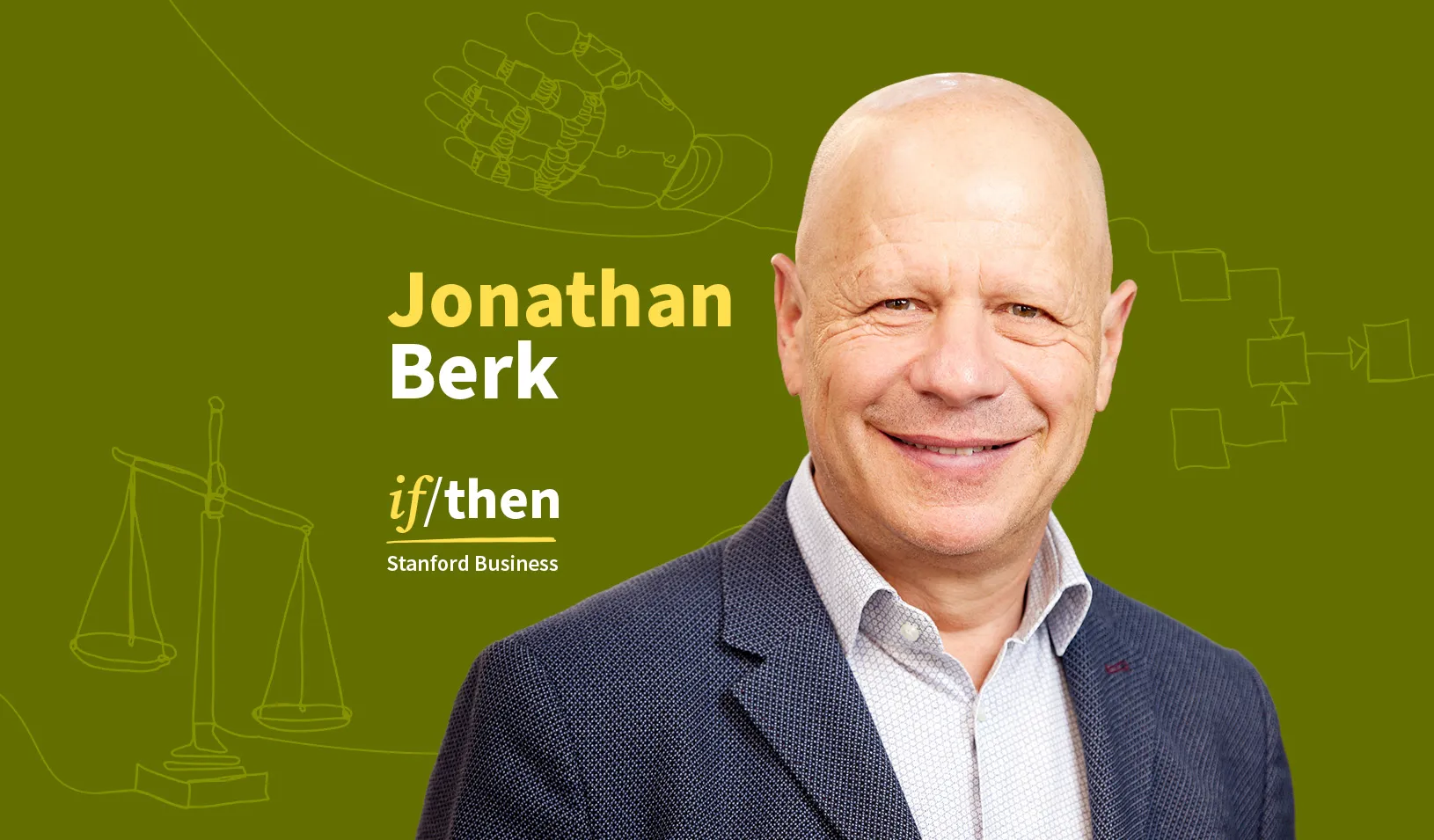
“I don’t see things like anybody else,” says Jonathan Berk, professor of finance at Stanford Graduate School of Business. “And so I can see things people don’t see.”
For example: In a recent paper, “Why Care About Debt-to-GDP?”, Berk argues that there is no solid economic justification for focusing on the debt-to-GDP ratio — a figure that causes consternation among policymakers, economists, and the financial press.
Essentially, Berk and coauthor Jules van Binsbergen are asking whether this handwringing is justified. “You can’t start making a fuss about a ratio with no real theoretical basis for that ratio,” he says on a new episode of the If/Then podcast.
In his research, Berk has also explored whether regulation is in consumers’ best interest. “When there’s money on the line, I think most people actually are quite capable of making good decisions,” he says. You may disagree, but: “That’s not enough: You have to show me that government can do better.”
Although questioning the status quo can make life more difficult, Berk says it “confers an enormous advantage.” He believes that organizations that harness the power of unconventional thinking gain a competitive edge.
“It’s allowed me to solve problems that other people couldn’t solve,” he says.

If/Then is a podcast from Stanford Graduate School of Business that examines research findings that can help us navigate the complex issues we face in business, leadership, and society. Each episode features an interview with a Stanford GSB faculty member.
Note: This transcript was generated by an automated system and has been lightly edited for clarity. It may contain errors or omissions.
Clip: The public is requested to remain as quiet as possible during the men’s high jump.
Kevin Cool: Have you ever heard of the Fosbury Flop? Unless you’re a high jumper, and even if you are a high jumper, you may not know the term.
Susan Brownell: I took up high jump in 1975, I guess, but I remember when I told people I did the high jump, they would say, “The Fosbury Flop?”
Kevin Cool: Susan Brownell is a former student athlete who represented the US internationally in the 1980s. Today, she’s a Professor of Anthropology and History at the University of Missouri St. Louis, where she specializes in international sports competitions.
Susan Brownell: Fosbury Flop is a way of clearing a high jump bar, and it’s, uh, quite, you know, unusual to watch because the athlete goes over backwards, sort of doing a backbend over the bar.
Kevin Cool: Dick Fosbury introduced the technique to the world when he hurled himself backwards over the bar during the high jump competition in the 1968 Mexico City Olympics.
Clip: All eyes are drawn to Dick Fosbury, known for his unorthodox but spectacular style.
Susan Brownell: I think that the attention given to Olympic Games in that era was really pretty intense, and they just fixated on him. He was just one of the big stories of those games.
Kevin Cool: Fosbury stunned everyone when he took the gold medal. I actually remember this. I watched those Olympics, and for several years after that, my friend who became a high school high jumper, learned the Fosbury Flop. And pretty soon, everybody else who was a high jumper was doing the same thing.
Susan Brownell: He won. So, like, that’s the important thing. ‘Cause if you’re doing something crazy like that and you don’t win; nobody cares that much. And it is pretty darn crazy. Like, you cannot imagine how they are clearing the heights they’re clearing doing what they’re doing.
Kevin Cool: When you watch high jumpers in action today, what you see is some version of the Fosbury Flop. But before Fosbury won in Mexico City, many people who saw him jump backwards over the bar had one of two reactions. Wow, that’s amazing. Or what the hell is this guy doing?
Susan Brownell: So, he had dealt with a lot of negativity all throughout his career, you know, high school, college, and there had been even some question about putting him on the Olympic team, even though he won the Olympic trials.
Kevin Cool: The approach that had made people think he was crazy was in fact his secret weapon.
Susan Brownell: He succeeded by, as we say, in track and field, talking with his feet, you know? He demonstrated the superiority of what he could do, and he won, and that ultimately slowly brought over other people.
Kevin Cool: Trying something nobody has done before inevitably attracts skeptics, but the willingness to do it can be a key to success.
Jonathan Berk: The value is it’s seeing things other people don’t see, looking at the problem in a different perspective. And so that confers an enormous advantage because the world is incredibly competitive.
Kevin Cool: That’s Jonathan a finance professor at Stanford Graduate School of Business. Today, we’ll talk with him about how seeing the world differently informs his research. For example, is the accepted way of measuring the national debt and how worried we should be about it, really valid?
This is If/Then from Stanford GSB, where we sit down with faculty and explore how their research deepens our understanding of business and leadership. I’m your host, Kevin Cool.
Well, we’re going to talk some today about some specific papers that you’ve done.
Jonathan Berk: Yeah.
Kevin Cool: But I want to start by sort of posing to you something that seems to be, if not a theme, a sort of recurring thing that you do with your research, which is, you sort of push back on conventional wisdom. Is that a fair interpretation?
Jonathan Berk: I think that’s a fair interpretation. I think, uh, it’s interesting to me that you noticed that. I mean, you’re obviously not a finance professor, but it’s true. That, that is a theme. And, you know, I had to admit it, but it’s kind of a theme for my life too.
Kevin Cool: Well, as I was reading your papers, I was sort of kind of squinting through, and thinking to myself, you know, the question that seems to be occurring here is, is that really true? Is that really the case? And that’s, I’m going to start by asking you about a paper that you did on the debt-to-GDP (gross domestic product) ratio. So first of all, why don’t you give a sort of capsule summary of what that metric is and where it came from?
Jonathan Berk: Well, let’s start from the beginning. Why don’t we just say, add up the amount of debt the US has and use that as a measure of US indebtedness? It would seem like that’s a pretty simple way of doing it.
Problem is the economy grows. So, if we compare the debt at the time of the revolution, at the time of the Constitution to the debt today, the time of, at the time of the co- was minute.
Kevin Cool: Sure.
Jonathan Berk: And we would say, “Oh my God, debt has exploded.” But if we compare it to some measure of how large the economy is, then maybe it hasn’t exploded. So, people didn’t want to just measure the total value of the debt. What they wanted was how much debt is it compared to how big the economy is? And so, they just thought, well, okay, what’s the obvious thing to do? Well, let’s just put the total indebtedness over the GDP, the gross domestic product. Yeah, the gross domestic product is a good measure of the size of the economy, and we’ll use that as a measure of debt.
And, you know, there’s nothing wrong with that measure of debt, per se. And if you did that, what you found was it, it’s been highly variable over time, and obviously during World Wars, it’s been very, very high, but in the last 20 to 30 years, that measure has actually exploded. We’re now at levels as high as ever before, including the Second World War.
So, people looked at that and said, “Oh my God, we have way too much debt.” And maybe they write about that, by the way. And so that’s what basically started the questions in, well, how much debt should we have and why have our debts exploded?
Kevin Cool: Yeah, and what is it supposed to indicate? Like, when do we know there’s a problem or not? We’ve heard all of these concerns about potentially catastrophic economic declines associated with the size of the debt relative to GDP right now. What is it supposed to tell us?
Jonathan Berk: Well, you know, there was a very influential book written by Reinhart and Rogoff, and that book is a very, very good book and definitely worth reading. But the main point of that book was, when countries get to points, when they default on their debt, that is very, very bad news.
Kevin Cool: Sure.
Jonathan Berk: And so, I guess the concern is, are we at the point of default? And if you look at the debt-to-GDP ratio, it’s enormous and it’s over 100% in the United States. Just to give you a sense of this, Argentina defaults at 40%. We’re over 100% and Japan’s at 250%.
So, I think the big puzzle people may have said is, “Wait a minute, hold on. Why can Japan have a 250% debt-to-GDP ratio? They seem perfectly fine. Nobody’s worried about them defaulting.”
Kevin Cool: Mm-hmm.
Jonathan Berk: We’re about 100%, nobody’s worried about our defaulting. And so, you know, that’s what started us on this whole process, like, wait a minute, you know, is there more to this than just looking at a single ratio?
Kevin Cool: And how did you go about answering that question?
Jonathan Berk: Well, it was, it’s me and a co-author, Jules van Binsbergen, we have our own podcast, and this is, in fact, it was on the podcast that we started discussing this. And we thought ourselves, wait a minute, hold on, we’re both finance professors. And so instead of coming this from a macroeconomic standpoint, let’s come at, from a financial standpoint.
What do I mean by that? Well, look, GDP, gross domestic product, is gross domestic price in a year, that’s a flow. The total amount of debt is a stock. So, what do we do in finance? The comparable to debt-to-GDP is something like debt of the firm over, say, revenues or earnings, some measure of the flow. And we, we have measures like that, but they’re not the most common measures used, the most common measure that are used is usually debt-to-equity.
Kevin Cool: Right.
Jonathan Berk: That’s stock to stock. And so, then we said, well, wait a minute, what would debt-to-equity look like for the US economy? And the astonishing result is nothing.
Kevin Cool: Mm.
Jonathan Berk: The debt-to-equity ratio has been flat. So, in this explosion of debt-to-GDP, debt-to-equity, debt-to-equity means total US debt over total value of the US stock market has essentially not gone up. So that immediately thought, well, wait a minute, this can’t be that big of a crisis if other measures, equally plausible, don’t display the same behavior. And then we thought, well, wait a minute, we could also put flow over flow. So, let’s go back to corporate finance. Flow over flow would be something like the interest to earnings ratio, say. Astonishingly, that also has been basically flat.
Kevin Cool: And that has been true even in times of, say, recession or in terms-
Jonathan Berk: Oh, no, no. I, I should be clear. It’s flat over the last 40 years.
Kevin Cool: Okay.
Jonathan Berk: The bottom line about other industrialized nations, I think that we have 40 nations in the paper, is the debt-to-GDP ratio for all of them has increased substantially.
Kevin Cool: Okay.
Jonathan Berk: Whereas these other ratios have shown no clear sign. Some of them, it’s increased, but other ones has decreased. There’s no clear sign for these other two ratios.
Kevin Cool: I just want to dig into this a little bit. So, if one of them shows that the debt-to-GDP is historically large, and that I think has led to these suggestions of alarm. And the other one, the debt-to-equity, equity in the economy, has been flat, then how do we know which of those tells us more accurately what the state of the economy will be if the stock market plunges and equity drops some 20% or something? How do we know what to be worried about or what not to be worried about?
Jonathan Berk: Yeah, so that’s the point of the paper. As economists, we need theories, right? And there’s no theory out there. And so, the point of the paper is before we decide that the world’s coming to an end, why don’t we first develop a theory to figure out what the best measure is?
And we haven’t done that as economists. This is an example of me basically poking people in the eye and saying, “Guys, you can’t start making a fuss about a ratio with no real theoretical basis for that ratio.” I will say one thing, the debt-to-equity measure has a big advantage because what is equity? Equity is the current value of future cash flows. In other words, it’s a forward-looking measure. So, there’s some reason to believe a forward-looking measure that incorporates people’s expectations about the future is probably a better measure of what will happen in the future, than non-forward-looking measures. But that’s just a very loose argument I made, right?
If you really want to do this, you have to write down a convincing theoretical model and analyze this.
Kevin Cool: We’ll be back with more from Jonathan in a moment. We’ll talk with him about whether regulation helps or hurts consumers.
So, let’s move on to another paper, which also I think fits into this interpretation of ours about pushing against conventional wisdom. The title of the paper is ‘Regulation of Charlatans in High-Skill Professions, and I’m going to ask you to tell us what that was about. What were you looking at? What was the question you were asking there?
Jonathan Berk: Well, the paper basically says, “If you’re regulating in the interests of consumers, no regulation is the best thing for consumers.” Now, people obviously look at me and say, “Are you crazy? What about doctors, you know? Are you going to let pilots fly?”
Kevin Cool: Mm-hmm.
Jonathan Berk: And the crucial insight in the paper is no regulation doesn’t mean anybody gets to fly an airplane, doesn’t mean anybody gets to be a doctor. If there’s no regulation, consumers are not stupid. They then say, “Well, if I’m going to let this guy operate on me, I better have enough confidence in him so that given what I’m paying-
Kevin Cool: And that my life might be involved.
Jonathan Berk: Yeah, and so if your life is involved, you have a very, very high standard. If it’s a toothache, you may not have a high standard. And the crucial insight is, obviously, that standards always there. So, the only regulation that’s interesting is a regulation to make the standard even higher, and that’s a problem. Why? Because if you make the regulation higher, the cost of the regulation is it reduces competition. And when you reduce competition, you increase prices. And what we show is that effect dominates everything.
In other words, what do I mean by what’s in the interest of consumers? Let’s define it. Interest of consumer means the following. There’s a certain amount that the consumer gets by buying the product or getting the service. In economic terms, we call that the willingness to pay. Meaning, at what point are you indifferent? At what price are you indifferent whether you get the service or not? That’s the consumer’s willingness to pay. And then the actual amount they pay, and the difference between those two numbers is the consumer surplus.
What we show is, consumer surplus always goes down if you regulate. That the effect of the competition means the price goes up, and because the price goes up, consumers are worse off. So, you don’t want to regulate, you want to let consumers, you know, do the due diligence themselves.
Now, of course, you could say to me, “Oh, Jonathan, that’s ridiculous. Consumers are morons.” Now, what I would say, it’s true that consumers are not the most sophisticated people, but then you’re assuming the government is better than consumers, and that’s where I have a problem, because I’m not sure governments are any good at looking after consumers. And so, I agree, consumers may not make the right decisions, but who else can make the decision for the consumer?
So again, this paper, just like the previous paper, isn’t the paper that says, “Stop regulating.” We didn’t say that. What we said was, in the current standard, it’s taken as given that regulation is the interest of consumers, and that regulation’s good. And what we’re saying is, no, you don’t get to take that for given. If you regulate, you have to justify why consumers are better off. The status quo is they’re worse off, and that is what we would like to see change.
By the way, you may wonder, then why do we see all this regulation if it’s against consumers? Because it’s in the, very much in the interest of producers. Producers love it when you reduce competition. So really what’s going on is the producers are generating the regulation in the interests, so- called interests of consumers.
Kevin Cool: So let me, uh, again, let me poke at this a little bit because a couple of things occur to me. One is, just so that we’re speaking the same language here, when you’re talking about regulation, you’re talking about licensing requirements, for example, or you’re talking about accreditations and so on.
Jonathan Berk: Yes.
Kevin Cool: Right? And it usually is the government doing that, although in some cases it could be a professional, um, organization of some kind.
Jonathan Berk: Well, so that’s the difference. Licensing has to be the government because it’s against the law to practice without a license.
Kevin Cool: Right.
Jonathan Berk: If you’re certification, that doesn’t need the government. So, like you could be a massage therapist.
Kevin Cool: Right.
Jonathan Berk: But you could be a certified massage therapist.
Kevin Cool: Okay. And that’s where what you’re saying is there’s a winnowing out of the competition because if you have to have that accreditation or license or whatever, then fewer people will reach that standard and-
Jonathan Berk: Yes.
Kevin Cool: Okay.
Jonathan Berk: And then you decrease the competition and of course helps producers.
Kevin Cool: Okay. So, and again, and I know you’re not saying in the, in the paper that regulation is bad necessarily, you’re asking the question, when should we, what’s the right amount, when should it occur and so on. So my, I think, logical question is consumers, and I will put myself at the top of the list, you know, may not always make good decisions or may not always have the right information, but can we expect consumers on their own to be able to sort of navigate this labyrinth of options and experiences and so on, it would seem that somebody has to have some sort of standard, right?
Jonathan Berk: No.
Kevin Cool: No. Okay. Okay.
Jonathan Berk: I mean, consumers are adults, right? Where, where they need a parent all the way through their lives? I mean, I’m one of those people who really object to the view that everybody’s an idiot. Right? I, I just think they’re not. Okay? Obviously, some decisions you make very easily because it takes a lot of effort to make a decision, but when the, when there’s money on the line, I think most people actually are quite capable of making good decisions. But if you disagree with me, and it’s fine, but that’s not enough. You have to show me-
Kevin Cool: Right.
Jonathan Berk: … that the government can do better.
Kevin Cool: Right.
Jonathan Berk: And there is no evidence, I think, the government can do better. It’s just unbelievable how regulation can disrupt industries and make things worse off.
And we see it all over the place. I mean, it’s, it, you know, I could go on so many examples of the government really screwing things up. So, it’s not good enough just to say consumers are idiots. That’s not good enough. You actually have to tell me what replaces the consumer thinking for themselves.
Kevin Cool: Does the risk of fraud at all change the calculus there?
Jonathan Berk: Well, okay. Obviously, we have laws, and if people are defrauded, well, those people need to be punished severely. But on the same token, if consumers, if they know there’s a probability of being defrauded, we’ll be more careful. And the more careful they are, the less likely you get people engaging in fraud.
So, my view is we should be very clear with people that they need to look after themselves, right? And, you know, it’s terrible when these financial advisors steal people’s money. You know, if somebody gives you a too good to be true story, it is too good to be true.
Kevin Cool: Mm.
Jonathan Berk: That’s the fundamental thing. Don’t give people your money when it’s too good to be true.
Kevin Cool: So, I want to circle back to something we talked about in the very beginning when I asked you about pushing against conventional wisdom. You said you’ve sort of always been like that. Does that confer some advantages in a way, even in terms of, say, an organization?
Jonathan Berk: Yeah. And I would go stage further. I think all organizations say they like it.
Kevin Cool: Right.
Jonathan Berk: I mean, isn’t that … it’s like the banal advice. Oh, we want everybody to express their opinions. We need to be able to look at our decisions, and we need to understand when we’ve made mistakes. In fact, nobody does that, right? It’s all words. You know, you have to be careful because most organizations can’t handle this. So, it can be very costly personally, right?
Kevin Cool: To be the person who’s pushing back.
Jonathan Berk: Who’s pushing back, right? And obviously, I mean, I never made the conscious decision in my life to be this way, and I never made the conscious decision of, “Well, what kind of organization should I work for? “
Kevin Cool: mm-hmm.
Jonathan Berk: Now, there’s one place on, on earth where pushing back gives you success, it’s academia. I mean, I’m very lucky, right? I have been able to, you know, point out things that other people have realized, boy, that’s a good point, right?
Kevin Cool: Mm-hmm.
Jonathan Berk: And that’s how you be- you’re successful in academia. So, in the end, I picked the areas where this competitive advantage of mine has helped, but I just want to caution people, you know, be careful because most organizations don’t work this way.
Kevin Cool: Well, and is there a way culturally to nourish? I mean, it, it seems you’re right. I think real life would give us plenty of examples of situations where the culture, the language of an organization says, “Feedback is a gift. We want honest exchanges, we want honest dialogue, we want people to question”. And yet sometimes that’s not the case. Organizationally, is there a way to enable that or even celebrate that?
Jonathan Berk: I think there’s only one way. It has to be by example. At the very, very top of the organization, those people have to set the example that this is how the organization works.
Kevin Cool: Mm-hmm.
Jonathan Berk: And then they have to cull. But those people actually can’t deal with this, can’t deal with being criticized. And so, when they see that, and they see somebody who’s, they got to cull them, right?
Kevin Cool: Mm-hmm.
Jonathan Berk: And make sure the organization is filled with people who understand that we all make mistakes. As I like to tell my students, we used to have a course called Critical Analytical Thinking at the GSB, where we tried to teach students to be able to think critically, and part of that course absolutely required people to admit they’d made a mistake.
Kevin Cool: Yeah.
Jonathan Berk: At the GSB, we have this fixation with Navy SEALs, and I’m sure there are five Navy SEALs in the class of 400 people. So I’d find a Navy SEAL, and then on the first day when I was talking about how important it is to admit that you’ve made a mistake and learn from the mistake, then I would call on the Navy SEAL and I would say, “You know, Jacob, you were in, uh, Afghanistan and you commanded a platoon. I mean, it’s very impressive. I just want to know, when you commanded that platoon, which soldiers did you like? Did you like the soldiers who, when they made a mistake, understood that immediately they made a mistake and admitted they made a mistake and learned? Or the soldier who just denied they made a mistake?’
And he looked at me like I was crazy. “Of course, I wanted the soldiers that admit.” … I said then, “Why would you want to be like the soldier that wouldn’t admit their mistake?” So,
Kevin Cool: Mm-hmm.
Jonathan Berk: … a well-run organization sets that as the standard. And then I would say to the students, “Well, of course, if you’re always admitting you made a mistake, that’s a problem, but that’s got nothing to do with admitting the mistake, there’s another problem.”
Kevin Cool: Yeah.
Jonathan Berk: Right?
Kevin Cool: Yeah.
Jonathan Berk: But most of us sometimes make mistakes and sometimes we have good ideas. And so, if you’re willing to learn from that, the organization’s forgiving in that, right? Because we can’t all be perfect.
Kevin Cool: Mm-hmm.
Jonathan Berk: And if the organization is forgiving and learning from that, you, I think, create an elite organization. It’s exceptionally difficult.
Kevin Cool: So, Jonathan, you, you talked about, that there is a cost to pushing back on conventional wisdom or always questioning. What is the value?
Jonathan Berk: The value is it’s seeing things other people don’t see. Looking at the problem in a different perspective, for whatever reason, my brain doesn’t work like anybody else’s brain. But it’s difficult when you go through life.
You know, when I was in school, I used to get in advice with teachers because I couldn’t learn the way they wanted me to learn. But of course, I’m incredibly grateful to have this brain because I don’t see things like anybody else. And so, I can see things people don’t see.
And so, that confers an enormous advantage because the world is incredibly competitive. So, in the context of my job, which is, you know, a researcher in financial economics, it’s allowed me to, to solve problems that other people couldn’t solve. 95% of the time, I say I don’t understand, it’s because I’m not looking at it the right way, and people get frustrated like, “Oh, you’re a moron, everybody else understands this.”
Kevin Cool: Mm-hmm.
Jonathan Berk: Stop disrupting, right? So, there’s that cost.
Kevin Cool: But that 5% is worth it.
Jonathan Berk: I mean, I wouldn’t be sitting here otherwise, right?
Kevin Cool: Yeah. Yeah. Jonathan, thank you for being here today.
Jonathan Berk: I’m, I’m thrilled to be here and, uh, happy to come back one day.
Kevin Cool: If/Then is a podcast from Stanford Graduate School of Business. I’m your host, Kevin Cool. Our show is written and produced by Making Room and the content and design team at the GSB. Our managing producers are Michael McDowell and Elizabeth Wyleczuk-Stern, executive producers are Sorel Husbands Denholtz and Jim Colgan. Sound design and additional production support by Mumble Media and Aech Ashe and a special thanks to Susan Brownell, professor of Anthropology at the University of Missouri, St. Louis.
For more on our faculty and their research, find Stanford GSB online at gsb.stanford.edu or on social media at StanfordGSB. Thanks for listening. We’ll be back with another episode soon.
For media inquiries, visit the Newsroom.