Stanford GSB faculty and students check in on our newest coworker, collaborator, and competitor
Whether you’ve just gotten your MBA or are leading a company, you’re probably figuring out how to work with the precocious up-and-comer who’s suddenly everywhere. Stanford Graduate School of Business faculty and students have spent the past year doing the same, exploring the best ways to employ AI without devaluing human labor and ingenuity. Here’s a progress report.
Work Samples
Stanford GSB faculty explore the boundaries of applied AI across multiple areas.
Beating the Market
Could AI, using nothing but public information, improve on the performance of mutual fund managers? Ed deHaan, the MBA Class of 1963 Professor of Management; Suzie Noh, an associate professor of accounting; and PhD student Chanseok Lee created an “AI analyst” to find out. When the results came in, they were skeptical. Yet even after a year of double-checking, they could find no problems with their analysis.
“It was stunning,” deHaan says. Between 1990 and 2020, fund managers had generated $2.8 million of alpha, or benchmark-adjusted returns, every quarter. When his team’s AI analyst readjusted the human managers’ portfolios, it generated $17.1 million per quarter on top of the actual returns. In short, deHaan says, “AI beat 93% of managers over a 30-year period by an average of 600%.”
The researchers fed the AI analyst market data from 1980 to 1990, which it used to correlate 170 variables with future stock performance. It was then given portfolio data from roughly 3,300 diversified U.S. equity mutual funds that were actively managed between 1990 and 2020. By altering roughly half of its entire portfolio every quarter, it increased returns sixfold over the 30-year market simulation.
That doesn’t mean the AI analyst could repeat this remarkable success in real-world conditions. “It’s easy to generate an eye-popping number that doesn’t actually stand up when you apply real rigor to the assumptions underneath,” deHaan says. And Noh notes, “If every investor were using this tool, then much of the advantage would go away.” — Dylan Walsh
The Grammar of Work
In May, Amir Goldberg, the Amman Mineral Professor of Organizational Behavior, and Yankai Wang, a PhD student in organizational behavior, won the AI for Organizations Grand Challenge, sponsored by the Stanford Institute for Human-Centered Artificial Intelligence and Google DeepMind. Their winning idea: using the transformer architecture behind large language models to learn the “grammar” of workplace coordination.
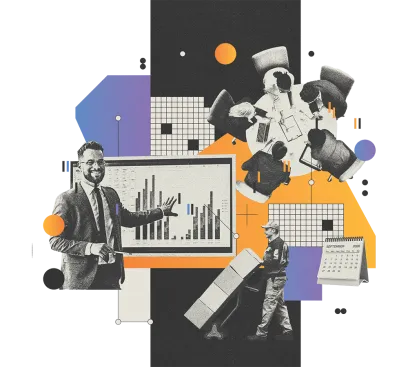
They propose building a “large coordination model” similar to an LLM. But instead of training it to predict the next word in a sentence, they’ll train it to predict the next event in a sequence of events, using anonymized workplace data — gleaned from calendars, emails, and shared documents, among other sources — so the model can learn the underlying patterns of coordination.
“You can learn a lot from predicting the next word in a sentence,” Wang says. “Here we are just replacing ‘sentence’ with ‘a stream of work events,’ and replacing the next word with the event that is going to happen next.” If this approach is successful, Wang imagines using the model to simulate a virtual replica of an organization, allowing researchers to test how changes in structure or workflow might play out.
Managers aren’t going away, however. “At this moment, it’s not obvious the extent to which algorithms and AI are going to fully replace human managers,” says Goldberg, a faculty director of the Computational Culture Lab. “And even if they’re capable of it, humans will be resistant to it, not simply because managers will resist their replacement, but because we won’t culturally agree to cede that responsibility to AI.” — Michael McDowell
The Financial Advice Gap
In a 2025 survey, more than half of Americans said they’d asked AI for financial advice. By comparison, about 40% have worked with a human financial advisor, suggesting that when generative AI talks money, people listen.
Tim de Silva, an assistant professor of finance at Stanford GSB, measures and analyzes the quality of AI-generated financial guidance in a recent paper. He and his coauthors find that LLMs generally give good long-term advice. “AI seems to be nudging people in the right direction,” de Silva says. “It’s not perfect, but it’s better than the way many people make decisions, such as talking to friends and family or doing simple internet searches.”
However, the models’ advice is only as good as the questions they’re asked. People with low financial literacy wrote prompts that conveyed less information about their financial situation, resulting in less personalized advice. Following this advice left simulated users nearly $50,000 poorer by age 60. Inexperience with AI also widened the gap: Users new to LLM-based financial guidance ended up nearly $100,000 behind those with more experience.
Overall, the results leave de Silva feeling more comfortable about the rapid adoption of generative AI as a financial tool for users who can’t afford financial advisors. But he’d like to see people develop a baseline knowledge of financial literacy so they can ask LLMs better questions. “Because then you can use this tool in a very powerful way,” he says. — Deborah Lynn Blumberg
Keeping the Books
Accounting relies on routine tasks like data entry and reconciliation: exactly the kind of work artificial intelligence can handle. But a recent survey by Jung Ho Choi, an assistant professor of accounting, and Chloe Xie, PhD ’20, of MIT Sloan School of Management, challenges the idea that AI is here to simply replace bean counters and bookkeepers.
They find that accountants who use generative AI can support more clients, close the books faster, and provide higher-quality service. And accountants themselves say that AI is making their jobs more manageable. Nearly half of the accountants in Choi and Xie’s survey said generative AI tools helped them meet deadlines more reliably and improve accuracy. Almost two-thirds said that automating routine tasks was the single biggest benefit of adopting AI.
“AI helps with multitasking,” Choi says. “In order to support each client, accountants have to pull information, connect bank transactions, track vendors — a lot of prework. AI assists with that setup, which means they can serve more clients, more efficiently.” However, about 62% of accountants said they were concerned about AI-generated errors, and a significant number expressed anxiety about AI’s effect on data security and job stability.
The takeaway isn’t that AI is taking over accounting — it’s that it works best when paired with human expertise. “Accountants are frequently the subject of a joke because so much of what they do is deeply routine and almost boring and procedural,” Xie says. “But there’s also a nontrivial proportion of an accountant’s job that is very contextual and requires a lot of judgment.” — Seb Murray
Apps and Leisure
To understand who’s using AI at home, Michael Blank, an assistant professor of finance at Stanford GSB, analyzed how thousands of U.S. households use their online time. He and his coauthors found that younger, higher-income households use generative AI, specifically ChatGPT, to improve their productivity and to spend the time they save on leisure activities.
Understanding how GenAI is used at home helps paint a fuller picture of AI-related productivity and value. “So far we haven’t seen a noticeable uptick in AI-related productivity for businesses in terms of output and revenue per unit of labor or unit of capital,” Blank says. “But the fact that people can do more enjoyable activities after adopting ChatGPT suggests a beneficial impact on productivity: People can consume more of what they want because they don’t have to spend as much time on what they see as chores.”
His findings also suggest a digital divide in GenAI adoption and usage, a gap that has widened over time. Blank found that people between the ages of 18 and 34 and those with annual incomes over $100,000 (especially over $200,000) were much more likely to use ChatGPT. “We see that people are using ChatGPT to improve from a productivity standpoint, giving them more time to spend on things they enjoy. But it’s not happening in an equal way across the income and age distributions,” he says. — Sachin Waikar
Career Opportunities
Erik Brynjolfsson — a professor (by courtesy) of economics and of operations, information, and technology at Stanford GSB and director of the Stanford Digital Economy Lab — has spent years anticipating and researching these questions. He spoke with Stanford Business about what it will take for humans and AI to work together successfully.
How can AI be deployed while also addressing its impacts on people?

At the Digital Economy Lab, we studied 51 AI deployments that actually delivered value in industries such as manufacturing, financial services, and technology. We found that 77% of the hardest challenges weren’t technical. They were change management, data quality, and process redesign. The difference was almost never the AI model. It was the organization.
Headcount reduction was important, but it was only 45% of cases. The rest were instances where workers were redeployed to higher-value tasks.
How do you get the better answer? Think tasks, not jobs. Almost no job is fully automatable, while almost every job has tasks that AI can change. Once you deconstruct work that way, displaced capacity shows up as the ability to redeploy workers instead of cutting headcount.
How do you see entry-level roles changing?
In another recent study, we found a 19% relative employment decline for 22- to 25-year-olds in the most AI-exposed occupations, such as software development and customer service. But the more interesting finding is that the decline concentrates in occupations where AI automates rather than complements human labor.
Entry-level jobs won’t vanish; they’ll start higher. The routine production part of junior work — the first draft, the basic query, the initial screen — is what these systems do well. What’s left is judgment, verification, client contact, and orchestrating AI. So for many, the early-career on-ramp gets steeper.
If AI fluency isn’t enough to protect your job, what will?
Fluency is table stakes. Being AI-fluent in 2026 is like being email-fluent in 2005. What protects you is learning how to complement your work with AI.
Exercising solid judgment in ambiguous situations. Framing the problem instead of answering the question. Accountability for the outcome. Relationships and trust. Directing AI toward something a customer actually wants. Those are the tasks where the machine makes you more valuable.
How should lawmakers and technologists prepare for the seismic shifts AI will bring about?
Measure the impacts first. Second, stop forecasting and start building. Institutions take years to construct, and transformative AI may not wait for them. Third, make the complementary path the profitable one. There should be tax neutrality between labor and capital and collaborations that reward human-plus-machine performance.
In 2036, what indicator would you consult to see whether we got this right?
GDP-B, a new measure of welfare and growth I devised with Stanford colleagues that accounts for how much consumers benefit from goods and services, not just how much they pay for them. Our assessment puts U.S. consumer surplus from generative AI at roughly $172 billion this year. Essentially, none of it shows up in traditional measures of GDP.
GDP was one of the great inventions of the 20th century, but it misses an increasing share of value in the 21st century. — Interview by Lisa Bonos
360-Degree Feedback
“Technology changes faster than organizations.… Ultimately, AI does not merely improve organizations; it will determine which organizations survive.” — Mohammad Akbarpour, the Walter and Elise Haas Professor and Professor of Economics, at AI@Work: The Executive Forum for Frontline Workforce Innovation, sponsored by the Stanford Leadership Institute.
“Nobody knows what this technology is going to do to the economy, and even if you ask the simplest possible question, which is, ‘Where can we see artificial intelligence in the labor market today?’ nobody knows anything.… We don’t have a very clear indication from economists of what AI is doing to the economy, and I am as frustrated by this as the folks in this room looking for a job.” — Derek Thompson, contributing writer at The Atlantic, speaking at an AI@GSB event.
“I like to think, in my more optimistic moments, that as the world fills with AI tools and tools of cognition that chatter and think, that there’ll be even more of a focus on what makes us human, what it means to be working with somebody to learn from them. What it means to work with a team that you’re very close with, that you produce creatively in a joint way with.” — Eric Horvitz, chief scientific officer at Microsoft, at an AI@GSB conversation with Dean Sarah A. Soule.
“If you look at older people in their careers doing more complex jobs, what you see is employment growth. And that’s not a foregone conclusion. I thought AI would just get rid of all the old, expensive people… especially because the junior ones know how to use AI. AI is not getting rid of me. It’s going after my kid, who’s going to graduate into a role that no longer exists.” — Nela Richardson, chief economist at ADP, at “Rewiring the Workforce in the Age of AI,” a session at the 2026 Stanford Leadership Forum.
“In our standard economic models, work is a bad, not a good — that’s why they pay us to do it. On the other hand, for many people in our economy… our work is actually something that also gives us meaning. I enjoy my job a lot. I would love to sit around and think about growth models even if I had infinite income.… So the question is, when the AI models are better at writing down growth models than I am, where am I going to find meaning?” — Charles Jones, the STANCO 25 Professor of Economics, on “Our AI Future: From Abundance to Apocalypse” on the If/Then podcast.
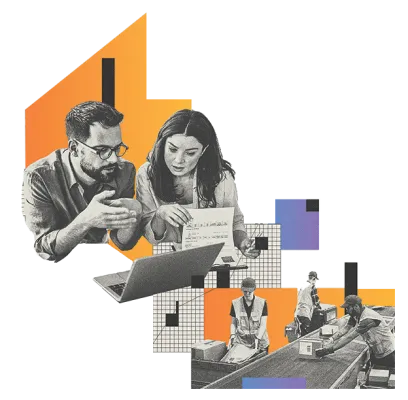
“According to our economic index, where we study how people are actually using artificial intelligence technology right now, it mostly looks like complementary skills. So you have artificial intelligence as an enabler of work; you don’t have it as a replacer of work, except in a very vanishingly small number of cases, which is mostly customer service.… What I expect is there will be a number of types of work that will feel a lot like they rhyme with a job that exists today, but they’re not necessarily the same as a job that exists today.” — Daniela Amodei, co-founder and president of Anthropic, at View From The Top.
“The most plausible way we would get this massive job loss is in a world where AI is profoundly valuable and causing profoundly large amounts of economic growth that is justifying the layoffs. It won’t be like a recession, because instead of everyone being in the same boat, you’ll have people losing their jobs while the economy is booming and investors and business owners are doing super well. Given where we already are politically in America, I think it will certainly fuel massively populist policy proposals.” — Andrew Hall, the Davies Family Professor of Political Economy, speaking with Stanford GSB Insights.
“Is everyone going to lose jobs in 12 months, or will it happen more slowly? The answer is not about how great the technology is. The pace of change is throttled by constraints — organizational, regulatory, infrastructural.” — Susan Athey, PhD ’95, the Economics of Technology Professor, AI@Work: The Executive Forum for Frontline Workforce Innovation, sponsored by the Stanford Leadership Institute.
“The world’s sort of your oyster, really. I kind of envy some of you now, because you’re the first generation that will be AI native, just like my generation was computer and internet native. It’s going to be in your hands in the end… how that future world gets built.” — Demis Hassabis, Google DeepMind co-founder and chair, at an AI@GSB conversation with Stanford President Jonathan Levin at Stanford GSB.
Explore More
Stanford GSB Economists Shape an In-Depth Look at AI’s Global Promise

Quick Study: Could AI Predict Your Next Job?
Explainer: What is AI Complementarity?