October 29, 2026
| by Dave GilsonIn Brief
- The World Development Report 2026 finds that AI has the potential to accelerate development in low- and middle-income countries.
- Susan Athey co-led the research, looking at the spread of past technologies, the effectiveness of current AI tools, and what’s required for broader impact.
- Inexpensive and practical “small AI” apps are already improving farming, health care, and public services in developing countries.
Earlier technological advances such as electricity and the internet took decades to reach the world’s poorest countries. As artificial intelligence spreads faster than anything before it, a new World Bank report finds that developing economies may have a chance to close the gap if they act strategically.
The opportunities created by the rapid diffusion of AI are the focus of the World Development Report 2026, “The Promise of Artificial Intelligence.” The World Bank Group’s flagship annual report presents the first comprehensive assessment of how AI could improve the lives of the 6.8 billion people living in low- and middle-income countries.
The report finds that AI presents an unprecedented chance to accelerate progress at a moment when movement on alleviating extreme poverty has slowed. AI could help developing countries overcome persistent challenges in areas such as agriculture, education, and health care. If developing countries deploy AI strategically and pragmatically, the report concludes, economic and social advances that once would have taken a century might be compressed into a decade.
“There is a huge gap in developing countries that can be potentially addressed if we do the right things,” said Susan Athey, a professor of economics at Stanford Graduate School of Business and one of the report’s two academic leads, at a recent one-day event held at Stanford GSB.
While AI’s potential impact in poor countries is huge, much of its immediate benefits stem from addressing everyday problems, she explained. “If you’re having difficulty feeding your children, if you don’t have the information you need to get the best price for your crops, if you spend half your day trying to manage your customer orders and your supplier orders when you’re running a small restaurant, there’s a lot of upside here,” Athey said at the event, which was sponsored by the World Bank Group, the Stanford Leadership Institute, the Stanford Digital Economy Lab, and the King Center on Global Development.
Athey, a “tech economist” who has published widely on topics including digital products and digital interventions in developing countries, helped shape the 380-page report’s interdisciplinary approach, which synthesizes macroeconomic models with new research on applied AI in developing countries. “My role was to develop frameworks that would encompass all of these ideas and then to bring my knowledge of the different strands of research together,” Athey said in an interview.
The World Development Report took shape over two years of research and consultation with academics, policymakers, and business leaders in more than 50 countries, including meetings in India, Japan, and South Africa. The report’s academic advisory committee included Athey’s Stanford GSB colleagues Erik Brynjolfsson, a professor of economics and of operations, information, and technology (by courtesy), and director of the Stanford Digital Economy Lab; and Nicholas Bloom, a professor of economics (by courtesy). (The three are also senior fellows at the Stanford Institute for Economic Policy Research).
Bloom, whose research on international business practices is cited in the report, calls it “a landmark.” “The World Development Report’s breadth, depth, and global perspective are impressive, and I’m glad our global data helped inform its findings,” he said.
Indermit Gill, the World Bank’s former chief economist and a distinguished visiting fellow at the Hoover Institution, said the report comes at a critical moment. “Until now, concrete evidence about AI’s impact on the developing world has been scant,” he writes in his foreword to the report. “This report starts to fill that void. It provides the first detailed assessment of how people, businesses, and governments in poorer countries are using AI, what is holding them back, and where the largest gains are likely.”
The World Bank Group will use the report to offer policy guidance in countries where it provides technical and financial assistance. One of its key recommendations is that developing countries not hesitate to adapt existing AI tools. While it may seem rational to wait for better information, Athey said now is the time to simultaneously implement and evaluate AI. “We need to start learning together,” she said. “The information and best practices are a public good — and the World Bank can disseminate and share that knowledge.”
Studying a Moving Target
Capturing the potential of AI within a single analytical framework was an ambitious task. “We’re talking about a technology that’s going to restructure the world from every dimension,” Athey said at the event. “So how could there possibly be one framework that captures all of that?” As a starting point, the World Development Report describes AI as a general-purpose technology (GPT). Like electricity and the internet, AI is a technology with wide-ranging uses that is capable of sparking innovation and reshaping entire economies. “The GPT theory is a framework, but microeconomic facts and logic operationalize it,” Athey said.
AI is also a moving target, making it difficult to predict its trajectory. “AI, obviously, is happening now,” Athey said. “This is a different kind of report than some past reports because it’s trying to be research-based, yet it’s much more forward-looking.” Past research may suggest AI’s overall trajectory, but the technology is moving so quickly that current research on real-world applications can quickly become outdated.
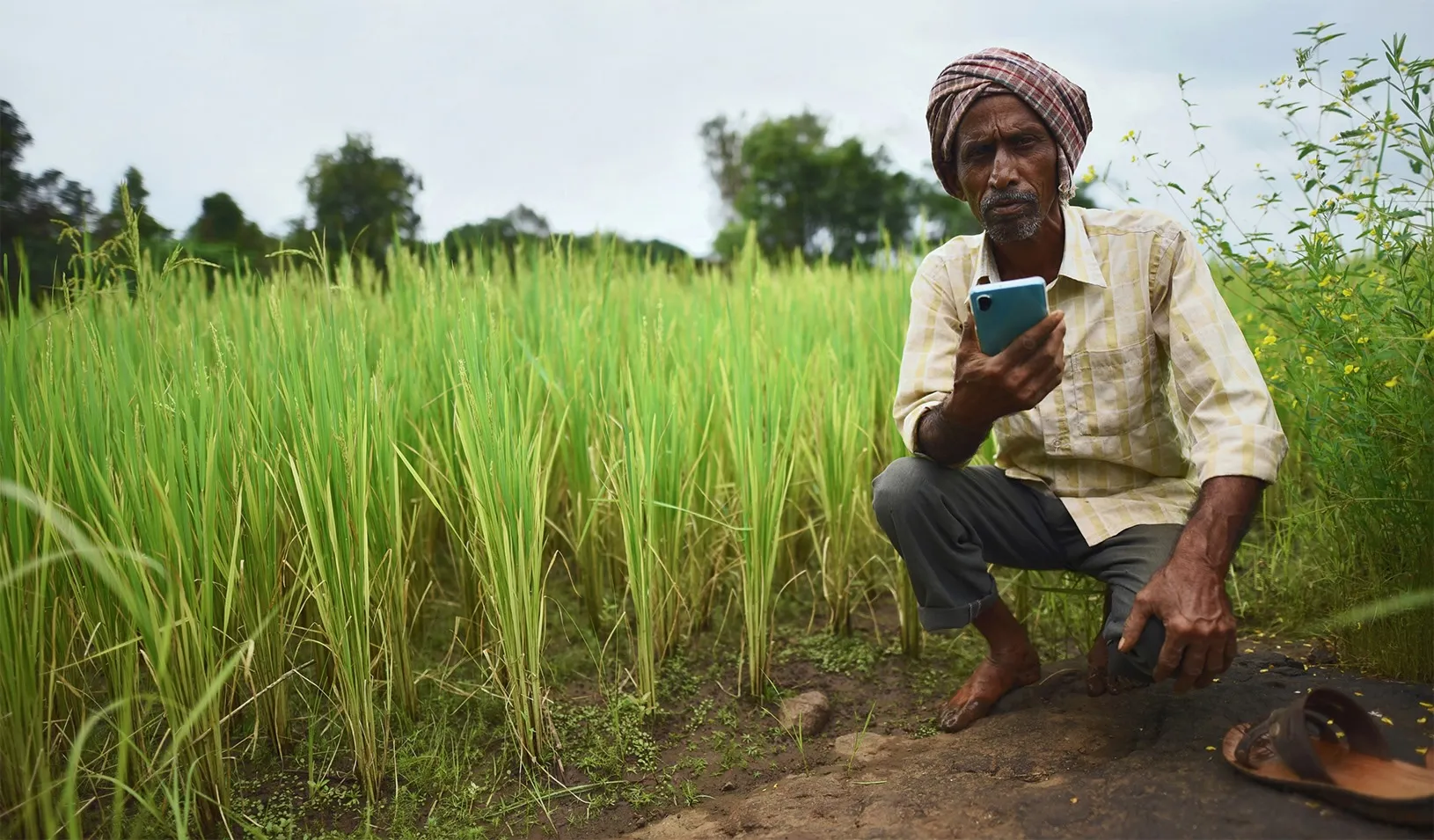
The report finds that AI is already being widely deployed in developing countries to address a wide range of problems. Many of these tools are “small AI” — lightweight, low-cost, practical applications that work with basic tools such as mobile phones and text messaging. Brynjolfsson said in an email that the report’s emphasis on small AI confirms what he’s found in his research: “The biggest gains often go to the people who previously had the least access to expertise.”
Among the AI applications discussed in the report were a predictive tool that reduced a backlog of court cases in Kenya, a weather forecasting app used by farmers in India, a phone app that can analyze coughs to screen for tuberculosis, and a WhatsApp-based assistant used by teachers in Sierra Leone. These apps illustrate the report’s recommendation that rather than developing expensive AI models or building data centers, developing countries should focus on making existing AI tools work in local contexts. “Adaptation enables adoption,” Athey said, “and that combination allows developing countries to participate.”
However, the sheer number of AI applications presented what Athey describes as one of the report’s toughest research puzzles — the “too many pilots” problem. The market has been flooded with competing AI apps, yet there’s little evidence of which are most effective. While visiting India, Athey recalls hearing, “The last thing we need is another agricultural advisor app. What we really need is one good one.”
Somik Lall, director of development strategy in the World Bank’s chief economist’s office, credits Athey with pursuing this idea. At the Stanford GSB event, Lall explained, “We need to get away from doing a million pilots to figuring out what sort of pilot is useful, what are the metrics to use to evaluate the success of some pilots, how to kill bad ones, and how to scale up the good ones.”
While much of the discussion about AI in the U.S. and other developed countries has focused on job loss, the World Development Report finds that AI could alleviate skill shortages in developing countries rather than replace existing jobs. “Most of the AI impacts in developing countries are good,” Athey said, “because they’re helping complement scarce expertise, which is holding everybody back.” In places where there are not enough teachers or doctors, AI could help students and patients without taking anyone’s job. And because much of the workforce in developing economies does manual labor, the report finds that workers there face much less risk of automation than those in wealthy countries.
The report draws on research by Brynjolfsson to illustrate how AI can “level up” certain jobs. In a study of roughly 5,000 customer support agents, mostly in the Philippines, Brynjolfsson and his coauthors found that generative AI helped the newest, least-skilled workers the most. “AI can put scarce expertise into many more hands if we use it to extend and complement the capabilities of workers, not merely replace them,” Brynjolfsson said in an email.
Watch Out for Speed Bumps
The World Development Report concludes that AI’s impact in developing countries will depend heavily on how quickly they can successfully deploy it. Yet the report also notes that general-purpose technologies are “unpredictable,” making it difficult to offer a clear view of AI’s future.
To understand the complex relationship between new technologies and economic growth, the report draws on research by Stanford GSB economists Charles Jones and Christopher Tonetti. They find that economic output is limited by its worst bottleneck, much as a chain is only as strong as its weakest link. “It’s really important to try to understand that there are barriers to technology adoption that are longstanding,” Tonetti said in an interview, “and those same barriers might affect the adoption of AI just like they affected adoption of previous technologies.”
Scarcity will cause bottlenecks, Athey said at the Stanford GSB event. “AI is going to expand capacity in some dimensions, but in the end, the overall impact is determined by the tightest part of the bottle.” She also highlighted the potential for some negative impacts to arise quickly, since cybercriminals and other bad actors face fewer impediments to adopting AI.
On the ground level, the speed of AI adoption in developing economies will depend on factors that already pose significant barriers to development. While small AI can work in environments with limited resources, the report states that AI adoption will stall without the basic infrastructure necessary to sustain it. These “complements” include reliable electricity, internet access, good education, and strong public institutions.
Here, too, Athey’s framework guided the research. “Susan really emphasized the importance of complements: going back to these very basic things, the nuts and bolts of how economies combine technology with markets and institutions are ultimately going to determine what impacts AI has,” said Gaurav Nayyar, the director of the World Development Report, in an interview.
People in developing economies have missed out on previous technological revolutions before. Athey hopes that the framework and evidence in the World Development Report will provide a roadmap for avoiding that pattern. AI tools are already making a difference in people’s everyday lives. Even if the gains are modest at first, they could add up to something transformative. “As a percentage change from the baseline, those benefits could be much larger in developing countries,” Athey said in her remarks at the event. “That’s what really gets me out of bed in the morning to work on this.”
For media inquiries, visit the Newsroom.