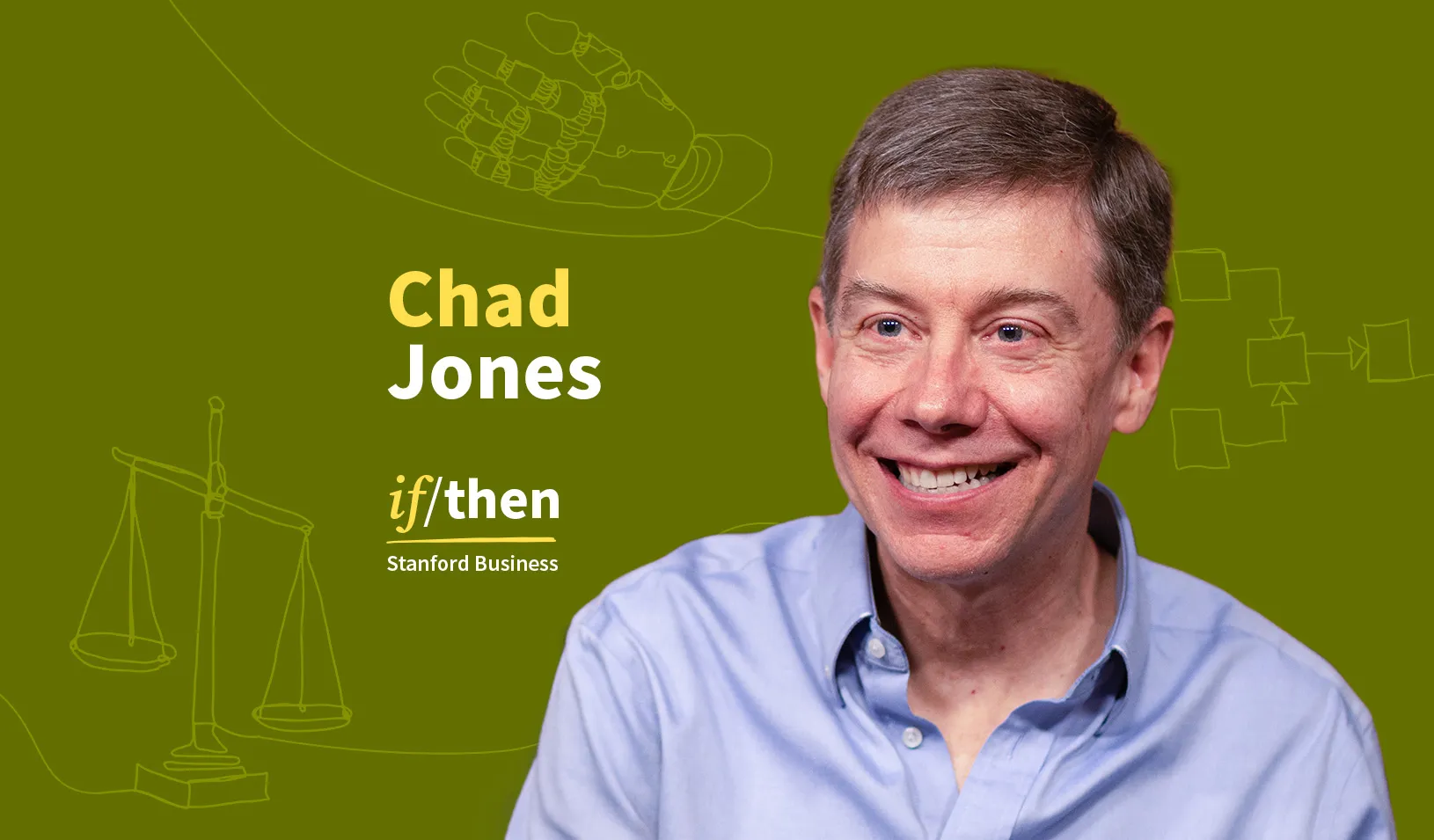
Charles I. Jones, a professor of economics at Stanford Graduate School of Business, recently published a paper, “AI and Our Economic Future.” Within it, he describes several scenarios. The first is business as usual, made possible by a general purpose technology that delivers enough innovation to generate steady economic growth until the next big innovation comes along.
In an even more optimistic scenario, AI fundamentally reorients everything we understand about economics and the human experience, leading to endless abundance. “This is a story that Sam Altman and Demis Hassabis and Dario Amodei have been telling for 10 years or more,” Jones says on a new episode of the If/Then podcast. “We’re kind of on that path.”
On the future of work, Jones is relatively sanguine, pointing to the many difficult-to-impossible to automate components of the vast majority of jobs (software engineering excepted).
But he also acknowledges the existential risks on the horizon. “We’re in the middle of actively creating a super intelligence that’s more powerful than we are,” he says. “Maybe it doesn’t end well.”
Overall, Jones is optimistic about the AI-powered economy that’s just around the corner. “I think the ability for an AI to do everything on a computer that the best software engineer can do, that seems like it’s either here now or will be here within five years, easily,” he says. “So hacking the electric grid, hacking the financial system, these kinds of scenarios are things that we definitely have to worry about. The good news is, I think if we get through that somehow, the ability of AI to transform the economy for good is really there and present. And that would be a very great and bright future.”

If/Then is a podcast from Stanford Graduate School of Business that examines research findings that can help us navigate the complex issues we face in business, leadership, and society. Each episode features an interview with a Stanford GSB faculty member.
Full Transcript
Note: This transcript was generated by an automated system and has been lightly edited for clarity. It may contain errors or omissions.
Kevin Cool: This is If/Then from Stanford Graduate School of Business, where we sit down with faculty and explore how their research deepens our understanding of business and leadership. I’m your host, Kevin Cool.
Jim Colgan: And I’m Jim Colgan, a producer on the show. And today we’re doing something a bit different. We’re talking about AI and how it will shape our economic future. And we’re giving you a longer episode than we usually do, and it’s with a professor of economics here at the GSB, Chad Jones.
Kevin Cool: And Chad is coming at this not only in terms of how it might transform the economy, but how it could transform the entire society, both positively and negatively.
Jim Colgan: Chad uses a lot of data and a lot of research to sketch out a scenario of abundance and one of apocalypse.
Kevin Cool: Yeah, as it turns out, this is not the first time we’ve had a transformational technological innovation that could have large, large effects, not only on the economy, but on society. And he goes back one hundred and fifty years, looks at, for example, the introduction of electricity in the 1800s.
Jim Colgan: And Chad uses that history to see what it might tell us about AI, which I think is a question on a lot of people’s minds right now.
Kevin Cool: It absolutely is.
Jim Colgan: So, let’s hear your conversation with Chad Jones.
Kevin Cool: I wanna start by talking about a recent paper that you’ve done about ‘AI and Our Economic Future’ is the name of the paper. And you apply a somewhat historical lens to talking about this. So, what’s happening with AI now that feels different from, say, periods of innovation a hundred years ago or fifty years ago?
Chad Jones: Yeah, yeah. No, this is a great question. I, I find myself going back and forth because I, I think two different perspectives are, are both useful here. On the one hand, automation’s been going on since the Industrial Revolution. So, so automation is certainly not a new thing.
On the other hand, this kind of automation feels a little different. So, in, in some of my research, we’ve looked back in time at past episodes of automation to try to learn something about the future of economic growth. And yeah, in this paper that you referenced, we have some simulations that are, that are motivated by what we’ve learned from the past.
Kevin Cool: Well, let’s talk about some of those simulations because you characterize it really in two scenarios, a kind of business-as-usual scenario, and then another one in where there’s a very large impact. But just kind of give us the general framework of those two scenarios.
Chad Jones: Yeah, yeah. So, in the paper, I lay out these two scenarios that you just referenced, and I think of them as two extremes. So, let me start first with one that’s popular here in Silicon Valley and among sort of AI experts, I would even say, and that’s a scenario where AI accelerates economic growth dramatically.
And kind of the story that goes along with this, and this is a story that, you know, Sam Altman and Demis Hassabis and Dario Amodei have been telling for ten years or more.
Kevin Cool: These are the leaders of Anthropic —
Chad Jones: Exactly. DeepMind —
Kevin Cool: Right
Chad Jones: … OpenAI, right? The, the story they, they tell is, well, the first thing we do with AI is we use it to accelerate software engineering. We use it to automate software engineering, so the AI can start writing software for us. And we feel very much like we’re in the middle of that right now. It really does feel like, especially with the agents that we’re seeing, Claude Code, OpenAI’s Codex, you’re seeing the automation of software engineering happening before our eyes. And every month it feels like there’s a next step in that process.
And then they said, “Well, once you can automate software engineering, once AI can, can write software, you ask it, “Develop some new algorithms for improving AI itself.” So, once you get that, then you might get an AI that is a virtual remote worker that can do anything on a computer that you or I could do on a computer.
Kevin Cool: Yeah, yeah.
Chad Jones: And once you’ve got these virtual remote workers, and remember, you know, once you develop it once, you could scale it up a billion times by just running it on more computers. In some sense, we could very soon after that get what Dario Amodei called a country of geniuses in a data center. We could have access to billions of AI agents running 100 times faster than we can perform tasks, and then you can ask it to do all sorts of things. You can ask it to design better computer chips or design better robots, run virtual simulations where you figure out how to make a hand that can finally grip things like the human hand.
On the designing better robots, I think that’s a critical one because, you know, AI could automate cognitive work, it could do things that you and I can do on a computer, but a lot of our tasks in the real world involve interacting with physical things, with factories, with construction, with classrooms, with cameras, with microphones, with everything else.
Kevin Cool: Leaky kitchen sinks.
Chad Jones: Leaky kitchen sinks. And so, you need good robots. Well, you could ask the AI to help us design better robots. And again, there may be several, maybe a decade of iteration on that, but at the end of that, we might have very good robots. And if we get to a point where we have robots run by the AI that can do anything a human can do, and we have AIs that can do anything on a cognitive level that any human can do, well, then you’ve got this situation where AI can do every task a human can do. And in the growth models that we write down to understand history, that kind of situation would lead growth to explode.
And so, this story that people have been telling for the last decade, first of all, it feels like we’re on track. We’re continuing along a path that they laid out for us. And so, it raises the question, are we gonna keep continuing on that path? I, I think in this optimistic scenario, I’m not sure it’s gonna happen in the next three years or five years. It’s more like, could it happen in the next twenty-five years? And I think, yeah, I don’t see any reason why it couldn’t. So, in the next twenty-five years, could we end up in a world where growth is significantly faster? Yeah, I think that’s that scenario.
Kevin Cool: So that’s the one in which there’s a massive impact, right? Huge growth changes. What’s the business-as-usual scenario and what would constrain the growth that would produce that outcome?
Chad Jones: Yeah, great. So, so I described that accelerating growth scenario. I think that’s very familiar to people in Silicon Valley.
I think the business-as-usual scenario is actually very familiar to economists and economists who study economic growth. And so, it’s based on very much the kind of things that we’ve studied for the last fifty years. And I think this scenario also has a lot of merit to it, even though it, it’s, it’s very different.
So, the most helpful way to think about this scenario is to imagine a straight line pointing up to the right. This actually is what average income per person looks like in the United States over the last hundred and fifty years. Basically, it’s a straight line with a slope of two percent per year. And what that says is over the last hundred and fifty years, decade by decade, growth in average living standards in real terms, adjusted for inflation, has been two percent per year plus or minus a little bit, but you don’t depart from that straight line trend very much. The Great Depression was a big departure, but a decade after the Great Depression, we’re back on trend, and it’s as if the Great Depression never happened.
Kevin Cool: The line is always going up over time.
Chad Jones: Yeah. Over, over a long enough period of time, the line is going up, and you don’t depart that far from this two percent line.
So first of all, I think that fact is, is remarkable. One of the things that’s striking about it is when you also look at the economic history that underlies that line. And in particular, sometimes we like to think that AI is this incredible new technology, and, and I think it is, but over the course of economic history, we’ve also developed incredible new technologies.
So, think about electricity. In eighteen seventy, a hundred and fifty years ago, you know, electric lighting and the electrification of the economy, that was just a glimmer in Thomas Edison’s eye. And over the next fifty years, electricity radically transformed the US economy.
Or then shortly after that, you get the internal combustion engine. And the same thing, it completely revolutionizes the way we transport goods and people throughout the economy. It made a country that was incredibly large that took months to cross into something that you could cross in less than a week.
Or then later you have, antibiotics or vacuum tubes and transistors and semiconductors, and then information technology and the internet. Each of these things were profound technologies that really transformed the US economy. And yet, when you look at the growth statistics, you see straight line two percent per year for a hundred and fifty years.
Kevin Cool: Which is surprising just on its face to me. When I think about electricity, for example, there are all kinds of ancillary benefits to having electricity. Office hours extend, you know, homework hours extend, you can keep your shop open after dark, all of these things. You would think it would be more than two percent.
Chad Jones: Exactly. And I, and I think it did radically transform the economy, and the question is how to reconcile that view with the data that we see in the statistics. And I think there is a reconciliation, but it, it’s not obvious. And the point is that you don’t know what would have happened to the US economy if we hadn’t developed electricity.
Kevin Cool: Yeah, yeah.
Chad Jones: And I think the answer is that within any general-purpose technology, within any paradigm, ideas get harder to find. So, the steam engine runs out of steam. Right? And so, if we’d only had electricity and we didn’t have the internal combustion engine and transistors and information technology, growth would have slowed dramatically, and we wouldn’t have had this 2% growth. This is a hypothesis. I don’t think this is a nailed down view, but it makes sense of the data.
According to this view, each of these new general-purpose technologies, the next big revolution was the thing that kept 2% growth going for another fifty years, right? Otherwise, we would have slowed below the 2%.
Kevin Cool: Yeah, yeah.
Chad Jones: Because ideas within electricity, you apply electricity everywhere. And then what do you do? It gets harder to make big improvements, and so you need the next big thing. And so, in this story, one could say AI is just the next big revolution that allows us to continue 2% growth for another fifty years, because otherwise we would slow even more.
Kevin Cool: Yeah, okay. That’s business as usual. All right, if you could, Chad, if you can unpack for us the analysis that you did using the historical lens, what that looks like if some of these most optimistic things, like what kind of percentages are we talking about then in terms of economic growth?
Chad Jones: Yeah, yeah, yeah. So how do we square scenario one and scenario two? How do they fit together? ‘Cause they both have points that are interesting. And so that’s this research paper that I’m working on now. And one of the key things we think helps to, to square those two scenarios is what we call weak links. So, there’s the old adage, “A chain is only as strong as its weakest link,” and I think many production tasks in the economy look like weak links, look like a chain with weak links.
And so, think about Apple making the latest iPhone. You have to design the iPhone, you have to get all the chips, design the chips, improve the chips, figure out how to manufacture the chips, get the chips manufactured, get all the other parts, assemble everything, transport the phones from where they’re manufactured. You need the Apple stores, you need marketing, you need the ability to repair things when things go wrong or when someone has trouble with using it.
Kevin Cool: A lot of things have to happen right.
Chad Jones: Exactly. A lot of things have to happen right. And in particular, if any one thing fails, the whole enterprise can see its value reduced a lot. With the iPhone 15, Foxconn had trouble manufacturing and, you know, up to standards, and so yeah, there were a lot fewer iPhones, and Apple’s profits were reduced considerably.
Lots of things look like this. There’s the Space Shuttle Challenger. So 1986, this space shuttle explodes, tragic event, Richard Feynman did a famous presentation where he showed a $25 rubber seal-
Kevin Cool: Yeah, I remember this
Chad Jones: …Failed, and that was the thing that took down —
Kevin Cool: Yeah
Chad Jones: … the entire Challenger, right?
Kevin Cool: Yeah.
Chad Jones: And so, this is very much a weak links production function. Okay, so why are weak links important? Well, what the automation process is, is we’ve got a bunch of tasks that need to be done, like the ones we just described for Apple and the iPhone, but lots of businesses have lots of tasks that need to be done.
Kevin Cool: Sure.
Chad Jones: And what automation is, is learning to replace slowly improving humans with rapidly improving machines, right? If I ask how much better am I at, you know, inverting matrices than the equivalent of me 50 years ago, not much better, right? But I use the computer to invert the matrices and manipulate the data, and it’s really, really good at it.
Kevin Cool: I would’ve said how much better is my golf swing, but okay,
Chad Jones: There you go.
Kevin Cool: I’ll, I’ll take yours. I’ll take yours.
Chad Jones: Yeah, well, I’m not sure the robots are as good at the golf swing yet, but it’s only a matter of time, I think. So, automation is doing more of these weak links with machines that get better very quickly.
So, on the one hand, you’ve got that. On the other hand, an important part of the weak link production function is we have a chain with 20 links. Imagine we take 17 of those links and make them infinitely strong.
Kevin Cool: Right.
Chad Jones: Well, you’re still limited by the last three links that aren’t strengthened yet.
Kevin Cool: Yeah, right.
Chad Jones: And so very much production processes look like that. You replace 17 of the links with machines that are getting better rapidly, and that’s great, but you’re still bottlenecked. You’re still limited by the last three links that slowly improving humans are still doing. And this has all sorts of interesting implications.
For example, if you ask what share of the sales, what share of the enterprise value gets paid to the machines versus paid to the workers, actually the stuff that’s scarce, gets the high share. And so actually, even if humans are doing a smaller and smaller set of tasks, those are the weak links. Those are the things that provide the most value, and so actually, it doesn’t have to be the case that, you know, wages decline and labor is worse off. It could be we’re doing the stuff that’s really essential and bottlenecked, and the machines are doing the stuff that are in ample supply.
So, I’ll give you a great example of this. In your pocket and in my pocket, I have a computer that has 100 million times the number of transistors than someone had on a computer chip in the 1970s. For all intents and purposes, I have infinite computing power, right? I can’t use my computer or my iPhone, you know, I barely use any of the transistors that are on there most hours of the day. And it’s great, that makes me more productive. We already talked about the ways it made me more productive.
And yet, I’m not 100 million times more productive. Why? Well, yeah, if I need to manipulate some data and invert some matrices, that’s the place to go. But if I need to decide which data, do I need to put in the matrix to invert, or which model do I wanna test, or which new theory am I coming up with, yeah, the computer’s not helping with those things, and so those become the weak link.
So maybe I’m twice as productive, but the computer’s 100 million times more productive. And so, this is another feature of one of these weak link models. So, what we do in this paper is we build some, some models and simulate them, and the models kind of have aspects of the growth accelerates scenario and aspects of the business-as-usual scenario.
So, what do I mean? So, we’ve got in the model that new ideas help you to automate more things. You can use machines on tasks instead of solely improving people. And then the fact that you’ve automated stuff helps you get more new ideas. So, ideas give you automation, give you new ideas, gives you automation. There’s a flywheel effect there. There’s positive feedback there. And that’s absolutely something that can cause growth to explode.
Kevin Cool: So, in the, let’s say the late 1960s or early 1970s, auto manufacturers started to automate more assembly and production, right? But the auto workers didn’t go away.
Chad Jones: Exactly, yeah. The motor vehicle sector is one of the sectors that we look at.
Kevin Cool: Right, right.
Chad Jones: And so yeah, you see pictures of motor vehicle assembly now, and it’s this assembly line with all these robotic arms doing all sorts of things.
Kevin Cool: Right.
Chad Jones: Except there’s still some things that only humans can do. So, inserting all the wiring into the vehicle through the different, you know, aluminum and steel and, and, and metal holes, that’s something actually that the robots can’t do. We still need humans for that. So —
Kevin Cool: Requires a lot of precision.
Chad Jones: Yeah, exactly. So, there are a bunch of tasks that the human dexterity is really important for that, that humans are still doing, even in, in automotive manufacturing.
But yeah, so we look at motor vehicles, we look at agriculture, we look at retail trade, and we ask how much were these tasks done by humans 50 years ago, and how has that changed over time? And, like another example is in, in, in retail trade. 50 years ago, a lot of things were done by hand, and now everything’s done with barcodes and scanners, and you keep track of your inventory, you, you know, get the pricing. There’s been a lot of automation in the retail sector of the economy.
So, it’s that kind of history we’re looking at to figure out what’s the rate of automation and what’s the rate at which machines are getting better, and then we, you know, run the model forward. And the striking thing when we simulate these models for the next century is there, there are two things that are striking.
First, growth explodes. Growth accelerates, 2% growth that we’ve had for the last 150 years, it gets faster and faster and faster. And in many of these scenarios, growth rises to 30% per year and higher. Okay?
Kevin Cool: Wow. Wow.
Chad Jones: Now, the other thing that’s surprising is it takes a long time before that happens.
Kevin Cool: So, it’s not a creep toward 30%, it’s slow, slow, slow, and then boom.
Chad Jones: Well, it, it, it, it is a creep, but the creep is so gradual that it really doesn’t show up —
Kevin Cool: Okay. Okay
Chad Jones: … For, you know, 75 years, let’s say.
Kevin Cool: Okay.
Chad Jones: And then you start, then you start to notice.
Kevin Cool: Yeah.
Chad Jones: And you can ask, why is it so slow? And the answer is these, this combination of ingredients. So absolutely there’s this flywheel effect, that automation gives you more ideas — gives you more automation, but again, the weak link model. We’re limited by our weak links. And —
Kevin Cool: Are the weak links always humans?
Chad Jones: Well, the, in our current model, weak links are always humans. It could be that they’re natural resources and land too.
Kevin Cool: Okay, sure.
Chad Jones: You wanna ask what are things that can’t be easily automated away? And if you, if you always need natural resources and land, then those could also be weak links. But the point is, yeah, until you’ve automated away lots of the weak links, you don’t see the explosion. It’s just those weak links hold you back.
Kevin Cool: After the break, we’ll hear about that world of abundance we talked about earlier and the existential catastrophe that all of us are at least a little concerned about
I want to pivot a little bit away from the scenarios specifically and talk about if one of the more optimistic scenarios occurs, in which AI is automating lots and lots of activities that humans previously did. Your paper, and I think maybe even a sort of consensus, is that that would create abundance broadly speaking, right?
So, how do you think about that as an economist in terms of what that would mean for society? If fewer and fewer people are doing fewer and fewer things, what does that look like?
Chad Jones: Yeah, no, this is a great question. So first of all, I, I think you described it accurately. It seems like in all the scenarios that we ran, it may take a while, but abundance is on the horizon, and I think that’s very good news.
There’re many poor people around the world, there’re poor people in the United States. people’s wants and needs in some sense are infinite. We would all love access to better healthcare or to cures for cancer, or heart disease, or better food, better entertainment. And AI has the prospect of delivering these things, and we’ve seen the early shoots, AlphaFold and the protein folding — for example, with the medical innovations.
And so, a world of abundance is certainly a world we should desire. I think that that’s a good world on many dimensions. When I was saying optimism before, I was meaning optimism in terms of the growth rate. You’re right to ask, though, are there some downsides to this?
And, and there almost always are downsides. You think about the agricultural revolution. 200 years ago, more than 80% of US workers worked in agriculture. And today it’s less than two or 3%. That’s by and large a good thing. We have access to lots more food at much lower prices on average than, than we did 200 years ago. And yet, there are far fewer family farms, and people have left farming for other jobs.
Historically, there have always been other jobs, right? So, the unemployment rate over time is basically flat. You don’t see that as we’ve automated more things, as we automated agriculture, it’s not that the unemployment rate went up. The unemployment rate today is as low as it’s ever been, roughly speaking.
Kevin Cool: Calculators didn’t put accountants out of business.
Chad Jones: Exactly. Calculators actually increased the demand for, for accountants. So historically, that’s all worked out. Now people are worried, what if AI plus robots can do everything a human can do? Do we have to worry about humans being displaced from jobs there?
And I, I think that’s absolutely a valid worry, and lots of economists are working on this right now. The research I would say is still very preliminary, and it’s unclear what the consequences are. If you read the newspaper, people are very worried about this, and I think they’re right to be worried.
I will say there are some forces that could make it not as bad as we currently think. And so, the abundance is one thing. So, the pie gets really big, there’s enough to go around. We have to figure out how to share it, and that’s a hard political economy problem. You should get some of our political scientists to come talk to you about that. I’m not gonna talk about political science.
Kevin Cool: And we might.
Chad Jones: But a world of abundance is a good world. There are a couple of other facts that I find useful here. One is that if you look at hours worked over the long course of history, how many hours a year did people work? In the US, we used to work seven days a week. The weekend is a modern invention, right? Seven days, then six days, then five days. Now in France, they’re often working four days a week.
And so, over time, what you see with hours worked is hours worked has been declining in virtually every country in the world for the last 50 years or sometimes even longer. In South Korea, you know, when economic growth really took off in the 1960s, hours worked was skyrocketing. But since 1970 or so, hours worked in South Korea has really plummeted, or Japan has plummeted. In Europe, it’s plummeted.
Actually, the only group you don’t see it falling for are everyone listening to this podcast, I think. College educated workers in the United States, we’re, we’re working harder, actually — over the last 40 years. That’s the exception rather than the rule. In our economic models, work is a bad, not a good. That’s why they have to pay you to do it. So, leisure is the good. We would all like to take more leisure.
Kevin Cool: Yeah.
Chad Jones: And the reason we work is because people pay us to do it. So, if we could have abundance without working Well, we could have abundance and leisure, and that would actually be a good world. In many ways, that’s one side of the optimism. Another side is it’s possible that we all pick the job that we’re best at. We’re doing that job, and say my job is as a software engineer, and I’m not that good as a software engineer. I, I was never very good at programming. And so, AI comes in, and AI can do software engineering much better than me, so I leave my job as a software engineer, and I go to my second-best job.
Well, kind of by definition, the fact that it’s second best means on average I’m gonna get paid less. So you could see the wage for me going down in that scenario, and that displacement from your best job to your second-best job is a way you can get very clear negative labor market effects, and I think that’s behind a lot of the things that, that, that people are worried about.
Kevin Cool: And that’s assuming that there’s a second job to go to.
Chad Jones: That’s right. I mean, I think in the near term there’s always gonna be a second job, but it might not be jobs that we’re ideally trained for, that we wanted to do —
Kevin Cool: Right
Chad Jones: … or the job in our college major.
Kevin Cool: Right.
Chad Jones: This weak link view of the world, one of the things it said is the economy’s not changing overnight. It’s not gonna be in two years, we’re not hiring young people ever again. I think it’s the kind of thing that’s gonna take 30 or 40 years, and it’s gonna be a gradual thing.
Kevin Cool: And so maybe there are ways we can adapt-
Chad Jones: Exactly. So-
Kevin Cool: … in the meantime
Chad Jones: … so the, the, one of the positive things about this weak link view is it says, yeah, things are gonna take a lot longer than we thought, so there is time for this adaption.
Another thing along these lines on the labor market, there was a famous statement by Geoff Hinton, a Nobel Prize-winning, computer scientist, just about 10 years ago in 2016 at a conference that I was at by chance. That was where he made this famous statement that we should stop training radiologists in 2016 because he said in five years, AI is gonna be better than radiologists. We’re not gonna need any more radiologists.
There was a recent paper by someone at Astros Magazine who went back and looked, how are radiologists doing today? And it turns out we have more radiologists than we did 10 years ago, and they’re better paid.
Kevin Cool: Right.
Chad Jones: So why is that? Well, actually, I think the weak link view of the world helps there, too.
So, economist David Autor has been pushing this notion that jobs are bundles of tasks, right? So, we don’t just do one task in our job. We have, you know, 10 or 20 tasks, let’s say, and radiologists have 10 or 20 tasks, and when AI automates 10 of your tasks, well, if the other tasks are the weak links, now you’re more productive because the AI is reading the scans and helping you solve the easy cases. You can devote your attention to the hard cases, right? That makes you more productive, and so you can have wages go up.
So that’s absolutely possible in these models. Now, the flip side is if AI automates every task that you do, then you might have to go to your second-best job, and then your wages can fall. So, I think the effects of AI on the labor market are nuanced. It’s gonna help some people, the people who half their tasks get automated, and they’re still doing tasks that are really valuable, and now they’re more valuable because they’re the weak links. Those people could see their wages rise, and it’s only when the AI can do all the tasks that you can do and you have to move to your second-best job, okay then you may, you may, and I, I think it’s not 100% clear, but you may be in trouble.
Kevin Cool: Who benefits the most from that abundance scenario, and where is the money going? And is there an opportunity to redistribute it somehow so that even though maybe we’re working fewer hours and there are fewer jobs in the aggregate, there’s more money in the system, but if it’s all way at the top and not at the bottom, we haven’t solved anything, right?
Chad Jones: Yeah. No, this, this is a fascinating question. Certainly, it’s possible that the people who own the AI companies can get fabulously rich, and that could raise inequality. At the same time, it’s possible that while it’s raising inequality, it’s raising wages in the economy as well, just not by as much as it’s raising the incomes at the top, right? So, you, you can have rising inequality when everyone is better off.
So, wages at the bottom grow rapidly, but wages at the top grow even faster, or, or capital income at the top grows even faster. So, inequality can rise even though everyone’s income is higher. That’s an interesting scenario in that economists are good at talking about let’s get the size of the pie to rise. Economists are less good about how should we divide the pie. That’s more of a question of political economy and that’s a question of values, and different-
Kevin Cool: Right, right …
Chad Jones: People have different values there.
Kevin Cool: Right.
Chad Jones: I will say to the extent that even the poorest among us are made better off by this abundance, I think that’s a good thing, not a bad thing, even if inequality goes up. You know, you, you might care about, okay, do poor people get access to cures for cancer and heart disease and obesity? And yes, and that makes their lives better off. Well, you know, Steve Jobs, Steve Jobs got fabulously rich by inventing the iPhone. That raised inequality, but all the rest of us got iPhones. I think it’s a better world when the rest of us get iPhones as well, and so that even the bottom 10% of the distribution could be better off, just not as well off as Steve Jobs is.
Kevin Cool: Right. So, let’s dig into, I’ll just call it the doomsday scenario, okay? You didn’t call it this in your paper, that’s my term, but there certainly is one fear, including among people who work on AI, of catastrophic effects of that. How are you looking at this?
Chad Jones: Yeah. So, this is actually something that, in contrast to the things we’ve been talking about, I actually take very, very seriously and I think is; I’m more nervous than the average economist about this question, and I think we should all be devoting a lot more attention to it.
So, so how would I say it? So, remember when, when we started, I mentioned that Sam Altman, Dario Amodei, Demis Hassabis were people who were describing this accelerating growth and what the path would look like, and we’re kind of on that path. Those same people, if you look at what they were talking about ten years ago, said AI could be more important than electricity or the internet, but it may be more dangerous than nuclear weapons.
They saw the downside, and they were outspoken about the downside and said, “We need to be careful.” And so, I, I absolutely think that’s something that they have taken seriously historically and we should be taking seriously today. Just to make this a little bit more tangible, I think there are two types of scenarios that one might worry about.
One, people often call the bad actor scenario. And the bad actor scenario is, imagine we have ChatGPT eight or Claude Opus seven, and it’s this incredible oracle that can answer any question beyond the knowledge of the smartest human. At least at the level of the smartest human, Maybe, maybe beyond, right?
But imagine it can be easily jailbroken, which all the models can be easily jailbroken today, and a bad actor gets a hold of this model and says, “Help me design a virus that’s more deadly than Ebola and that takes a month before anyone displays any symptoms, and that’s highly contagious.”.
If that’s possible, and we have every reason to believe that things like that are possible, maybe the AI can design it, maybe with some iteration it can design it. Maybe you need a wet lab to do it, but maybe this is the kind of thing that a bad actor, a terrorist, could design. You might say, “Well, probably most of them fail.” Well, have it design a hundred of these.
Kevin Cool: Sounds like a James Bond villain.
Chad Jones: Yeah, exactly. But in some sense, nuclear weapons, we got through so far, it’s not over I guess, we got through the last fifty years of nuclear weapons without having a major incident, in part because only a small number of parties had access to this red button.
But if eight billion people had access to a red button, can you be sure that no individual’s gonna push … the red button?
Kevin Cool: Right.
Chad Jones: That’s, that’s a very difficult problem. So that’s one kind of scenario, the bad actor scenario.
The other kind, which is more science fiction-y, I like to think of as the alien intelligence scenario. So, imagine we found out this afternoon that there’s an alien spacecraft on its way into our solar system passing Pluto, right? How would we feel about that? We’d be pretty excited at first. We’d learn a lot about the nature of the universe and life in the universe. But after reflection, we might say, “Well, we’re also slightly worried,” because clearly this is something that’s much more intelligent than we are, and we know in the history of humanity on Earth, when advanced societies or species encounter less advanced, it often doesn’t end well for the less advanced.
And there’s a, there’s a computer scientist at Berkeley, Stuart Russell, who’s written about these kinds of things before. We were on a panel together, and he, he used this quote that I, I found very provocative and worth contemplating. His quote was, “How do we retain power over entities more powerful than us forever?”
Kevin Cool: We don’t wanna be the colonized in this.
Chad Jones: Yeah, exactly. I think when the, the New World and the Old World came together, ninety percent of the Indigenous people died of guns, germs, and steel. So, there’s not a great answer, I think, to that question, and we’re in the middle of actively creating a super intelligence that’s more powerful than we are. That we’re, we’re trying to do that, and maybe it, it, it doesn’t end well.
So, I, I think this is something that a lot of the AI experts who are building these things have said in the past that we need to be very, very careful, and I think they’re right. You see with Mythos, Anthropic’s latest model-
Kevin Cool: Right.
Chad Jones: These kinds of things are particularly worrisome. Let me say one other thing along these lines ‘cause this, this ties together our earlier discussion.
The weak link view of the world, what I emphasized up until now is it’s a reason why the good happens more slowly than you might have thought.
Kevin Cool: Right.
Chad Jones: Because you have to automate all the weak links, right? Otherwise, you’re constrained by the last weak links. Well, the same thing you could talk about on the negative side. Well, suppose you’ve got a chain and you’ve got twenty links, all you have to do is break one of the links and the whole chain is useless, right?
And so, the downside of the weak link view of the world is if the next AI model becomes powerful enough to do on a computer what any human can do, it can hack computers as well as the best human. And it seems like with Mythos, we’re already there. This is not a far-fetched scenario. If the model decides or if a bad actor using the model decides to hack the electricity grid or hack the financial system, imagine zeroing out the bank balances in all of your favorite financial institution, that would do enormous harm to the economy and to people, but that seems like it’s not something a long way away.
So interestingly, the good, in a weak link view of the world, the good takes a long time to arrive, but the bad can happen very quickly. And so actually, when I saw these simulations where the good comes takes a long time to arrive, I actually was optimistic because I thought, “Okay, our kids getting jobs, we’ve got twenty or thirty years to figure it out, and we’ll find our way through it. Adaptation will help.”
And I thought, well, if the powerful AI building the dangerous virus is twenty or thirty years away because of weak links, then again, we’re fine. But actually, the realization that no, no, no, the weak link view of the world says the good takes a long time to come, but the bad can come very quickly.
I think actually I’m probably more worried than I was a year ago from this perspective, and seeing Mythos only kind of reinforces that. So, I actually think we should be working very hard in all walks of life, you know, computer scientists, economists, political scientists on doing our best to, to pay attention to these catastrophic risks.
Kevin Cool: So, I wanna read something that came from one of your papers and just have you reflect on this a bit, because it seems to me to sort of marry some of the things we’re talking about. Here’s what you said: “Advanced AI will perhaps understand humanity better than we understand ourselves, and we can ask it for advice about how best to live a meaningful life in a brave new world.”
Chad Jones: Yeah. I thought a lot about this because as we were saying, in our standard economic models, work is a bad, not a good, that’s why they pay us to do it. On the other hand, for many people in our economy, certainly not enough, but for many people, for you and me, our work is actually something that also gives us meaning.
I enjoy my job a lot. I would love to sit around and think about growth models even if I had infinite income. That’s true for a lot of people, actually. So, the question is, when the AI models, the AIs are better at writing down growth models than I am, where am I gonna find meaning? And I think that’s a question we’re all asking ourselves about, you know, when we see AI doing the tasks that we do.
One of the reactions I came to is that part of why a lot of us became academics is we loved learning. We actually loved sitting there reading the textbook and learning something we didn’t know before, or having a great professor who showed us how to look at something in a way we didn’t see before. And that, that sort of learning new knowledge was something that gave us value.
And so partly I thought, “Well, my friends and I will still get together for economic growth conferences, and we’ll get the AI to teach us the latest model,” and that learning that new insight will still be valuable.
Kevin Cool: Even though no one’s paying you, you’ll just—
Chad Jones: Yeah. Even, even though no one’s paying me. Where, where do I find meaning? So, some other analogies that I find helpful, retirees. We don’t bemoan the fact that retirees no longer have meaningful work. Instead, they seem very happy. And if you look at the happiness surveys, retirees are some of the happiest people. They have an abundance mindset often because they’ve worked hard their whole life. They have these resources, and they spend time with friends, they go traveling, they go have new experiences. And I think, again, in a world of abundance, those things will be at our fingertips. Experiences involving people may be some of the more valuable things.
So, my iPhone can beat Magnus Carlsen at chess And yet chess has never been more popular than it is today.
Kevin Cool: Yeah.
Chad Jones: People watch chess on YouTube in greater numbers than ever before. And why? Well, we value some things because they’re done by humans, right? So, FC Barcelona, I’m a big fan. I want to watch Leo Messi play soccer. I don’t want to watch the robots play soccer. Or entertainment, maybe we get together and want to go watch our friends in their new band performing because of the experience of being together as a community.
So, I actually think, paradoxically, one of the lessons we thought we should tell our kids for a long time was, “Go get STEM degrees. Don’t work in the arts because there are no jobs there.”
Kevin Cool: Right.
Chad Jones: And I think paradoxically, those are the things that we’re gonna be celebrating in this world of abundance, you know, provided we get there. I, I think there are gonna be lots of things that humans do that we value because they’re done by humans, and that will provide a great source of meaning for many people.
Kevin Cool: In the context of talking about leisure time as a positive outcome of what’s happening with AI, people have been talking about that for a long time. I mean, John Maynard Keynes was talking about it in, you know, 1930. But we’ve always found ways to keep working, so how is it gonna be different this time?
Chad Jones: Yeah, I, I think this is a good question. On, on the one hand, we’ve got this long-run trend downward in hours worked. So, so Keynes was right about the direction. He was wrong about the timing. It hasn’t declined nearly as fast as, as he forecast. And in some sense, it’s because of, of what you just said.
We’ve, we’ve created these new jobs where people are incredibly productive, and so it’s worth having them work on those jobs. I do think that in this world where AI can do everything a creative cognitive worker can do and AI plus robots can do everything a, a physical worker can do, we will have this opportunity to take a lot more leisure, right?
I do think we spoke a little bit about the, the jobs that we value because they’re done by humans, so the Taylor Swifts and Magnus Carlsens and Leo Messis and even your best friend performing in their band at the bar down the street. I, I think there are a lot of things we will value because they’re done by humans, and that will provide work. And to a great extent, I think it, it will by and large often be the meaningful work. Maybe not always, and the jobs that are less meaningful might actually command a higher wage because, you know, it’s fun to do the jobs that are meaningful, and you can accept a lower wage.
So, I think, first of all, a world of leisure is a good world, and second, there will be jobs that we do because we value them because they’re done by humans and, and there, there’s meaning that way, I suspect.
Kevin Cool: So, it brings me to my last question, which again, I’m gonna at least paraphrase something that you said. In roughly one generation, what will the world look like as a child born today grows into an adult? How does that inform your work, how you think about this?
Chad Jones: Yeah, I, I think these are the type of questions that all of us care about. The language of talking about our kids born today and what their life is gonna be like is something that every parent cares dearly about. And, I think in some sense, my research on long-term economic growth is exactly about this question: What does the future 30 years from now look like?
And in the past, you know, this straight-line graph for 150 years, I could say, “Well, continue the straight line for another 30 years at 2%,” and that’s historically been a very good guide to what the future was gonna look like. I no longer think that’s the case, right? The simulations that I’ve run say that things can get much better in terms of GDP. We could end up in an abundance economy, but all the problems we’ve been talking about, the problems for the labor market, the problems for inequality, and the problems for catastrophic risk feel like they’re there as well.
And as we were just discussing, I think that the next five years is actually gonna be very pivotal because I think these models are getting rapidly better, and I think the ability for an AI to do everything on a computer that the best software engineer can do, that seems like it’s either here now or will be here within five years easily.
And so, some of these hacking the electric grid, hacking the financials, these kinds of scenarios are things that we definitely have to worry about. The good news is I think if we get through that somehow, the ability of AI to transform the economy for good is really there and present, and that would be a, a, a very great and bright future.
So that’s certainly the future that I hope for my kids and your kids, so.
Kevin Cool: Well, Chad, I have found this absolutely fascinating and highly engaging and thank you for kind of taking us deep into this subject. There’s a lot to chew on here, obviously, but really, really interesting. Thank you.
Chad Jones: Yeah. Thanks very much, Kevin. Thanks for having me on, and I, I’ve really enjoyed it.
Kevin Cool: If/Then is a podcast from Stanford Graduate School of Business. I’m your host, Kevin Cool. Our show is written and produced by Making Room and the content and design team at the GSB. Our managing producers are Michael McDowell and Elizabeth Wyleczuk-Stern.
Executive producers are Sorrel Husbands Denholtz and Jim Colgan. Sound design and additional production support by Mumble Media and Aech Ashe. For more on our faculty and their research, find Stanford GSB online at gsb.stanford.edu or on social media at Stanford GSB. Thanks for listening. We’ll be back with another episode soon.
For media inquiries, visit the Newsroom.