June 25, 2026
| by Aimee LevittIn Brief
- People often make decisions through “satisficing” — gathering just enough information to make a satisfactory prediction of a likely outcome.
- A series of experimental games shows that people also employ satisficing to learn social rules and conventions.
- This finding offers new insight into social learning and reveals a key difference between how humans and LLMs make predictions.
The premise of AI large language models is that any problem can be solved by vacuuming up as much information as possible, running it through probability models, and performing complex calculations to make predictions and come up with the optimal solution.
Another premise behind LLMs is that they emulate the way human brains operate. This is why computers can simulate human intelligence in the first place — and one of the reasons AI is so fascinating and terrifying. If AI can solve problems better and faster than a person can, what do we need humans for?
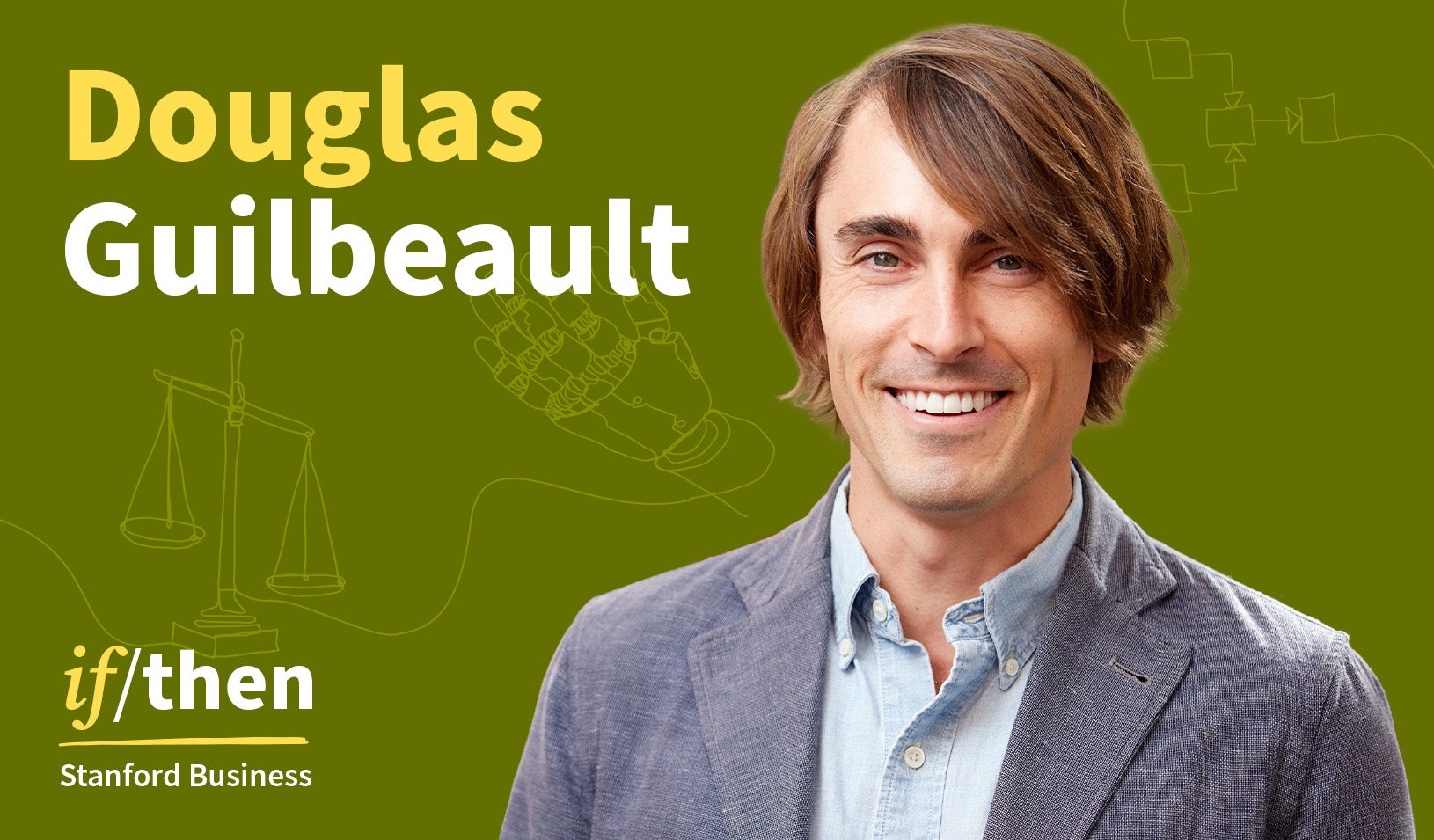
But Douglas Guilbeault, an associate professor of organizational behavior at Stanford Graduate School of Business who has done a lot of thinking about the way people think, does not believe our brains work this way at all.
“It’s certainly true that aspects of thinking involve making predictions,” he says. “And sometimes we have to solve rational problems. When we define it that way, like when we write a test and make certain puzzles, it may very well be the case that AI is going to be as good or in some cases better at solving some of those kinds of problems. But there are so many other fascinating and complex aspects of human life that involve a really, really subtle and profound interaction of our minds and our behavior and our social context.”
The world is far more complex than an LLM’s understanding of it, and there are lots of things that it’s impossible for us to know. What is the person sitting opposite us really thinking? And what are they thinking about us? Life is full of uncertainty. Human beings also have a limited number of neurons. We can’t just expand our brains the way AI companies expand their data centers. We have to work with what we have.
“When you actually look at human behavior in the wild,” Guilbeault says, “the vast majority of the time, people are making decisions under circumstances where they have very little data and are unable to get the data they would need in order to really develop a high confidence in the outcome. Or they’re lazy or distracted or just simply limited in how much information they can process and make sense of.”
Herbert Simon, a Nobel Prize-winning economist and one of the founders of the discipline of organizational behavior, called this method of decision-making “satisficing”: People gather information only up to the point where they can make the intuitive leap to a satisfactory conclusion. Historically, this hasn’t served humanity that badly. People built cities, established trade routes, and constructed international financial markets before anyone created a complete map of the world. Einstein used a thought experiment about a train and a flash of light to extrapolate the special theory of relativity.
This doesn’t just apply to geniuses: The average toddler can’t read a dictionary or a textbook, but by listening to conversations around them, they absorb the rules of grammar and make the cognitive leap from babble to sentences. Linguists have devised an equation called the Tolerance Principle to precisely calculate how much information is necessary for children to make some sort of order out of what seems like linguistic chaos.
When Guilbeault was a PhD student at the University of Pennsylvania, he and his friend Spencer Caplan took a seminar with Charles Yang, a professor of linguistics and cognitive science. Yang was interested in how people learn rules and language. As they worked together, he, Caplan, and Guilbeault began to wonder if there was some sort of connection between how children learn grammar and how people learn social rules.
Previous researchers assumed that humans learn social conventions the way LLMs learn to generate content: Either through imitation or optimization, they absorb and process enough information to be able to predict what to do in any situation. But Guilbeault, Caplan, and Yang wondered if adults learn social norms the way they once learned language, through satisficing. And if so, was there a measurable threshold like the Tolerance Principle?
Recently, Guilbeault and Caplan (now at CUNY Graduate Center) reunited with Yang to conduct a series of experiments, which they described in a paper in PNAS.
Games Reveal the Rules
The researchers considered a variety of settings, including social media, to test their threshold theory. Yet they decided to use games instead, reasoning that the environment would be more closely controlled. Also, Guilbeault says, “If we study people in really simple environments like games and we can’t understand how they’re functioning, what chance do we have of understanding how they behave in environments that are way more complicated?”
The first game, the Name Game, involved showing a group of 24, 48, or 96 people a picture of a face and asking them to give it a name. If more than one participant suggested the same name, they were rewarded. The participants were unable to talk to one another or strategize ways to promote a particular name. The game would continue for multiple rounds until the group reached consensus. This took between 20 and 30 rounds, regardless of the size of the group.
Then the researchers used four different models based on theories of human learning to analyze the groups’ choices. The Tolerance Principle provided the best explanation: There was chaos until more members of the group noticed that there seemed to be a social rule in play and began repeating the dominant name. A follow-up experiment, in which a small minority of dissenters was planted within a group, showed that consensus could be overturned once opposition reached 25%.
In the second game, the Mind Reading Game, participants had to predict whether someone else would choose red or blue, despite contradictions and other “noise.” It had similar results: The Tolerance Principle was the best at predicting the participants’ behavior.
“The fact that we show the Tolerance Principle is by far the most successful at capturing what’s actually happening suggests that it might be something really fundamental about how we understand each other and relate to each other socially when we try to make inferences about what people actually think and what they actually intend, despite the fact that we only get really limited data when we observe them,” Guilbeault says. “I think there might be something powerful about some of these simple rules that end up working really well at allowing us to find common ground and coordinate despite that information gap.” And, amazingly, it can be captured in a simple equation.
Guilbeault plans to continue to explore the Tolerance Principle in other aspects of social behavior, specifically social contagion, one of his main scholarly interests.
He also wants to emphasize that these intuitive and imaginative leaps, from confusion to understanding, are what distinguish human intelligence from machines.
“We take for granted how we go from not really understanding to suddenly getting the gist of something,” he says. “And that core process is still very mysterious. And I’m on a bit of a mission to champion that because I think it’s largely missing from the conversations in the world of AI.”
Douglas Guilbeault teaches Designing Culture: Networks, AI, and the Future of Organizations and Theoretical Computational Social Science.
For media inquiries, visit the Newsroom.