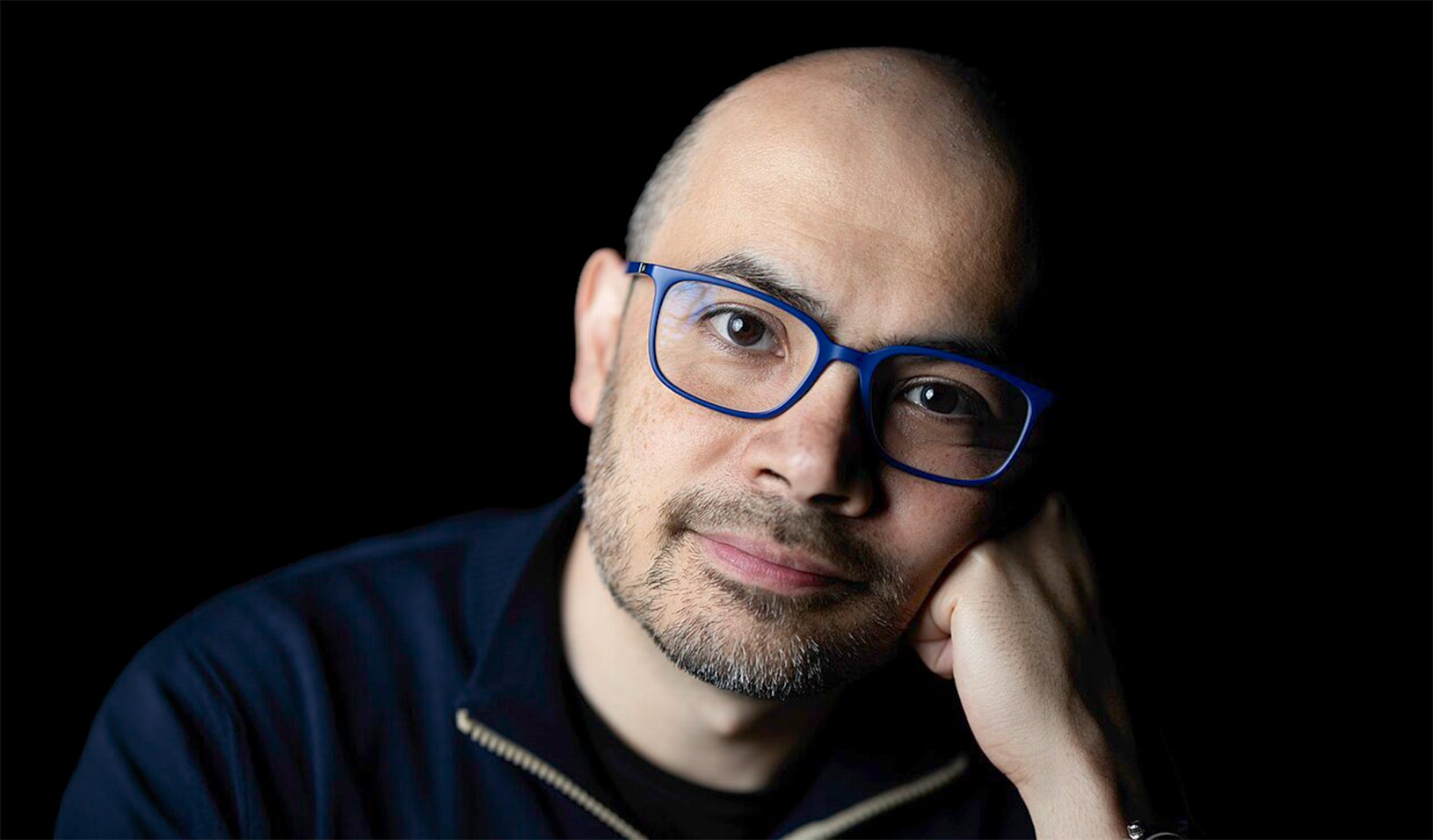
“Humans manage to do so much with surprisingly little,” says Douglas Guilbeault, an assistant professor of organizational behavior at Stanford Graduate School of Business. “Whereas AI, by comparison, is doing relatively little, but with so much power, so much compute, so many resources, and by comparison, relatively fewer constraints.”
On a bonus episode of the If/Then podcast, Guilbeault describes the implications of his recent work. Guilbeault and his colleagues believe they have identified a key principle that distinguishes human intelligence from machine intelligence — and illuminates the limitations of machine thinking.
“You encounter a lot of noise, a lot of chaos, a lot of randomness,” Guilbeault says. “We somehow figure out how to make meaning and establish strong understandings from within that.”
Although some researchers and AI boosters believe both people and AI learn via optimization, Guilbeault and his colleagues have shown that a concept known as satisficing — or absorbing a limited yet sufficient amount of information to act appropriately — more accurately captures how humans distill the seemingly infinite complexity of the world.
“Humans are just an absolutely magnificent form of intelligence,” he says. “The question I’m asking myself is, ‘Why are people so ready to shortchange human brilliance?’”

If/Then is a podcast from Stanford Graduate School of Business that examines research findings that can help us navigate the complex issues we face in business, leadership, and society. Each episode features an interview with a Stanford GSB faculty member.
Full Transcript
Note: This transcript was generated by an automated system and has been lightly edited for clarity. It may contain errors or omissions.
Kevin Cool: This is If/Then from Stanford Graduate School of Business, where we sit down with faculty and explore how their research deepens our understanding of business and leadership. I’m your host, Kevin Cool.
Michael McDowell: And I’m Michael McDowell, a producer here at the GSB. Kevin, we have another fascinating AI conversation today.
Kevin Cool: Fascinating is the right word, and what’s particularly fascinating about this one is that we’re talking about what AI can’t do and may never be able to do.
Michael McDowell: And that’s something we don’t hear very often. So, you spoke with Douglas Guilbeault, an assistant professor of organizational behavior here at the GSB, and I have to say, as an admitted non-expert, it feels like Doug is really onto something.
Kevin Cool: Yeah, I agree, he is. What he’s done essentially is look at how AI learns in comparison to how humans learn. And what he discovers is, and, and what I find particularly interesting, is that human cognition is more complex than simply doing big calculations to arrive at answers, what he would describe as a sort of, quote, brute force, unquote, approach.
Michael McDowell: It isn’t as if Doug is saying that this technology isn’t incredibly phenomenally impressive. It’s just he’s saying, “So are we.”
Kevin Cool: Exactly. So are we.
Michael McDowell: And I think that’s a great place to leave it, so without further ado, Kevin, let’s go right to your conversation with Doug Guilbeault.
Kevin Cool: You have a new paper out. And the title of it is ‘A Simple Threshold Captures the Social Learning of Conventions’, which, spoiler alert for our listeners, doesn’t say anything about AI. But a lot of what we talk about today has big, big implications potentially for AI development and its applications.
Before we get into all of that, though, I just wanted to sort of set the frame for the conversation here a little bit and ask you, why is understanding how humans learn essential for AI development? Or is that even the right question?
Douglas Guilbeault: Yeah, it’s a wonderful question, and I would start by saying that it’s not simply that learning how humans learn, unlocks a fundamental understanding about learning in general. It’s that humans seem to learn through particularly special and puzzling ways. What seems to characterize human learning, both individually and socially, is we manage to achieve a lot, an enormous amount, from surprisingly little.
And so, what I mean by that is we are confronted with so many constraints. We have a body of a very particular kind. Our brain is really powerful, elegant machine, but it has all kinds of quirks. It’s all kinds of limitations. Like —
Kevin Cool: You were describing me individually there. Thank you.
Douglas Guilbeault: Yeah. So, things like limitations of memory, limitations of attention. we can communicate really well, but we have to do it with a particular kind of vocal system. You name it. Like, wherever, you look at in the human experience, there are constraints, but consistently, we manage to punch well above our weight in terms of our ability to understand things of pretty robust, insightful, even, potentially even universal or infinite scale. And if you think about our achievements in mathematics and quantum physics, let alone, like, the complexity of the world that we’ve built, and current technologies, right?
And so, the puzzle of human learning is actually an, an age-old puzzle of it’s not quite how does something come from nothing, but it has that flavor, which is, like, how does so much emerge from surprisingly little? And the reason why this is such a crux puzzle for AI is the current AI approach is the exact opposite strategy.
So, we’re actually at present doing, when I say surprisingly little, I mean in comparison to everything that humans can do. Of course, AI is increasingly able to do quite a lot, but it’s a direct function of so much computing power, so much engineering, and so much data. So, by contrast, it seems humans manage to do so much with surprisingly little, with all these constraints, whereas AI is, by comparison, doing relatively little, but, with so much power, so much compute, so many resources, and by comparison, relatively fewer constraints.
Kevin Cool: So, I’m gonna, I’m gonna read a little bit from the paper —
Douglas Guilbeault: Yeah
Kevin Cool: … and then have you respond, and I hope that will sort of frame it and take us —
Douglas Guilbeault: Absolutely
Kevin Cool: … take us down that lane. Optimization-based models, which you’ve been talking about, “Optimization-based models of human behavior may overlook some of the simple categorical processes that characterize human social learning as satisficing.” Now, when I encountered that word, I’d never heard that word before. Just first of all, just quickly tell us what is satisficing?
Douglas Guilbeault: Yeah, so arguably one of the founders of the field of organizational behavior is Nobel Prize-winning, Herb Simon, and he’s, he’s famous for this book, “Organizations”.
And satisficing was this idea that he, he had this sense that if you really take seriously the limitations that people face individually, like they actually can’t gather all the information. Most of the time they have pretty limited information. They’re lazy, they’re tired, or they’re, multitasking, and they have to make decisions under time pressure with limited information. Satisficing is basically his term for people really pursue like satisfactory models or beliefs. So, they wait until something’s good enough.
Kevin Cool: Good enough, yeah.
Douglas Guilbeault: And then they proceed. And so satisficing was basically that idea, that you’re, you’ve reached a satisfactory model. But his point was not it’s not even that they necessarily realize that they’re making a compromise and they’re satisficing. It’s like that’s just how we roll. We’re just —
Kevin Cool: Yeah
Douglas Guilbeault: Basically, vague but, but effective enough approximations and then just adapting in real time. Yeah.
Kevin Cool: We’re somehow making a calculation about what that sort of point is, but that’s a, that’s a good proxy for, I think, describing what that means. So let me just go on here.
“Despite their many achievements, the accelerating embrace of AI methodologies and LLM specifically as a framework for simulating human learning is likely to maintain this blind spot, since such models are prevailingly designed to emulate human behavior through a brute force, statistically optimized approach,” Which again, you’ve talked about. So, what is this blind spot?
Douglas Guilbeault: Yeah. So, in contrast to what we were saying before about humans having very limited data and just having to roll with these flexible adaptive concepts, LLMs, do exactly the opposite. So if you think about the core logic of an LLM, it’s based on the following problem, which is I have a sentence like, “I grabbed the leash to walk my blank,” and it would remove a word like dog and then try to predict what word is most likely to fill that slot.
Kevin Cool: Right.
Douglas Guilbeault: How does it do that? It looks at every sentence ever created on the internet.
Kevin Cool: Yeah. Right?
Douglas Guilbeault: Yeah. And that’s what I mean. It, it has this high set of hypotheses where the hypotheses are all the possible words that could go into that slot. Now, humans say, “Oh, well, it’s obviously dog,” but we’re in a world where, like, we take for granted that we have intuitions and familiarity and experience.
The AI model starts without any of that, and that… I mean, in some ways, that’s what makes them fascinating, right? But they’re pitched as, like, they learn it all from the data.
Kevin Cool: Yeah.
Douglas Guilbeault: That’s why you need data centers basically the size of, like, Austin, Texas- because it’s cranking through every possible combination of word based on, like, which words have shown up with each other in all the different sentences, all of these different data sets, just to complete that one prediction problem.
No human has encountered a fraction of that amount of data to the point where you could argue that they must be learning these, these tasks through just a fundamentally different approach.
Michael McDowell: Yeah.
Douglas Guilbeault: Cause it’s not realistic to say, “Oh, therefore, they must be doing some next order problem of optimization where somehow they manage to go way beyond the current data,” because it… the, the statistics don’t add up. It doesn’t add up how you could possibly fill that slot. The premise is they must just be adopting, a qualitatively different kind of approach, one that we honestly don’t have a full theory for.
And as a side note, you know, and this is sort of where I’m coming from, is like we’re still very early days in cognitive science. Like, it’s barely integrated with neurobiology, let alone, like, understanding, cultural evolution and all the, like, ways that technology influences our behavior. There are so many fascinating open questions, but that’s precisely why we’re not in a position to say, “Oh, LLMs or AI are, are solving problems or doing things the way that humans do or in a way that’s even comparable to humans —
Kevin Cool: Yeah
Douglas Guilbeault: …let alone that they’re in a position to replace humans.”
Kevin Cool: Sure.
Douglas Guilbeault: So that’s sort of the deeper set of problems, and —
Kevin Cool: So, what are the implications of that in your mind? What, what does that suggest going forward? And, and as, as a sort of, additional question to that, who do you think needs to know these insights and, and who you’re trying to influence with them?
Douglas Guilbeault: Yeah. So, I’m trying to speak to every person who is trying to understand their place and their purpose in the age of AI. And what I see pervasively, is a sense of disempowerment and fear as these companies and a lot of the AI researchers continue en masse to put out this grandiose narrative that we’re on the verge of creating a super intelligence, that we’re gonna automate all this, cognitive work that humans do. Like maybe, and I’m not making this up, you’ll have people say things like, “In five or ten years, we won’t need human scientists ‘cause AI can do all the science.”
Kevin Cool: They’re essentially replaceable by AI, yeah.
Douglas Guilbeault: Right. And it goes even a step further, which is you have AI companies, just the other day, I saw an advertisement in San Francisco from an AI startup where the tagline just said, “Predict anything.”
So they’re in a world where they’re putting an enormous amount of stock in their very particular approach to learning and saying it’s not just that they’ll be able to learn as well as humans and better, but they’re gonna be able to learn all the social world and its complexity and then have, you know, think of all the control possibilities, all the influence possibilities. People see this narrative, and they’re rightly concerned and afraid.
Kevin Cool: Frightened. Sure.
Douglas Guilbeault: Like, are humans going to become obsolete? And to me, we’re in absolutely no position to conclude any of that. If anything, what I hope through this research and this broader set of, perspectives is, in some ways, humans are just an absolutely magnificent form of intelligence because somehow, we, again, we’ve managed under all these remarkable constraints to figure out profound things about this universe.
Think about, like, the nature of infinity or quantum physics. And, and this is something I don’t think people fully appreciate, is, like, the achievement that goes into something like quantum physics, where we can predict the movement of particles to, like, 0.000000000001 precision. We have clearly developed a pretty serious level of understanding about this universe. All the mathematical paradoxes that we’ve understood, all of the incredible feats of brilliance in the arts and the expression and culture. And the question I’m asking myself is, why are people so ready to shortchange —
Michael McDowell: Yeah
Douglas Guilbeault: …the, the, the, the, the human brilliance and let alone the fact that we’ve only had science and engineering for basically, to cast a broad stroke, two hundred years, whatever. There was another ad I saw in San Francisco from a startup company which said, “Humanity has had a good run.”
Kevin Cool: Wow.
Douglas Guilbeault: So, putting aside, putting aside, putting aside the very, very legit ethical question of why would that be your, your public-facing message.
Kevin Cool: Right. And why would you want to state that if you’re trying to attract investors —
Douglas Guilbeault: Exactly.
Kevin Cool: …or adopters or whatever.
Douglas Guilbeault: It’s like trying to invite them to a run of the lemmings off the cliff, you know?
Kevin Cool: Yeah, yeah.
Douglas Guilbeault: Like, come on, everyone’s doing it.
Kevin Cool: Yeah, yeah.
Douglas Guilbeault: You know, but I say this, I present this to my students who are the MBAs, and I basically say, like, I show them the picture of the ad, and I say, like, “We can all agree this is bad vibes, right?”
Kevin Cool: Yeah.
Douglas Guilbeault: And they all laugh, but then I say to them, “Yeah, but we’re, we also have to figure out how to respond to this ‘cause it’s growing. It’s a way of thinking.” And one of the things I think that gets it off the ground is this perspective that humans are just these prediction machines, we’re just, at some level, under the hood, just crunching numbers. And of course, a machine’s gonna be better at that.
Kevin Cool: Right.
Douglas Guilbeault: And if that’s how you think about intelligence, you’re not only drastically misrepresenting all of the complexities and the enumerable, like, all these radically different capabilities that humans have. If you compress it all into its all just prediction and number crunching at the end of the day, then you’re not setting yourself up to, to be able to motivate or defend your relevance.
Kevin Cool: Yeah, if AI were, you know, a personality, you could say, “If only I could do what humans do.”
Douglas Guilbeault: Right.
Kevin Cool: Right? After the break, we’ll talk about why Doug believes what’s going on in our heads is fundamentally different from the way AI works and why that matters
I’m going to poke at some things to see if I can get to a, a really clear understanding here. So clearly there’s some sort of nuanced process that’s going on.
Douglas Guilbeault: Yeah.
Kevin Cool: …in the human brain that AI so far has not achieved. Are we talking about some amalgam of intuition and experience. Can you tease this apart for me? What, what is it that we’re really sort of suggesting that might be different in the human brain than what an AI could produce?
Douglas Guilbeault: Yeah, this is, again, another wonderful question. I’ll start by saying a word like intuition, I think it generally resonates that people have a sense of what that means. There’s a lot of frustration or criticism with that term as a technical term scientifically that leads a lot of people to dismiss it.
I tend to be of the side where I actually don’t dismiss it. I agree that it’s not exactly clear, but the reason why I don’t dismiss it is there’s just so many accounts of, like, famous mathematicians or scientists and artists who, like, in their own biography, like, put a lot of stock in something like intuition.
Kevin Cool: The ah-ha moment, right?
Douglas Guilbeault: Yeah, exactly. And what I like about it, even though we still don’t understand it, is there’s a way in which it involves a kind of leaping, like an epiphany, where it’s not a gradual step from what you’ve been thinking or what you’re familiar with. It’s like you fundamentally are struck by a new way of thinking about something.
And to the extent that it evokes something like a leap of inference or insight, I actually think that is deeply, deeply characteristic of human learning. And I actually think what we find in this paper could be construed as a kind of conceptual leaping.
And there are very real debates happening in the AI world right now that the current large language model architectures are not capable of doing that because they have to they have to move step by step in a smooth, they would say continuous way, where you have to be within some sort of space that they’ve understood.
So, in terms of what makes that possible, one inkling that has some evidence is humans don’t just think statistically. There’s actually a number of kinds of counterintuitive mechanisms that human’s reason through. One is, we use a lot of metaphors and analogies. We are able to develop, for lack of a better word, like feelings towards ideas. So, you know, in current language, we would say, like, vibes or these sorts of things.
Kevin Cool: Yeah.
Douglas Guilbeault: But there is a reality to that. There is a sense, like an aesthetic sense that, like, and I experience in my own work, I know lots of people who experience it, where you just kind of know something’s a good idea. You don’t exactly know— You can’t even put it… There’s an ineffability to it.
Kevin Cool: Yes. I think everyone can relate to that, right?
Douglas Guilbeault: Yeah.
Kevin Cool: You sort of know it when you see it sort of thing.
Douglas Guilbeault: Yeah. And one of my favorite examples, ‘cause it is like there are mathematicians where they will have an intuition that either a problem is solvable or there’s a particular way to solve a problem. And it will take them 10 years, and they will fail and fail again and again and again. And people around them will tell them that they’re crazy, that it won’t work. At that point, you would characterize their behavior as irrational.
But then we know, I mean, some of them, they end up failing, and we don’t hear about those cases. But then some of the time, they end up succeeding, and it’s a major breakthrough. And what was it that they held on to? Some, some intuition, some sense that this was the right direction despite all odds. And that’s, that’s something that I think is really profound and fascinating about human learning, that we, we really are nowhere close to understanding fundamentally now. And it does not at all fall out of the current statistical framework. If anything, they just kind of sidestep it or are not even conversant with that being as foundational of a problem as it is.
Kevin Cool: Yeah. If you were going to describe this paper or this research in a way that would tell us what kind of the foundational thing is that you’re seeking to answer here, what is that?
Douglas Guilbeault: Yeah. So, on that theme of how humans manage to do a lot with a little, the specific puzzles and mysteries that lie in that is like the stuff that falls in that little camp, like what are the components? What are the basic principles, the regularities?
We found a simple mathematical regularity, a rule-like pattern that appears to characterize everything from how children learn grammatical rules, uh, how they learn simple mathematical rules.
Kevin Cool: Mm-hmm.
Douglas Guilbeault: We’ve shown that these same, the same regularity also characterizes how humans learn behavioral patterns, possibly quite a wide range of behaviors, everything from what style of clothing, like formality or informality is appropriate to wear at work, what are the greetings that people say —
Kevin Cool: Yeah
Douglas Guilbeault: … what are the topics of conversations as a, that are appropriate or inappropriate in particular contexts.
And then we’ve also generalized it even to just how we make inferences about what’s going on in each other’s heads, like what we’re actually, thinking or feeling or believing in particular, interactions.
Kevin Cool: Yeah.
Douglas Guilbeault: And so, we’re excited about the possibility of having something very simple that we can hold onto —
Kevin Cool: Yeah
Douglas Guilbeault: …to understand all these different phenomena.
Kevin Cool: Yeah. This, this just sounds so interesting, and it’s unlike, frankly, anything that I’ve heard before.
So, let me ask you this. There, there’s been— Part of the conversation is sort of what is the ceiling for AI? What’s the upper limit of what it can know or do? Do these findings suggest that there is an upper limit?
Douglas Guilbeault: Well, it’s a very good question because, so I will say like one of the things that we show in the paper, right, is like this optimization framework is very limited in predicting human behavior.
And it’s not in the paper, but we have results that we will be submitting for publication soon where we replicate LLMs in these experiments and they behave exactly what you would expect of the more optimizer approach.
What does that mean? It means that if LLMs are learning human behavior through all these predictions, there might be a limit to which that approach can understand the underlying human —
Michael McDowell: Yeah.
Douglas Guilbeault: …nature —
Kevin Cool: Yeah
Douglas Guilbeault: … which is we’re the, creative leapers, because what we see in the threshold paper is, and this might not come across to people reading it, is it’s not just that, oh, there’s this simple rule that people use that they learn, but that rule has this very unique property, which is in the early stages before that tolerance principle is reached, people’s behavior is basically random.
And then suddenly they converge to a stable categorical understanding. So, they’ve leapt from a random state to an ordered state. There may be a fundamental limit in the ability for LLM to understand that kind of transitional behavior.
Kevin Cool: Right.
Michael McDowell: Right.
Douglas Guilbeault: And that’s actually something that, humans seem to… There’s a paper that came out in PNAS a year ago looking at when do mathematicians have their insights, and they’re following their behavior at the board. And they show that right before they have an insight, their body actually becomes more erratic and random, their eye gazes dart around.
Kevin Cool: Wow.
Douglas Guilbeault: They become more chaotic and noisy. So, I mean, that’s just a cute example, but there are so many ways in which humans actually seem to be able to harness randomness and inhabit disorder and, and incoherence and ineffability and chaos and somehow make meaning from that state.
It’s not clear to me that LLMs or any, current approach to understanding AI is positioned to solve that problem.
Kevin Cool: Yeah.
Douglas Guilbeault: And one of the reasons, and I I know I could go on and on, is, you know, I think the, the party line from an AI hype person would be like, “No, but that’s what AIs do, ‘cause we give them all this data, and they just have to learn from the bottom up.” But that’s not what they’re doing. You’ve given them highly structured data. You’re not giving them order and chaos and ineffability and randomness.
Kevin Cool: Right.
Douglas Guilbeault: You’re giving them sentences which are, in some ways, perfectly designed to be learned from. ‘Cause I can knock out a word and know for sure that a word’s supposed to be there, and I know for sure that other language that I’ve seen in the world will help solve that problem.
That’s the kind of crutch, a learning crutch, that humans fundamentally do not have. We did not have it in our evolution as a species. I mean, you could debate to what extent our biology has given us some of that but suffice to say for this point that we are, we actually have to solve a fundamentally different problem. Which is you don’t even know if there’s regularity and order in the world at all, and actually, you encounter a lot of noise, a lot of chaos, a lot of randomness, and we somehow figure how to make meaning and establish —
Kevin Cool: Yeah
Douglas Guilbeault: …strong understandings from within that.
Kevin Cool: This is just absolutely fascinating, ‘cause as you’re talking, I’m thinking about all the various situations in one’s life, even in one day —
Douglas Guilbeault: Yeah.
Kevin Cool: …in which what you’re describing is part of your, quote-unquote, “learning,” you know. What is lost, do you think, … if we assume that everything is sort of a matter of optimization?
Douglas Guilbeault: I’ll end by saying something perhaps poetic, but I hope it’s, it’s pregnant and gives the listeners a sense of all that this could possibly, imply.
Which is, you know, a driving force in the sense of awe and wonder that powers science and artists and spirituality is a sense that there’s a fundamental strangeness. Things are so overwhelmingly complex and beautiful and chaotic. There’s a strangeness, there’s a weirdness to knowing and experiencing something like infinite potentials, having a sense of meaning. Like, you know, Wittgenstein, my favorite philosopher, said, “The mystery is not what exists, but that it exists,” that this is —
Kevin Cool: Yeah, yeah, yeah.
Douglas Guilbeault: …and we have some stable felt reality of that. What’s lost is the fact that that matters at a foundational level. There’s a way in which this optimization approach is a mechanization approach, and what, you know, people who come from a rational point of view, they wanna be dismissive and say, “No, I don’t need to feel this strangeness or weirdness. I don’t need to include that into my models because it’s all a machine at the end of the day.”
Now, I’m not saying it’s not mechanistic. I think there are ways in which these things work, but the mystery is, like, I actually think when we end up developing an understanding of all these things, it will be in service of pointing out the strangeness.
Kevin Cool: Yeah.
Douglas Guilbeault: There’s a weirdness to human nature. It’s strange, it’s quirky, it’s idiosyncratic, it’s creative —
Kevin Cool: And beautiful.
Douglas Guilbeault: … and beautiful. And, and one of the things I would point to is look at biology. Biology is, is crazy. Look at all the different life forms, like the giraffe, the squid. That’s the kind of system we are. We’re not this orderly machine as much as society and the incentives and the forces that might want that to be true.
Kevin Cool: Doug, I, I actually was riveted by this conversation. I hadn’t heard a lot of this before. I hope this research gets transmitted and has some impact on how people are thinking about these things and thank you very much for being here.
Douglas Guilbeault: Thank you. It’s absolutely such a pleasure, and I hope we can, not just us, but I hope people continue this conversation forward. I think it’s a really important conversation to be having.
Kevin Cool: Absolutely. Yeah, thanks.
If/Then is a podcast from Stanford Graduate School of Business. I’m your host, Kevin Cool. This episode was produced by Michael McDowell, editing and mixing by Will Stanton. Elizabeth Wyleczuk-Stern is our head of content and operations, and Kristin Harlan is captain of this ship. Additional production support from Jim Colgan, Whitney Legg, Tatiana Goldman, and Aech Ashe.
For more on our faculty and their research, find Stanford GSB online at gsb.stanford.edu or on social media @StanfordGSB. Thanks for listening. We’ll be back with another episode soon.
For media inquiries, visit the Newsroom.