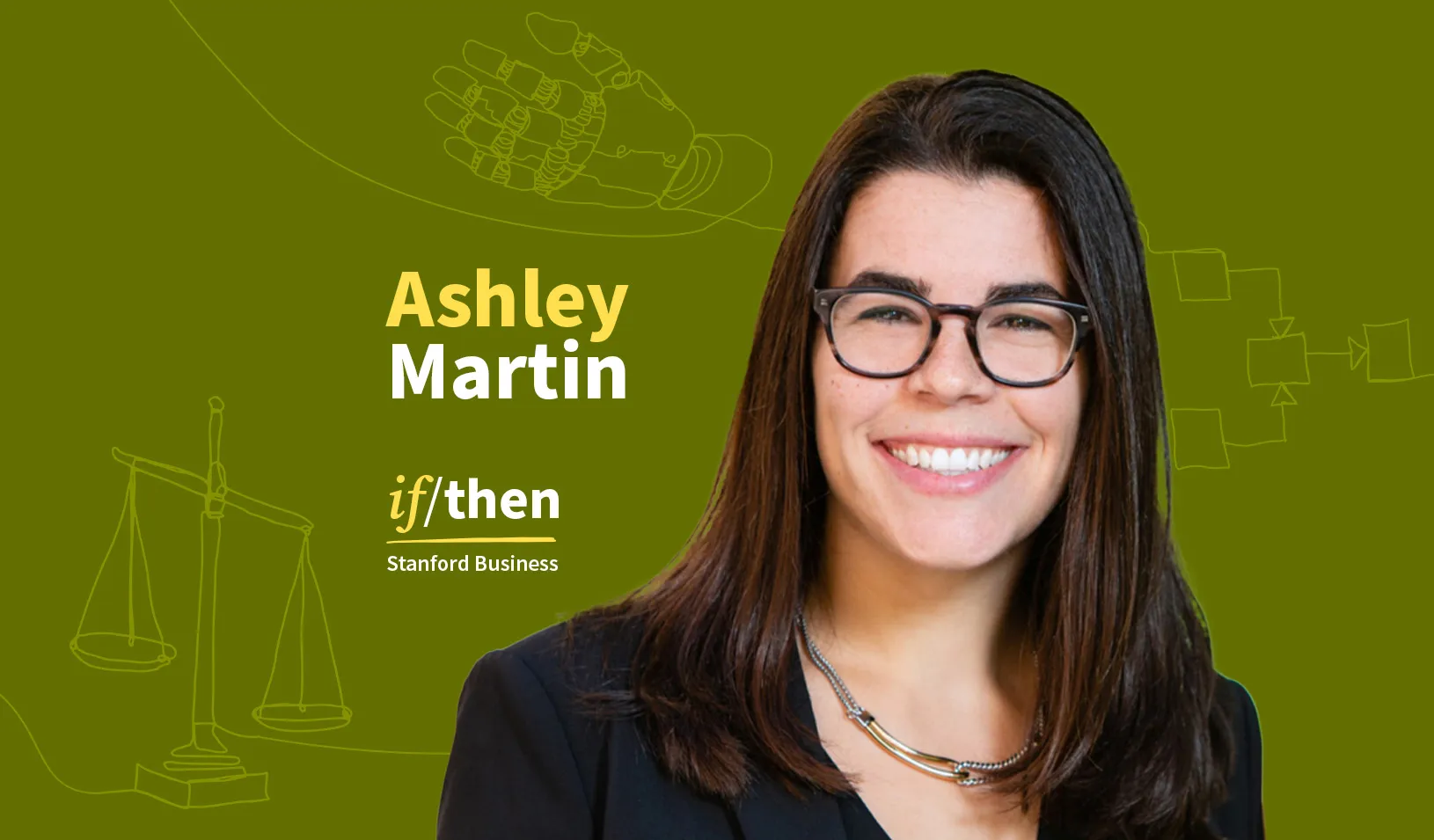
“We spend a lot of time talking about gender inequality through the lens of women’s disadvantage,” says Ashley Martin, an associate professor of organizational behavior at Stanford Graduate School of Business. “I think that many of the problems that we’re seeing today… are actually bound up in masculinity.”
On this episode of the If/Then podcast, Martin discusses her recent research, which examines how traits associated with masculinity are simultaneously organizationally rewarded and personally harmful to men. “Being seen as aggressive and strong and tough is an advantage at work, but at the same time, by not seeing men as compassionate and emotional, we’re actually denying them the fundamental human traits and capacities that are really important for people,” she says.
“Things that only humans can have — like morality and compassion and the ability to love and feel and express and emote — these are all fundamentally and uniquely human traits, and they’re all associated with women,” Martin explains. “And if we look at the traits that are associated with men, like tough and strong and hard and aggressive, many non-human things also possess those traits. Tables can be hard. The stock market can be aggressive. Steel can be strong. These are all things that we talk about when we talk about non-human things.”
On the flip side, digital assistants and other “helpful” technologies are often gendered as feminine.
Martin’s findings have important implications for how we understand gender in and out of the workplace. She believes that her work could be applied to all sorts of issues, from rising authoritarianism to climate change.
“Masculinity is my new frontier,” she says. “This is a totally new line of research and one that I’m very excited about.”

If/Then is a podcast from Stanford Graduate School of Business that examines research findings that can help us navigate the complex issues we face in business, leadership, and society. Each episode features an interview with a Stanford GSB faculty member.
Full Transcript
Note: This transcript was generated by an automated system and has been lightly edited for clarity. It may contain errors or omissions.
Kevin Cool: How do the movies you watched growing up Shape your idea of what it means to be a man.
Natasha: I grew up watching a lot of like Raiders of the Lost Ark and Jaws, and all those like very manly men movies.
Kevin Cool: We asked moviegoers that question as they were coming out of the AMC multiplex in Emeryville, California, on a recent weekend night. Like Natasha, a senior at UC Berkeley.
Natasha: It’s all about men going to places where they don’t belong, and then just kicking butt and killing sharks.
Movie Clip: “Shut off that engine.”
Kevin Cool: Natasha says her dad felt it was important for her to watch these movies.
Natasha: He’s got this like very manly perspective where he’ll make me watch a lot of those movies that like came from the seventies, eighties, and a lot of them I really like, like I love Raiders, I love Jaws. But certain ones now, I’m like, I’m not watching that.
Riley: I grew up in the early to mid two thousands, so a lot of the media I was ingesting was a backlash to the macho, hyper-masculine idea.
Kevin Cool: That’s Riley, an elementary school librarian from Oakland. He says he was interested in nerdy films growing up, but his father was into more macho genres, like Westerns and Blaxploitation films.
Riley: The hyper-masculine idea of my father’s day was “The Cowboy” and “The Pimp”, both people who took charge, and in the Cowboy’s case, he went alone and was solitary.
Movie Clip: “See, in this world, there’s two kinds of people, my friend, those with loaded guns, and those who dig.”
Kevin Cool: Natasha says she could tell how much these manly films influenced her father.
Natasha: My dad is a lovely person with so much kindness in his soul, and like myself, he has a very strong sense of justice. And he used to get into a lot of fights when he was younger, a lot of the times defending people in his life, a lot of the times women. And I think that sort of inclination comes from these very masculine movies where, like it is men going out into the world and like doing a sacrifice for the sake of others.
Riley: I think my dad internalized some of them.
Kevin Cool: Riley believes these movies affected his dad’s behavior.
Riley: He was always the loudest and funniest person in the room, so I feel like he sort of put on the performance of masculinity that he was seeing in tv.
Kevin Cool: What about movies coming out today?
Natasha: I just watched Marty Supreme recently. I thought that movie was terrible.
Movie Clip: “Hey, I’ll rip that unibrow right off his forehead. All right. You want to get physical? Like an eight.”
Natasha: So, Marty Supreme is all about this very masculine narrative about this guy going to these places that are foreign to him to find success for his family, I mean, he is not really doing it for his family. I know so many men who have seen this movie and been like, oh, I loved it.
Kevin Cool: Riley has a different take.
Riley: When you watch that movie, I see it as the male audience has two paths. We can either be like Marty Mauser, who lies and cheats and steals and has little to no empathy for anyone other than himself. Or we can be like his friend who survived the Holocaust and covered himself in honey in order to feed his brothers in Auschwitz.
Kevin Cool: If you haven’t watched the film Riley’s talking about a scene that shows starving concentration, camp prisoners licking honey off of the character’s chest.
Movie Clip: “And I smear the honey all over my chest, my arms, everywhere.”
Riley: And that scene was very powerful to me because it was, it showed a level of tenderness between men and a level of intimacy between men.
Kevin Cool: Movies and TV shows both shape and reflect our ideas about gender. And that affects all of us according to Ashley Martin, associate professor of Organizational Behavior at Stanford Graduate School of Business.
Ashley Martin: We oftentimes talk about women not being qualified for leadership positions because they’re too emotional or they’re too compassionate, right? But at the same time, by not seeing men as compassionate and emotional, we’re actually denying them the fundamental human traits and capacities that are really important for people.
Kevin Cool: We’ll talk with Ashley about the frontiers of gender research, specifically her research on masculinity. How does the way we think about gender impact our lives and the organizations we’re part of?
This is If/Then from Stanford GSB, where we sit down with faculty and explore how their research deepens our understanding of business and leadership. I’m your host, Kevin Cool.
To start, we talked with Ashley about why she got into this subject in the first place.
Ashley Martin: I came into it wanting to know more honestly about my experience as a woman in the workplace. So, sometimes they say research is ‘me search’, and I was in a very competitive business program in my undergrad, I was an accounting major, and I was interested in the experience of feeling a little bit excluded and maybe some of the stereotypes that were applied to me. So, I was interested in, in mainly why I felt so different and why inequality exists in, in a number of organizations and why people just treat men and women differently. So that’s how it started.
Kevin Cool: So, let’s dig into the papers themselves a little bit. And I’d like to have you talk a little bit about what you found, for example, when you take gender out of, say a hiring process, what happens?
Ashley Martin: Yeah, so there was a number of different studies that showed, not even just my work, but basically showed that when you de-identified resumes or you used genderless resumes, or even genderless names, you know, you mitigated some gender bias.
So, women were more likely to get hired, when, let’s say there was a curtain in front of an audition for orchestras. Or if you took names off of resumes, women were more likely to get callbacks. But when it came to imagining a person or guessing as to who is behind that resume or who is behind that wall or curtain, people were still using gender.
And in fact, they oftentimes were assuming, that that person was a man. And so, were we really getting rid of gender or were we kind of just creating an androcentric default where people were misunderstanding that women were actually, men?
Kevin Cool: So, they were defaulting to “This is a man.”
Ashley Martin: Exactly.
Kevin Cool: So, tell us about what you did in this study where you asked people to assign a gender using rocks, painted rocks to express this.
Ashley Martin: Well, yes. That’s when I started doing this 180, where I was like, actually, gender is so important. It’s not just unimportant. It’s maybe the most important social category there is. And so, I wanted to test that and look at the social categories that went along when we saw someone or something as human.
And so, one of the, probably the most infamous study I did was called like the pet rock study, and we had participants come into the lab and they basically created a, a pet rock. So, we had googly eyes, sparkles, paints, you know, pipe cleaners. And then afterwards we asked them to describe it and then we asked them the extent to which they thought it had a gender or race, or sexual orientation or an age, you know, very important social categories to people.
And what we found was that people ascribed gender much more strongly than they ascribed any other social category. But not only that, the more they ascribe gender, the more human-like they saw that rock to be. So again, gender and humanness went very strongly, hand in hand in those studies and kind of showed that, when we think of human, we oftentimes think of gender.
Kevin Cool: So, this leads me to wonder whether this is somehow some sort of encoding that leads us to that, or is there social conditioning going on of some kind? And so, your follow-up test explored that additional question, right?
Ashley Martin: Yeah. So, one question that goes along with asking is gender fundamental or is it primary? Is that a fundamental human process? Is whether or not it’s just a Western phenomenon, and there’s something specific to our culture that makes gender really important? Or is it something more, universal or evolutionary? And it’s really hard to tease that apart and tell, right? Because especially many cultures transmit information to one another. We see all the time movies and culture from other nations. And so, it spreads; there’s cultural contagion.
And so, what we did to really understand whether this was more of a universal phenomenon, we actually did this study in Nicaragua in a small-scale society, in the Mayangna community. And what was great about this sample is that they really didn’t have access to kind of global media. So, if gender took primacy in this particular community, then at the minimum we would be able to say that it’s a, a cross-cultural phenomenon. But in some cases, we might be able to say that if these two cultures who have never had exposure to one another both show that gender is primary in their understanding of what it means to be human, that it might be, somewhat more evolved or fundamental to what it means to perceive as a human being.
And so, we did that study there, and we found the exact same pattern. Actually, even in terms of the rank ordering of the different important social categories, we found very consistent evidence. So, gender was the most strongly ascribed social category, and the only one that predicted how human-like their rock ended up seeming to them.
Kevin Cool: So, there’s a suggestion at least that this could be a universal human trait, like this is just how we think about these things.
Ashley Martin: I do think that there is something more innate about the use of gender, and if I were to posture why, I think that gender just gives a lot of information about people, like who someone might be, what they might like. There is ample gender stereotypes out there to be able to kind of make a guess at, at what someone might be like, right? And I think that it’s useful in that way. So, it’s, it’s functional in trying to predict, trying to understand, and these are all things that humans seek to do. So, it makes sense to me that gender would be important, even though it’s also dysfunctional.
The same process that’s useful in kind of understanding, predicting, providing structure can also be the same process that’s, responsible for inequality and gender stereotyping and assumptions about people that are inaccurate. So, I think there’s a double-edged nature to gender.
Kevin Cool: Yeah, I’m glad you said that because it occurs to me that whenever we think about something as innate, it’s a short walk from there to ascribing certain characteristics to one gender or another, which of course leads to stereotypes, and so on. But you’re not saying that we’re just wired this way, like we’re going to automatically end up stereotyping one side or the other, right?
Ashley Martin: Well, I don’t think the content of the stereotypes are innate at all. So, do I think that there’s something about, the stereotype content of being a man and maybe associating men with like competitiveness or aggressiveness and women with nurturing or caring? I don’t think anything about that content is fundamental. I think the use of gender has been really helpful in our history and so, you know, there is something that’s been adaptive about it, particularly for being able to reproduce as a human species.
But that said, I think that that could change as well, right? The nature of reproduction is changing the categories that we have to understand different gender categories and identities is also changing. So, there’s nothing about it that I think is fixed or unchangeable, but I do think that it’s been such an important social category for so long that it is hard to tell people not to use it when they’ve been relying on it as a, an assumption or a heuristic for as long as we’ve been using it for.
Kevin Cool: Yeah. Now this might be a rather anodyne example, but I’ve always kind of wondered why are ships female. Like ships are always female, seemingly, like captains will say, yeah, she was great in that storm, blah, blah, blah, blah, and now, businesses are starting to sort of gender their products. And you did a study that looked at that as well, and it turns out it kind of works, right?
Ashley Martin: That’s the double-edged nature of gender. Yes, I do think a product gendering can be problematic in some ways, but it does lead to more attachment. At least that’s what, me and my collaborator and Malia Mason found in one of our studies.
Kevin Cool: Let’s just throw out a couple of examples. Like, so let’s say Alexa, right? What, what are some other examples that you looked at where a product has been gendered somehow?
Ashley Martin: Well, anytime a product is anthropomorphized, it’s usually gendered. It’s very rare to see some form of anthropomorphism without some sort of gender description. So, Alexa would be an example, we took products, where actually, people anthropomorphize themselves.
So, we oftentimes took robotic vacuums. You know, it didn’t come along with, you know, a gender, but people would create one. Oh, and sometimes it would be like Hazel or ah, Roombie. So, we, we took that, we took voice assistants, different voice assistants that we have.
Kevin Cool: What’s an example of a male one? I’m trying to think of one and I’m coming up empty.
Ashley Martin: You know, it’s interesting. I can’t think of one either. And there’s actually good reason why, people tend to gender their anthropomorphized products as female, and that’s because we associate women with care and tenderness and nurturance and helpfulness, right?
These are all things that we want when we’re talking to somebody. And I feel like oftentimes when people are seeking connection or companionship, they’re looking for those qualities, right? And those qualities are all attached to and assumed to be female. And so, it doesn’t surprise me that a lot of these stereotypes are kind of an entrenched in and reified through female products.
Kevin Cool: When we’re back, we’ll talk about how views of masculinity affect everyone, especially men, in surprising ways.
So, I think it would be fair to say that historically we have thought about stereotypes as disadvantaging women. But I want to pivot to a brand-new study that you’ve got out that comes at this from a different angle. And I want to actually read something from the abstract that I think frames this beautifully.
This paper reverses the traditional focus of gender research in organizational behavior by arguing that masculinity is not only a source of advantage. It is also a system of traits, expectations and values that imposes psychological and social costs on men. And just continuing, we argue that aspects of masculinity, such as stoicism, risk taking, aggression, self-reliance, ambition, and dominance are simultaneously, organizationally rewarded, as well as personally harmful.
Ashley Martin: So, yeah, this is a totally new line of research and one that I’m very excited about. But it actually came out of some of the work that I had been doing on gendered products and kind of the overlap between non-human entities, let’s say, and human traits. And one of the things that we kept finding was that these very, very fundamentally human traits, right, things that only humans can have, like morality and compassion and the ability to love and feel and express and emote, right? These are all fundamentally and uniquely human traits; they’re all associated with women.
And if we look at the traits that are associated with men, you know, the primary ones. So, I’ll give you a few, like tough and strong and hard and aggressive. Many non-human things also possess those traits, right? Tables can be hard, the stock market can be aggressive, steel can be strong. These are all things that we talk about when we talk about non-human things. And so, there was some connection between objects and men that I kept finding again and again, and it led me to wonder, well, what are the consequences of that?
What does it mean when we’re associating men with non-human things, is that actually an advantage? So, being seen as an aggressive and strong and tough is an advantage at work, right? We, we oftentimes, talk about women not being qualified for leadership skills or leadership positions, I should say, because they’re too emotional or they’re too compassionate, right?
But, at the same time, by not seeing men as compassionate and emotional, we’re actually denying them the fundamental human traits and capacities that are really important for people. And so, I’ve been thinking a lot about this question, this question of whether or not these things that we’ve assumed to be advantageous in the workplace are actually costly in our interpersonal lives.
Kevin Cool: Well, and I’m especially, and not just me, I think a lot of people are especially interested in questions like this in this current moment where we have, and I’ll just use the phrase, ‘The Manosphere’. Right? We’ve seen an increasing and pervasive, I would say, effort to reclaim men’s voices, or reclaim men’s agency maybe in some respect. And, I wanted to have you talk a little bit about this because there are certainly, I think, legitimate problems, maybe especially among young men of not feeling a sense of belonging, of feeling cut off and not knowing where to go and are finding these communities online as a substitute perhaps for that.
So, is this phenomenon that we’re seeing consistent, or does it somehow resonate with what you’re finding in your studies?
Ashley Martin: I think so. So, one implication I find of this work, and I think I’m extending beyond the data a little bit, is that we are valuing, quote unquote, masculine traits more so in women than we have historically, right?
So, when we think about women entering the workforce in the past, let’s say 50 years, they’ve entered the workforce in great numbers, and as a consequence, they’ve become associated with things like independence and assertiveness. And they’re still associated with things like compassion and morality. So, they have both of these dimensions.
And while we still associate men with these masculine qualities, more so, we still see them as more competitive or aggressive than we do women. We have not increased the extent to which we see them as emotional, compassionate, loving. And by having those stereotypes, we don’t really treat men in ways that allow them to express emotions or be loving and caring and tender.
And so, I think that’s at the heart of the problem. Where we’ve allowed women to be more masculine, but we haven’t allowed men to become more feminine. And so, when you look at how they’re dealing with the problems, oftentimes it would, you know, need more emotional awareness, more ability to connect, to be vulnerable to, you know, express concern and ask for help. These are all things that we still don’t really allow men to do, and so it doesn’t really surprise me that they’re turning to kind of these maladaptive ways of coping with the problem.
Kevin Cool: Considering that, and I’ll use your word, these maladaptive sorts of responses to those what I think are real and legitimate issues, what is the answer?
Ashley Martin: Well, I would say it’s a, it’s a really hard, question to find solutions for it. But I think a good place to start is really asking, well, how can we find connection, community support, for men and how do we find spaces in which they can be vulnerable or, look for help or support or talk about some of these issues?
Because I think one of the things that we expect is that men don’t feel. And it’s very clear to me that men are feeling a lot, you know, and they’re looking for support and they’re trying to find it in communities that I don’t think are all that helpful. And so, how do we move that kind of conversation to the surface and actually have empathy for some of the issues and the, the experiences that men are having and the fact that in society we expect men not to have those experiences.
I mean, to be a good man, part of, that notion of masculinity is to not express emotions, to be tough, to not feel. And I think that’s just so harmful for men. And so, I think kind of changing that would be a good place to start.
Now how do you do that? I don’t know. This is my new frontier, but I think trying to, attack that issue would be a nice place to start. I’d be very happy with that.
Kevin Cool: You know, I think about when I was a kid who my favorite movie stars were, well, one of them was Clint Eastwood. And one of my favorite characters was his character in ‘The Good, The Bad, and The Ugly’, where he hardly ever even said a word. he like was practically mute, that he would just show up and take care of the problem.And he was so cool at some level, right?
And so, to me, this is almost like a generational thing. It’s going to take a span of time where all of those sorts of cultural influences and what came before that have conditioned us to think a certain way. I mean, it’s hard to unwind that.
Ashley Martin: Yes, this has been my whole career, is trying to unwind gender. And figuring out how kind of entrenched it is and how tangled up it is with social cognition. It’s been very, very difficult. And I agree, what people are looking for in, in others is moving farther and farther away from masculinity. So, this idea of like non emotionality and rigidness and toughness, I don’t think people are as, attracted to that anymore, right?
And so, as the value of that changes, it becomes really hard for men in particular to figure out an alternative model. And there’s not a lot of options out there. At this point, and you look, I agree, you look at the people who are saying, “Hey men, I see you. I see that you’re hurting and it’s you know, here’s how to solve it.”
And they offer some version of a solution that’s actually really destructive, right? And we don’t have a lot of offerings of alternative solutions. And I think that’s the space that’s really exciting.
Kevin Cool: So where do you want to go next, Ashley? What’s, what’s the next thing you want to ask or explore?
Ashley Martin: Oh, well, masculinity is my new frontier. This, this work, that I’ve been doing that you mentioned is very new. In fact, some of it, most of it is not published. So, I’m very excited about looking at how the way in which we see our material world, so how we talk about, let’s say tables and, chairs and, nature is also kind of tangled up in the way in which we describe men and women, and how that shapes how we see our material worlds, and in particular, the impacts for men. I really think that that’s been an understudied area where we spend a lot of time talking about gender inequality through the lens of women’s disadvantage.
I actually think that switching and reversing that focus can help us gain a lot of insight into a lot of societal problems. I think that many of the problems that we’re seeing today whether it’s, you know, authoritarianism or even, kind of, the climate crisis is actually bound up in masculinity. And I think kind of understanding those associations is going to give really good insight into how to solve some of the world’s greatest problems.
Kevin Cool: That sounds exciting. That sounds like maybe we’ll have you here again to talk about something along those lines in the future.
Ashley Martin: I hope so.
Kevin Cool: Well, thank you, Ashley. This has really, really been interesting. Thank you so much, it’s fascinating research and best of luck with going forward.
Ashley Martin: Thank you so much. It’s, it’s been such a pleasure to be here. So, thank you for inviting me.
Kevin Cool: If/Then is a podcast from Stanford Graduate School of Business. I’m your host, Kevin Cool. Our show is written and produced by Making Room and the Content and Design team at the GSB. Our managing producers are Michael McDowell and Elizabeth Wyleczuk-Stern. Executive producers are Sorel Husbands Denholtz and Jim Colgan. Sound design and additional production support by Mumble Media and Aech Ashe.
For more on our faculty and their research, find Stanford GSB online at gsb.stanford.edu or on social media @StanfordGSB. Thanks for listening. We’ll be back with another episode soon.
Natasha: That’s like the most educated way I’ve had anyone talk to me about Marty Supreme.
Riley: I’d love to talk to you more about it, man.
Natasha: I’d love to. It’s a pleasure to meet you.
Riley: I’m, I’m Riley.
Jim Colgan: Sir, you don’t know each other?
Riley: I don’t know any of you guys.
Natasha: No, no, no, no, no. He just came up here.
Riley: I saw you with the equipment. I’m, I’m a, I have a recorded audio, recorded experience, so I was like, oh, this guy’s on the scene. Let me see what they’re snooping.
Jim Colgan: Thank you guys.
Riley: Yeah, sure man.
For media inquiries, visit the Newsroom.