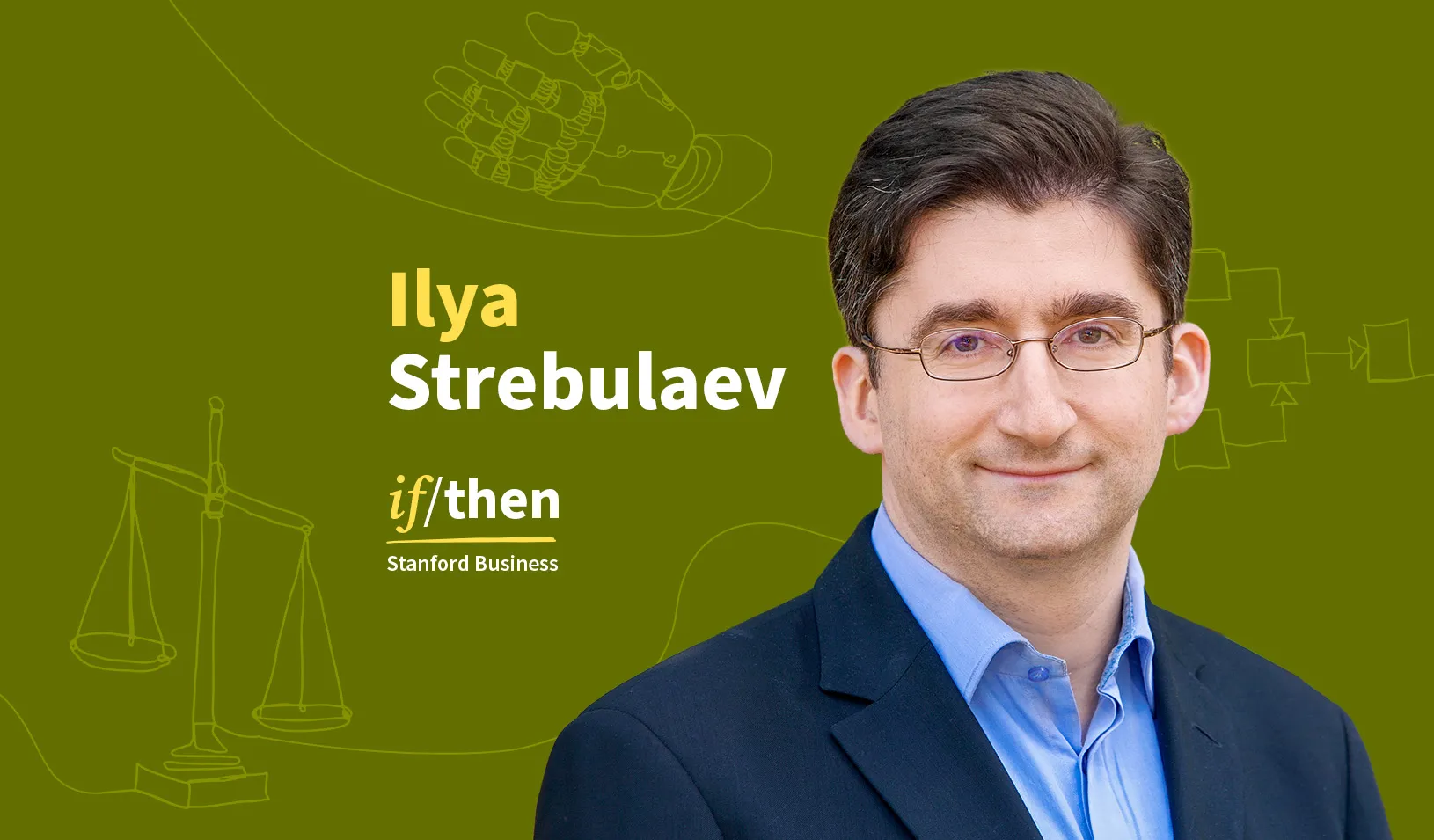
Ilya Strebulaev, a professor of finance at Stanford Graduate School of Business and Alex Dang, MS ’14, a tech executive and innovation advisor, didn’t write their book, The Venture Mindset: How to Make Smarter Bets and Achieve Extraordinary Growth, for venture capitalists.
“We wrote it for people who are located far away from Silicon Valley, thousands of miles away, and for people whose day-to-day professional job has nothing to do with Silicon Valley, with technology, with startups,” Strebulaev says on a new episode of the If/Then podcast. Their book shows why the “venture mindset” has applications beyond the world of seed rounds and unicorns. “Our world is changing very fast, and the future [will] require a very different type of decision-making,” he says.
Instead of trying to avoid failure, VCs succeed by making numerous bets, ensuring that a few big successes can cover the many losses. “‘Home runs matter; strikeouts don’t’ is the first, and I would say foundational, principle of the venture mindset,” Strebulaev explains.
Strebulaev also discusses why VCs look for ideas “outside the four walls” and why they bet on teams before ideas. In a volatile world, he recommends all leaders add the venture mindset to their toolbox. “I believe that many — not just small businesses, but many large companies — will be displaced, and soon, unless their leaders realize that they need to change their paradigm, how they think,” Strebulaev says. “This is where the venture mindset is particularly helpful.”
This episode also features Lars Leckie, MBA ’06 and managing director at Aspenwood Ventures, talking about how VCs swing for the fences while at a Giants game.

If/Then is a podcast from Stanford Graduate School of Business that examines research findings that can help us navigate the complex issues we face in business, leadership, and society. Each episode features an interview with a Stanford GSB faculty member.
Full Transcript
Note: This transcript was generated by an automated system and has been lightly edited for clarity. It may contain errors or omissions.
Kevin Cool: We are at Oracle Park, watching the Giants and the Cardinals. It’s a gorgeous night in September.
On that gorgeous night, my producer and I headed to San Francisco to watch some baseball, along with Lars Leckie, a venture capitalist at the firm Aspenwood Ventures.
Lars Leckie: I mean, I think one of the things I find fascinating about a game like this is that every single player on the team is somebody who has reached the top of the pyramid of the thing that they do.
And, and I find, I find those stories of those people fascinating.
Kevin Cool: Lars says the players have a rare set of characteristics that you might also see in the founders of a successful startup.
Lars Leckie: Take this pitcher. You know, in his hometown there were 10 of those pitchers, and then there’s, you know, 50 hometowns across his state, and, you know, you sort of add up all the people who had a lot of the same skills.
But something about this player got him to go from the local leagues to the state leagues to the minors to the majors.
Kevin Cool: Unfortunately, in that moment, he was not doing so well. He just gave up a home run. In this game, players were trying to hit the ball over the fence, but more often than not, they swung and missed. That’s a lot like what happens in the VC world.
Lars Leckie: Yeah, that, that’s absolutely the way venture capital works. You can only lose one times your money, but you can make five times, 10 times, 20 times, 100 times your money.
Kevin Cool: Right.
Lars Leckie: You need to be willing to lose, you know, your principal many times over on the chance that you get the sort of the outsize return winner. In baseball parlance, you-
Kevin Cool: Yeah
Lars Leckie: … swing, swing for the fences and-
Kevin Cool: Yeah, yeah
Lars Leckie: and go for the, the big return.
Kevin Cool: Yeah. Venture investors place bets on many companies, knowing that most of them will fail.
Lars Leckie: We call them actually at bats.
Kevin Cool: Is that right?
Lars Leckie: You have enough at bats to have that one or two outliers per fund, but they take longer. Because of the way venture capital works, we need to make, call it 20 or 25 investments, with the hope that you get one that will work.
I mean, most of these at bats are gonna be strikeouts. That’s just sort of the way it, it, it works. So, we call them, but, but none of that matters until you actually you know, score a home run.
Kevin Cool: Giants player just hit a double and slid into second safely, and the Cardinals fan next to us is not happy about it
The Giants won the game that night on two solo home runs, and the Cardinals went home unhappy. Nobody likes losing, but that’s part of the game, in baseball and in Lars’ world.
Lars Leckie: I mean, it’s painful, but it’s exciting. Everyone would love you to say, “Okay, I’m gonna venture capitalist today. Give me a checklist of the things I need to do right.” But it, the world changes so fast that you need to be constantly revising your model, your thinking, because markets are changing, and people are changing, and opportunities are changing. So, it is more of a mindset than a checklist.
Kevin Cool: And that mindset is the focus of today’s episode, how VCs approach the world, and how anyone in an organization can apply that thinking.
Our guest is Ilya Strebulaev, professor of private equity and finance at Stanford Graduate School of Business. His book, The Venture Mindset, draws on more than a decade of research to lay out the principles VCs use to make decisions.
Ilya Strebulaev: This first principle, ‘Home runs matter, strikeouts don’t’, is the first, and I would say foundational principle of the venture mindset. It means that smart VCs understand that failures are inevitable.
Kevin Cool: This is If/Then from Stanford GSB, where we sit down with faculty and explore how their research deepens our understanding of business and leadership. I’m your host, Kevin Cool I asked Ilya who this book is for.
Ilya Strebulaev: First of all, we wrote the book not for venture capitalists, even though venture capitalists now assign this book to all their junior- associates, analysts, newcomers. Not even for founders, even though founders find the book extremely helpful. We did write it for people who are located far away from Silicon Valley, thousands of miles away, and for people whose day-to-day professional job has nothing to do with Silicon Valley, with technology, with startups. There is a reason behind it.
There is a deep reason, is that our world is changing very fast. It was clear to me when I started thinking about the book back in 2020. It was clear to my coauthor and my former student, Alex Dank, and me when we started really writing the book in 2022/2023.
But I think it’s clear, should be clear to everybody now, given all the changes in AI, robotics, et cetera, in every single industry, that the future is going to be very different. And this future requires very different type of decision-making. And venture capitalists, because they faced with this hostile, I would say, environment of decision-making for, you know, fifty-plus years, they developed what I call the venture mindset.
Kevin Cool: So, we wanna talk today about some of the principles that undergird your research with respect to the venture mindset and to some degree even take it out of the venture capital context because these may be things that are quite applicable across business. And one of those principles that you talk about is ‘home runs matter, strikeouts don’t’, which is essentially another way of saying go big.
Why does that matter so much in the venture world? And talk to us a little bit about, in your experience and the research that you’ve done, how that is borne out.
Ilya Strebulaev: Well, first of all, I have a confession to make, I don’t know much about baseball. But indeed, we have nine principles in, the book, The Venture Mindset. But as we were writing the book, our, publishing agent told us, “If you guys would like your book to become a bestseller, you must have baseball analogy there.”
Kevin Cool: Really?
Ilya Strebulaev: And so, we did. We named one of our nine principles after baseball, ‘Home runs matter, strikeouts don’t’. Okay? And this first principle, ‘home runs matter, strikeouts don’t’, is the first, and I would say, foundational principle of The Venture Mindset.
So, what this principle really means, it means that smart VCs understand that failures are inevitable. Not only they are inevitable, but they’re frequent. Not only they’re frequent, but they are expected. If you think about a typical portfolio of early stage venture bets, maybe up to 75% of those bets will fail.
And I’m not going to tell you that, venture capitalists love failure. Nobody likes failure, okay? But VCs have a different approach to failure. They know that failure is inevitable, and the entire business model is based around kind of encouraging failure in a way, knowing that taking very high risk of a very particular kind and following other principles of the venture mindset will ensure that if you invest enough, then some, maybe 1/20, maybe 1/15 companies in your portfolio will become those home runs. And those home runs will overwhelm all the unsuccessful failures that you also ended up investing in.
So that is the first principle, and if you think about traditional business, you should not be following this principle. If you think about the world of incremental innovation, where you innovate your product or your service, but bit by bit, step by step, you should not be following this principle.
But the moment you face the environment of disruption in your industry, when you face unpredictability, not just about competition, but about the entire business model of the industry, when there are a lot of experiments where your business model changes, your customer changes, the relationship with your customer changes, this is where the venture mindset, and this principle in particular, becomes very, very important.
Kevin Cool: And it’s interesting that you say failure is sort of accepted as part of the process in the venture world because it isn’t just that strikeouts don’t matter, right? It’s that you actually should be striking out a lot if you want to hit the home run, right?
Ilya Strebulaev: Absolutely. When we, look at successful VCs that are kind of more or less by construction have more home runs. In fact, these VCs also have higher failure rate.
Kevin Cool: Yeah.
Ilya Strebulaev: They have more strikeouts. By the way, I did mention that I don’t know much about baseball, but I did study baseball statistics as I was writing the book, and I can tell you that it’s exactly the same true about baseball players.
Kevin Cool: That’s right.
Ilya Strebulaev: That is baseball players with a very high home run rate, the most successful baseball players, in history, they in fact also had a higher strikeout rate.
Kevin Cool: That’s right. Babe Ruth struck out thousands of times. Yes, absolutely.
So, let’s just sort of unpack a couple of other of these principles. One of them is in sort of the pathway toward finding that big idea, that home run. You talk about the importance of, as you put it, going outside the four walls to look in unusual places for those ideas. And you use actually the example of Burning Man. Now, you’re not necessarily suggesting that everyone go to a hedonistic festival in the desert to find their ideas but talk a little bit about what you’re getting at there.
Ilya Strebulaev: So, no, I don’t suggest that. In fact, we also give an example of, a Finnish sauna festival, okay? So, I don’t suggest that all of us should, get a flight to, to Finland right now. I think it’s about getting outside your comfort zone, which is more important.
Let me give you my personal example, how also I follow this principle myself. Now, like I’m sure many of our listeners, I fly all the time. I travel, on business and on pleasure, and very often internationally. And I used to travel like a, well, real professor, meaning that I was kind of, you know, inside myself. But now I am, I think, doing this much better, much more efficiently.
So, whenever I travel alone on business, my goal is to speak to at least five people. And you know, this is really interesting. It’s statistics very similar to home runs matter, strikeouts don’t. Now, here I might talk for five minutes to twenty-five minutes, and very often it’s not interesting or it’s interesting, but nothing important. But sometimes on those rare occasions, wow. This is a part of that principle that VCs, smart VCs know how to use.
Kevin Cool: And presumably having AI as a tool would enable that process in itself.
Ilya Strebulaev: AI is changing absolutely everything. And yet, I think the opposite side of AI Is that human connections, I think, have never been more important.
So how AI is changing, it takes now less than 10 seconds to analyze your LinkedIn connections and produce the entire analysis, something that in the past would have been done manually, or you had to write a code or whatever. AI made this very, very simple. Now obviously, what is still for you to do is to take an action based on that analysis. Okay?
For VCs, I think AI is a double-edged sword. On the one hand, it is much easier to find… to analyze data, to proceed with the due diligence, to find new companies, to find new founders, ideas, projects, et cetera, et cetera. It’s easier to go outside the four walls. However, it also means there is a high competition. In the past, only some people could do it successfully. nowadays many people can do it, and as a result of this, standing out in the crowd has become more difficult.
But I also mentioned human connections, and I think in the age of AI, especially in the world of VC, but also in the world of the venture mindset, I think human connection is very important.
Now, if you can prove to a counterparty that actually you’re a human, which is becoming more difficult to do, it is, I think, becoming more important because at the end of the day, the most valuable tool we have is our time. So, if you can devote even 10 minutes of your personal busy time to somebody else, then it is a signal. It’s a costly signal, and I think that’s important
Kevin Cool: You stress the importance of saying no a lot. Now, is it the mindset? Is it just a matter of sort of disciplining yourself at a certain level? Is it a skill set? Talk a little bit about that.
Ilya Strebulaev: I do believe in skill sets. Obviously, I do because I’m a professor and I teach. And I think one of the important skills that I’m, we’re trying to communicate to them and teach them is the power of saying no.
By the way, the power of saying no as a venture capitalist, as an investor, but also as a founder. And I think that the power of saying no is useful for everybody else. Let me give you specific examples because it— we, we see this under different guises.
First, when you first see an opportunity, and not necessarily an investment opportunity, maybe a hiring opportunity, et cetera, what is a typical question people ask? “Well, why would I invest in this company? should I hire this person for a job?” Okay? This is not how VCs approach this question initially. They are operating in what I call the fast lane or the red flag approach. What it means is that they ask, exactly the opposite question. They ask the mirror question, which is, “Why would I not invest in this opportunity? Why would I not hire that person? Why would I not even want to spend another ten minutes to think about this opportunity?”
And when you identify any red flags, you just move on to the next one. So, this combination of going outside the four walls and having hundreds, if not thousands of opportunities. And at the same time, asking red flag questions and trying to very efficiently minimize or attenuate the number of opportunities that you would like to consider in a slow lane, which is doing the slow due diligence process, which is happening anyway faster because of developments in AI. So, I think that is a very important part of the skill set.
Kevin Cool: Yeah. Now sort of an adjunct to that, I think, is that you’ve talked about the fact that when venture capitalists stay up at night thinking about whatever it is they regret, the regrets are not the mistakes they made. The regrets are the companies they didn’t invest in that have gone on to 100 or 1000x what their investment would have been. And we’re really talking here about decision making. How does that part of the mindset affect their decision making?
Ilya Strebulaev: Bill Gurley, who is a partner at Benchmark, once said, “If you invest in a company that doesn’t work, just fails, you can lose only 1x your money.”
Kevin Cool: Sure. The money you put in is all you lose.
Ilya Strebulaev: Right. But if you miss investing in Google, you lose 10,000x your money.
I think that is the approach of most VCs. If you ask VCs, what are your sleepless nights on? It’s not about the companies that failed. It’s about the investments that you could have made but did not make. That definitely affects their decision-making process because whenever they see a founder, they’re asking themselves really a question is, can this founder be, you know, the next Jensen Huang? Or following the red flag, why can’t this founder be the next Jensen Huang? Okay. And that is another principle of the venture mindset.
The execution is critically important. There are lots of great ideas around the world. There are not so many people who can execute them really, really, really well. As a result of this, I think who is going to execute on the idea is important. And again, that is a huge difference between the world of the venture mindset and the traditional business. In the traditional business, we think about the project, convince ourselves it’s a great project, and then ask ourselves a question, oh, so who’s going to do it?
Let’s form a team. But in the world of the venture mindset, the team comes first. You can have a great project, but you will not be able to do anything about it if you don’t have the right people.
Kevin Cool: Yeah. So, it can be a fantastic idea, but if the VCs are looking at a possibility, they are putting more importance on who those founders are and what they’re capable of even more than the idea itself. Is that fair?
Ilya Strebulaev: I would say it’s fair, which is, I wouldn’t say that VCs would invest in founders if there is nothing else. Just because VCs are so excited about the founder, they think, “Gosh, this founder has nothing right now but will come up with something.”
Kevin Cool: Yeah.
Ilya Strebulaev: But I would say that if a VC sees a founding team with a great product, potentially high, large market or interesting technology, but they really dislike the team for whatever reason, I think most VCs today would say, “Well, let’s try to find somebody else-”
Kevin Cool: Yeah
Ilya Strebulaev: with a similar idea.”
Kevin Cool: Even in my own experience, I can speak to the fact that when I’ve interviewed people for jobs, sometimes I’m moved by the fact that this is a person I want to work with. This is a person who’s on the way up. They’re going to be full of ideas. They’re full of energy. I’ll find something for them to do, right?
Ilya Strebulaev: The answer is yes, even though when you said, “I’m looking for a person that I want to work with,” sometimes people want to work with people who are easygoing, nice people.
Kevin Cool: That’s a different thing.
Ilya Strebulaev: That’s a very different thing.
Kevin Cool: Yeah.
Ilya Strebulaev: One very famous VC whom I will not identify, told me because we were arguing about, about factors of success, and he told me, “There’s one type of founders I would never invest in, and those are nice people.”
Kevin Cool: Yeah.
Ilya Strebulaev: And then he qualified because nice people will have great difficulty firing, laying people off-
Kevin Cool: Yeah.
Ilya Strebulaev: …convincing customers they are the best, and so on and so forth.
Kevin Cool: Yeah. So, Ilya, we’ve talked a lot today about all of the advantages that venture capital provides for business development and how the mindset of a venture capitalist can be applied in various ways, in very positive ways.
I wanted to ask you though, to some degree, the flip side of that. Because there certainly have been venture-backed companies that have exploded, that have been terrifically disruptive. So, the question I have is, is venture capital always good for the world?
Ilya Strebulaev: I don’t think really anything is always good for the world. There’s always the flip side. So, the answer is no, absolutely not.
But this is not the way I think we should look at venture capital. We live in the world where there is a lot of competition, not just among people, not just among, companies, not just among universities, but also among countries. And if we are not going to proceed with including venture capital, well, somebody else will.
Kevin Cool: Yeah.
Ilya Strebulaev: I do agree that I think the venture capital industry gives rise to many companies that are disruptive by their nature.
Kevin Cool: Yeah.
Ilya Strebulaev: Now, this is why I think the venture mindset is critical, because I believe that many, not just small businesses, but many large companies will be displaced. And soon, unless their leaders realize that they need to change their paradigm, how they think. And this is where the venture mindset is particularly helpful.
Kevin Cool: If/Then is a podcast from Stanford Graduate School of Business. I’m your host, Kevin Cool. Our show is written and produced by Making Room and the content team at the GSB. Executive producers are Michael McDowell and Jim Colgan. Sound design by Mumble Media with video production from Whitney Legg, Tatiana Goldman, and Aech Ashe. Special thanks to GSB alum Lars Leckie of Aspenwood Ventures.
For more on our faculty and their research, find Stanford GSB online at gsb.stanford.edu or on social media at Stanford GSB. Thanks for listening. We’ll be back with another episode soon.
For media inquiries, visit the Newsroom.