Design for Extreme Affordability tackled challenging global issues through hands-on teaching.
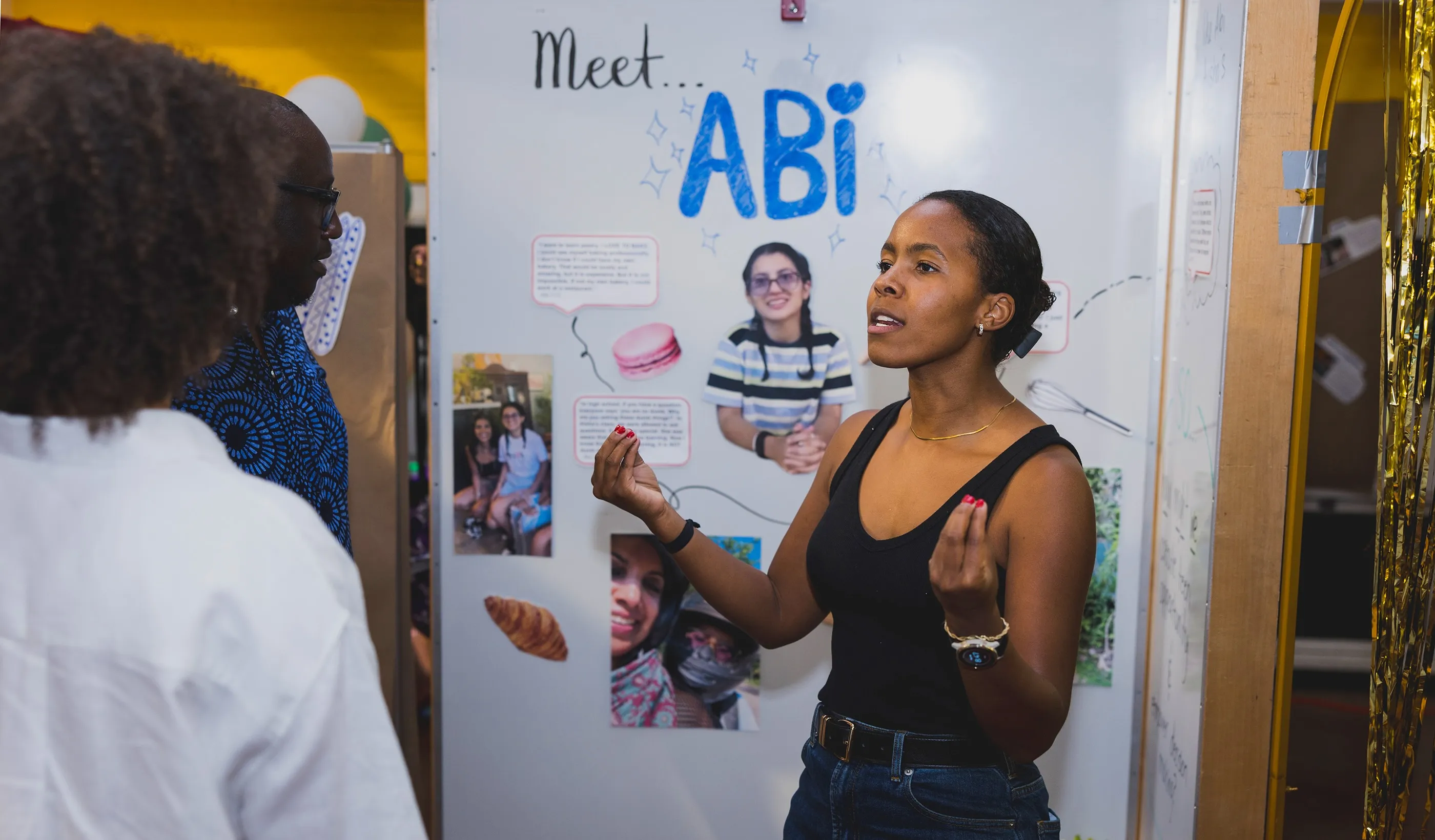
Edith Elliott and Shahed Alam needed a new plan. The two students in the Design for Extreme Affordability course — colloquially known as Extreme — wanted to build an organization that would help nurses in rural health clinics in India. The need was large — most of the clinics were poorly staffed and some of the patient care fell to family members. But as they mobilized their small team in the course, Elliott, earning her master’s in education at Stanford, and Alam, a Stanford medical student, learned that another school was already further along in a similar effort.
Disappointed, the students “were standing in a corner with their heads down,” recalls Extreme faculty director and Stanford Graduate School of Business lecturer Stuart Coulson. “Then they began thinking about what they had seen on their visits to these clinics. Family members played a big role in helping their loved ones recover. In some cases, they actually slept under the patients’ beds at the clinic.”
That insight led Elliott and Alam, with teammates Jessie Liu and Katy Ashe, to a new idea: train family members in basic nursing skills that would help patients during and after their clinical treatment. The result was Noora Health, a company that today serves more than 10,000 clinics and 800 hospitals in India and thousands more in Bangladesh, Indonesia, and Nepal. Since 2014, when the company was launched from Extreme’s Social E Lab program, Noora has trained more than 67 million caregivers and patients on everything from setting medication reminders to educating new mothers on the importance of cuddling their babies. And it has dramatically improved patient outcomes: Postsurgical complications have been reduced by 71%; newborn mortality has dropped 18%.
Elliott and Alam’s stories exemplify Extreme’s impact and global reach. The course — a collaboration between Stanford GSB and the d.school — involved a combination of on-the-ground discovery in cities and villages around the world and intensive design iteration in the classroom. Since the course was founded in 2003, Extreme students have completed hundreds of projects that have served more than 350 million people, and it has produced a community of alumni who consider Extreme one of the most transformative experiences of their lives.
“It fundamentally changed me,” says Courtney Burton, MBA ’24, an associate at McKinsey & Co. “I can’t imagine my MBA experience without it.”
Extreme “wasn’t like anything else Stanford offered,” says Coulson, who was so devoted to the course he worked for nine years as an unpaid lecturer. “As an elective open to students across the Stanford campus, multidisciplinary teams were an integral part of the innovation experience,” Coulson says. “The excitement in seeing an MBA, engineer, med student, and a physicist come together to successfully create solutions made the struggle of facilitating and resourcing such a class worth all the effort.”
Coulson’s remarks are tinged with wistfulness, however; as of fall 2026, Extreme will no longer be offered. A loss of funding, combined with changes in student preferences post-COVID, led to the course’s ending. But the Extreme teaching team is determined to preserve the two-plus decades of data, processes, and learning to enable others to continue the work. The details of how that information will be cataloged and shared will occupy the Extreme teaching team for the next several months in what they have dubbed the Sunset Project.
“Pack a Lunch”
Extreme founder Jim Patell was trained as an engineer and is perhaps never happier than when he is building something. A professor of Operations, Information, and Technology at Stanford GSB, Patell saw an opportunity in the early 2000s to develop a product design course aimed at those who usually don’t benefit from design but perhaps need it most. As founder of International Development Enterprises (iDE) and early course partner Paul Polak said, “90% of the designers in the world work only for the richest 10% of the world’s customers. A revolution in design is needed to reverse this silly ratio.”
In a nutshell, that meant finding and fixing problems that troubled some of the most marginalized people on earth, says Patell, the Herbert Hoover Professor of Public and Private Management, Emeritus. He collaborated with NGOs such as iDE to find partners in places where Extreme might help, and as word soon spread, the network of partnerships expanded rapidly. “People started calling us,” Patell recalls.
“Extreme became successful due to the singular dedication of Jim Patell, along with Dave Beach and Julian Gorodsky, and important early contributions by Bill Behrman and David Kelley,” says Sarah Stein Greenberg, MBA ’06, executive director of the Stanford d.school and an early Extreme teaching fellow. “What made Extreme’s longevity possible was the dedication of a teaching team that was able to carry the original vision forward while also adapting as the world the students were designing for kept changing.”
For students, Extreme involved an immersion in often unfamiliar locations and working under severe constraints. One of which was time: They had about 20 weeks. The two-quarter course required a deep understanding of customers’ needs as well as cultural nuances very different from those that students might encounter when making products for Western consumers. The projects were fraught with uncertainty and subject to high failure rates, and they demanded a grind-it-out mentality. Patell characterized the ethos of early Extreme with his now-famous admonition to students: “Pack a lunch.”
Students quickly realized “this is going to be messy,” Coulson notes. Roadblocks arose, like the one Elliott and Alam faced when imagining their project in India. He believes that learning how to navigate such ambiguous situations was one of the key takeaways from the course.
Getting comfortable with the messiness means leaving behind some assumptions, notes Katherine Hu, whose team worked with a nonprofit to help LGBTQ migrants in Central America — a persecuted minority in many countries in that region — find basic services. “There can be a misalignment between the scope of the project imagined by your team and the partner. We had to prioritize what the community members needed, not our original plan,” says Hu, who is completing a dual MBA/MD program in 2027.
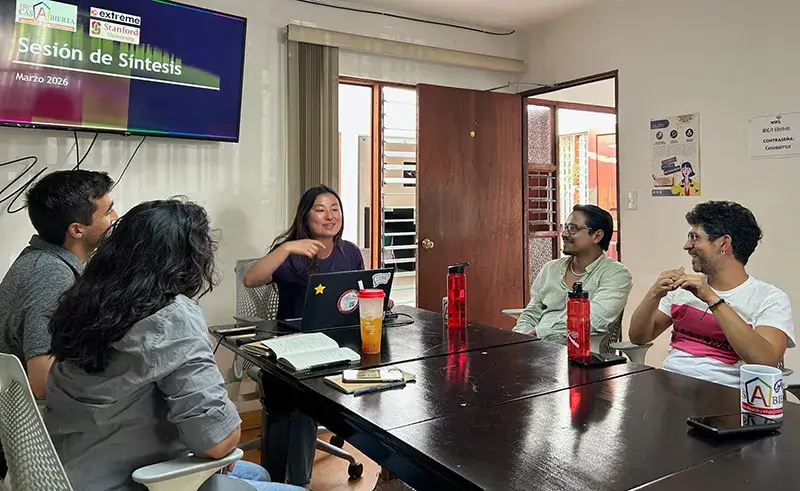
Students in Extreme each spent about 20 weeks immersed in varied global locales as part of the course; Katherine Hu (center) worked with a nonprofit in Central America. | Courtesy of Katherine Hu
Coursework in design is sometimes caricatured as a laboratory for mad-scientist invention, and innovation certainly was a hallmark of Extreme. But for Burton, the journey to a solution was not about deploying head-spinning ideas. Instead, Extreme taught her that “the relationship is the project.”
Working with young adults in Costa Rica, her team developed tools and programs to help them build career pathways. Success depended on building trust, forming connections, and nurturing collaboration — community co-design in Extreme’s parlance. “You learned how to build something together,” she says.
Burton also believes the lessons from her Extreme experience will be long-lasting, fitting into three big buckets: skills, mindset, and process. “I was learning all the time,” she notes. “These are durable skills — how do you let go of your agenda and create the space to build with community members? It gave me the confidence to show up with vulnerability during the most challenging parts of the design process. It underscored for me the personhood inherent in design.”
“It was one of the most formative experiences of my time at Stanford,” says Walter Woo, MBA ’25, who worked with SIFAIS, a social enterprise. Woo, who now works at IDinsight, a social impact company in the Philippines, found both inspiration and aspiration in the Extreme project he and his team completed. The level of rigor and time demands were unlike any other academic endeavor, he says. “The class was a sacrifice. I had to decide what I was willing to give up [to participate].” But it was all worth it, he says, and informed his decision to continue pursuing mission-oriented work as a professional. “I’m confident I will have an impact doing this type of work.”
It Begins with Humility
Hu says she prioritized Extreme among her other courses because “it had larger stakes.”
“This wasn’t just about ourselves and our own education; it was going to have an impact on other people’s lives very directly,” she says. That sense of responsibility was a common characteristic of students in the course, notes Coulson, and animated what he believes made Extreme special. “They were designing for somebody else, and that introduces a whole different set of needs that have to be considered and addressed.”
“The emphasis as we evolved curriculum was to ensure that we were not creating the conditions for drop-in development — that students were building with the community, and including the community in the decision making, so that the impact could continue well beyond their involvement,” says Manasa Yeturu, faculty lead for Extreme at the d.school.
And it begins with humility: “Not only to acknowledge that you don’t have all the answers, but that you do not even know the question,” notes Coulson.
He saw this in a project close to home — working with the landscape gardeners at Stanford. When students set about arranging a “ride-along” with the landscapers, they learned that they would have to do it at 6 a.m. — the early start is required to avoid making noise during classes later in the morning. “You could see the students’ faces drop,” Coulson recalls. “It helped them realize that there’s a whole bunch of people on the campus that they never see who are doing amazing things for them every day.”
The grounds crew collaboration was a Stanford Service Corps project, in which faculty organized students into small teams and assigned them a campus partner that had described an issue they wanted the students to tackle. These short, intensive projects served as practice before students dove into their larger, international ones. “There are a number of things across the campus that came straight out of Extreme,” Coulson says. Examples: how the bike shop manages its bike repair process; new labels on campus gym equipment that describe how best to clean the machines after use.
In all the projects, those nearby and those further afield, students were learning “the ability to be innovative at will,” Coulson says, or what Patell describes as “making yourself creatively accident-prone.”
“You’re not waiting for the lightbulb moment, running from your bathtub shouting ‘Eureka,’” Coulson says. “You construct a pathway that allows you to identify and address a problem.”
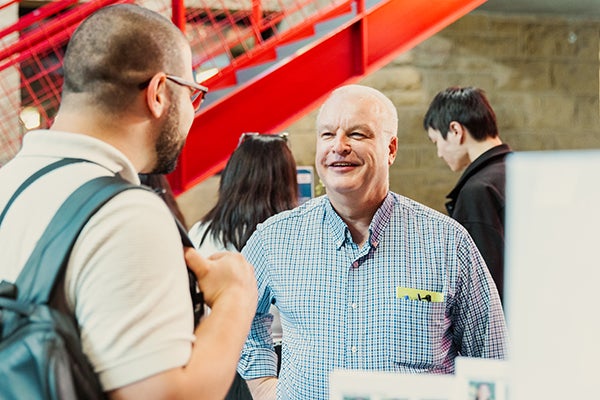
Extreme faculty director Stuart Coulson | Patrick Beaudouin
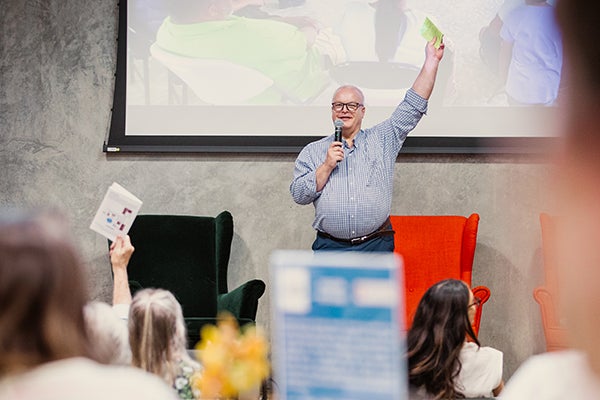
Stuart Coulson, Extreme faculty director, in the classroom | Patrick Beaudouin
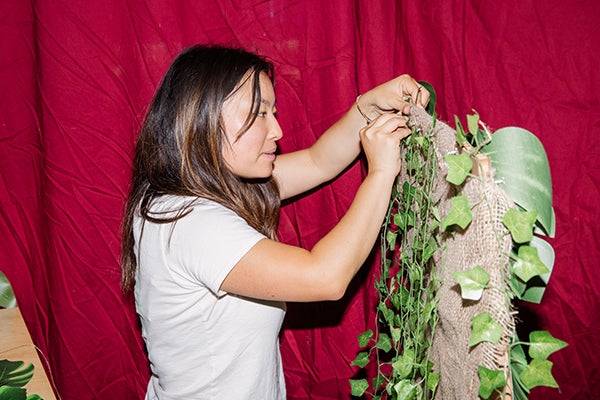
Extreme involved hands-on design iteration in the classroom, as Katherine Hu demonstrates here. | Patrick Beaudouin
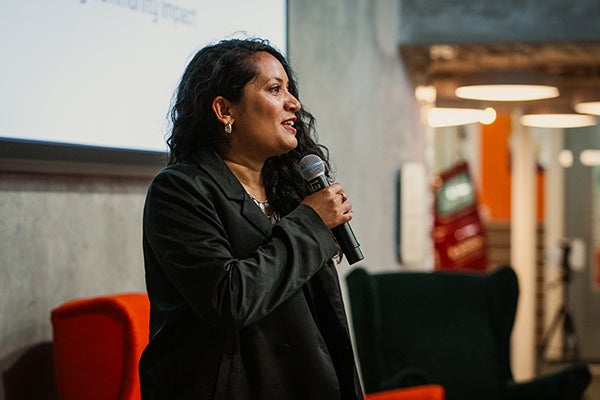
Manasa Yeturu, faculty lead for Extreme at the d.school | Patrick Beaudouin
What Happens Next
As for that sunsetting project, Coulson, Yeturu, and associate director Naita Saechao Chialvo are working through how best to organize, codify, and transmit 23 years of Extreme experience. According to Coulson, there is a lot that could be helpful for social innovators, practitioners, and educators interested in immersive co-design, especially in places that otherwise have few resources. That could include sharing curricular guides, ways to find and keep partners, how to construct teams, and advice on positioning a program within a university across different academic areas. Finding the right way to provide all of that “relies on people becoming creative” in the social impact space, which sits squarely in the Extreme team wheelhouse, Coulson notes.
“One thing I really think is important, not just for Extreme and not just for global development, but for this kind of work overall, is to make sure that the work isn’t centered on one person, that the baton is passed,” says Yeturu. One example is the network of local coaches nurtured and influenced by Extreme, who may themselves become banner carriers for the program’s ongoing influence. “We have seen transformational relationships develop, such as our coaches, who are going on to do this work and maybe start a collective together.”
The cohort of alumni is another powerful and potentially highly impactful group of Extreme ambassadors. Yeturu says she gets emails from alumni all the time asking about methods and approaches for projects they would like to pursue.

Extreme “wasn’t like anything else Stanford offered,” says Stuart Coulson, who felt so passionate about the course that he worked for nine years as an unpaid lecturer. | Patrick Beaudouin
Yeturu describes the vast, interconnected web of tools, methods, and people in the Extreme community as “an ecosystem of care.”
“When things like this end, my metric of success is how these beautiful, brilliant relationships that have been formed are going to continue,” she says. “A big part of the Sunset Project is to do a deep dive with our stakeholders, look for the linchpins that are going to help continue these relationships. Because that’s how change happens.”
Explore More
Pivot: Getting the Best of Both Worlds
Catalyst: Empowering the Entrepreneurial Spirit in Madagascar