September 24, 2026
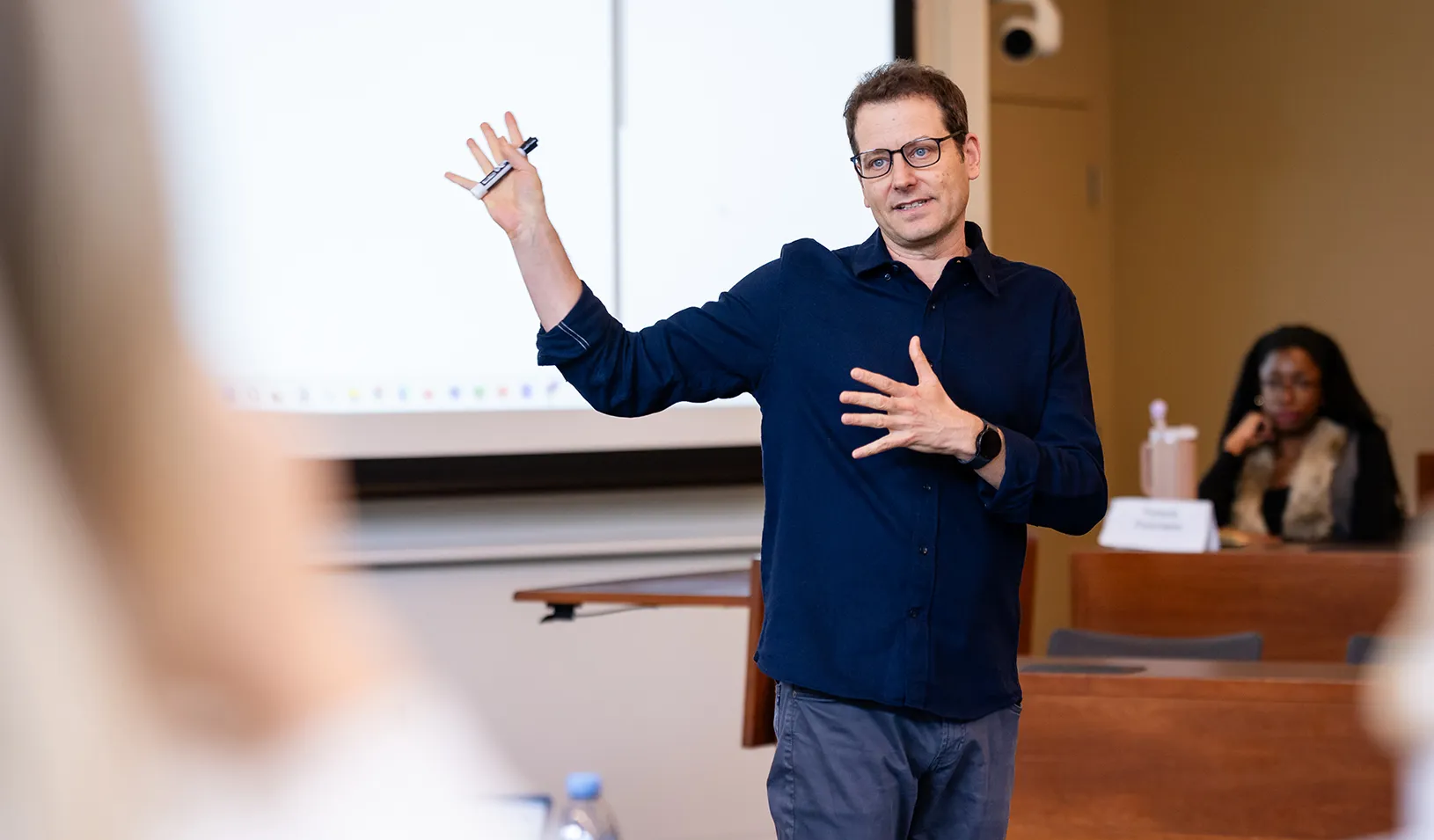
| by Michael McDowell“Surveys of representative samples of Americans indicate that people have soured on AI,” said Amir Goldberg, the Amman Mineral Professor of Organizational Behavior at Stanford Graduate School of Business. “The overwhelming majority of Americans are afraid of AI, don’t want it in their workplace, their meetings, or even their shopping.”
Back to Class
In this ongoing series, we bring you inside the classroom to experience a memorable Stanford GSB course.
Goldberg was speaking before a roomful of MBAs during a recent session of The AI-Powered Org: Evolution, Rebirth, or Death? — an elective course designed to prepare future leaders for the challenges they will encounter as their organizations adapt to artificial intelligence — including skepticism.
“I think AI opens the opportunity for dynamic network management,” Goldberg continued. “Networks are central to the efficient functioning of an organization. In most settings, they were previously practically invisible; however, this is no longer necessarily the case, as our interactions are increasingly being intermediated through digital and AI systems — meaning that these networks are increasingly becoming more easily visible and manageable.”
“But when I mentioned this in the undergraduate class” — Goldberg also taught a version of the course to Stanford undergraduate students — “there was a huge pushback against it. The students referred to it as a dystopian vision.”
Goldberg makes no pretense of predicting where AI will take the workplace. One of his premises is that nobody knows whether we’re headed to dystopia, utopia, or somewhere in between. Instead, he draws on a century of social science research to illustrate the nature of the modern organization as a general-purpose coordination technology.
“Most people coming into the class would assume that because I teach about it, I’m excited about it, I’m optimistic about it. Not necessarily — I’m concerned about a lot of things that might occur,” he says. “I want my students to be equipped to observe the downsides as they materialize and perhaps to counteract them when they occur.”
Over 10 weeks, OB 301 moves from discrete organizational functions like hiring, performance evaluation, and compensation to the social fabric of organizations — culture, networks, team dynamics, the role of the manager — before zooming out to innovation, learning, strategy, and the societal stakes of an AI-saturated organizational landscape. An animating question is whether AI represents another step in the organization’s continuous evolution, a fundamental reinvention, or something so profound that the organization as we know it will cease to exist.
But for those who are about to manage AI in organizations, Goldberg offers a practical framework to develop viable human-machine interfaces: Understand what AI actually does, and then determine, task by task, where it should substitute for human labor and where it may more effectively augment it.
To help students develop this know-how, Goldberg stages lively discussions and invites them to think through real-world scenarios, such as leading an oncology department that’s implementing an AI tool that records and transcribes team briefings. How might it make those meetings more collaborative? What would the AI need to know about each doctor and patient to be useful rather than intrusive? Would anyone actually want to sit in a meeting run by a machine?
“In some ways, AI is a continuation of a trend that has existed for the last 20-plus years, ever since the maturation of the internet and digital revolutions has helped us transform a lot of things into data,” Goldberg says. “In that respect, nothing is new under the sun. But here AI is enabling us to transform organizational life — life that hitherto had not been transformable — into data.”
If meetings are a small unit of organizational life, M&A is about as large as they come. “The overall majority of mergers and acquisitions fail, and the overwhelming majority of these failures are attributable to cultural mismatch,” Goldberg notes before asking students to play forensic analysts and examine the union of two unnamed regional banks using language models trained on anonymized employee emails to measure whether the two cultures were actually integrating.
Practitioner visits connect classroom work and theory to real-world adoption, and over the past quarter, students heard from guests including Ravi Radhakrishnan, CIO at American Express; Tomer Cohen, MBA ’10, former chief product officer at LinkedIn; and Kathy Baxter, VP of responsible AI and tech at Salesforce.
“I’m trying to give them a framework for understanding what is happening, one which helps them understand if things fail, why they failed — or if things succeed, why they succeed, and a kind of conceptual infrastructure with which to build the organizations that they will be building,” Goldberg says.
The course concludes with a final project: Students draft a proposal for an AI-based product that improves an organizational process, grounded in course theory and vetted through stakeholder interviews. One of Goldberg’s favorites came from a student who proposed a platform to preserve not just the decisions organizations make, but why they made them — solving what Goldberg calls a fundamental problem that all organizations have: their understanding of their own decision-making.
“We’re living through a transformative moment,” he says. “I don’t have a recipe — nobody has a recipe. If you wait for the recipe, you will have waited until everybody else will have discovered how to use this technology. And by the time they do, they will have translated it into an advantage and will have made you obsolete.”
For media inquiries, visit the Newsroom.