At Stanford Graduate School of Business, entrepreneurial education is built on a simple premise: The skills required to build something from nothing can be taught, practiced, and refined. For years, Stanford GSB has, through its entrepreneurial curriculum, educated founders and operators who have gone on to launch new ventures, deliver innovative solutions, and shape industries. That entrepreneurial education is supported and strengthened by Stanford GSB’s vibrant and active entrepreneurial community. Across class years and industries, alumni form a network of people who trust one another in ways that compound long after graduation. Nowhere is that trust more visible than in the relationships between founders and the investors — often fellow classmates, alumni, or faculty — who back them.
Stanford GSB has centers of excellence in entrepreneurship and investing, generating active alumni communities across both areas. The Grousbeck-Holloway Center for Entrepreneurial Studies (GHCES) has focused on entrepreneurial education and community for more than 30 years. Its success inspired the creation of the new Stanford GSB Initiative for Investing. The initiative “is designed to showcase the same high level of education, experiential learning, research, and community to investors that we have provided to our entrepreneurs,” says faculty director Peter DeMarzo, the John G. McDonald Professor of Finance.
Sarah A. Soule, the Philip H. Knight Professor and Dean and Morgridge Professor of Organizational Behavior, notes that when people think about Stanford GSB’s entrepreneurship, they often focus on company founders. “The investors also play a critical role in the GSB entrepreneurial ecosystem, often providing not only financing but also introductions and insights,” she says. “When GSB investors and founders connect, shared experiences and values cultivated in the classroom can make a first conversation start from a warmer place than a cold introduction might allow.”
Here are three recent Stanford GSB founder/investor pairings that illustrate what that can look like in practice.
Benepass/Threshold Ventures: Classmates Collaborating on a Series A Startup
Mo Islam, MBA ’19, came to Stanford GSB having already spent several years as a venture investor. When he graduated alongside Jaclyn Chen, MBA ’19, and returned to what had by then become Threshold Ventures, a spinout of prominent VC firm Draper Fisher Jurvetson, he carried with him not only his investing experience but a cohort of classmates who were beginning to start their own companies. Chen was one of them.
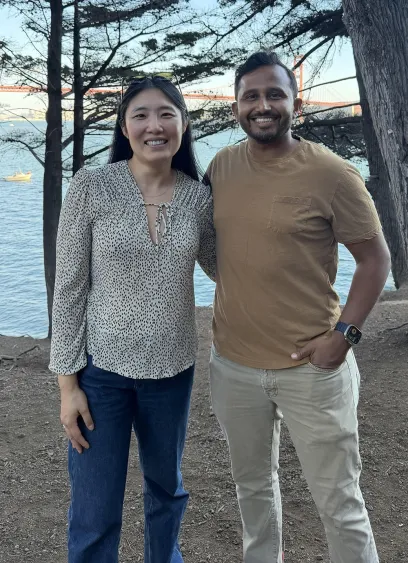
Jaclyn Chen and Mo Islam | Courtesy of Chen/Islam
The two had met in a Stanford GSB course, Building and Managing Sales Organizations, and stayed connected after graduation. In 2021, when Chen was ready to raise a Series A for her new company, Benepass, Islam was a natural call. “Mo was one of the first people I reached out to, and immediately, I could tell that he was someone I wanted by my side,” Chen says.
Benepass was built on the observation that workplace benefits, despite their complexity and cost, were badly fragmented. Most companies administer pre-tax and post-tax benefit programs across multiple vendors, creating a significant administrative burden for HR teams and contributing to chronically low employee use of the benefits companies are already paying for. Benepass consolidates everything onto a single platform and card, reducing the operational overhead of managing benefits while substantially improving the employee experience of actually using them.
Today, Benepass serves enterprise clients including EY, Tesla, and Workday, has raised $75 million in venture capital, employs 100 people in a fully remote organization, and processes over $1 billion through its cards and recordkeeping infrastructure across three business lines: healthcare-oriented benefit programs, a SaaS subscription layer, and fintech infrastructure.
Threshold led Benepass’ Series A round in 2021, making one of the first investments from the firm’s new third fund. The partnership has since drawn on Islam’s pattern-matching across Threshold’s portfolio of SaaS, healthcare, and fintech companies — three domains Benepass occupies simultaneously — as well as his guidance on metrics, fundraising introductions, and the back-channel conversations that shape how a financing process unfolds.
The Stanford GSB sales course that Chen and Islam shared didn’t engineer the relationship, but it created the early conditions for one. It put them in the same room, gave them a common vocabulary, and established the kind of familiarity that, years later, made Islam one of the first people Chen trusted with her company.
The Faculty Member Who Became the First Believer
Mada Seghete, MBA ’14, came to Stanford GSB having already given serious thought to becoming a founder. Her first company, Branch, was started alongside her business school classmates and grew into one of the foundational infrastructure layers of the mobile internet, providing deep-linking and measurement tools that help apps understand how users find them, move through them, and convert. Seghete served as Branch’s chief marketing officer for more than a decade, helping the company cross $100 million in revenue.
As CMO, Seghete sat at the intersection of marketing, sales, and revenue, trying to understand what was actually driving enterprise deals. Knowing which marketing investments were generating real pipeline and which were producing noise was a problem that available tools couldn’t reliably answer. She built an internal solution to fill the gap and, in the process, recognized a company worth starting — one built around a tool she had spent years wishing existed. That insight became her next company, Upside.
During her time at Branch, Seghete would sometimes take walks with a former teacher, Fern Mandelbaum, MBA ’88, a lecturer at Stanford GSB and a managing director at Emerson Collective. Seghete had taken Mandelbaum’s course, Entrepreneurship from Diverse Perspectives, while she was a student.
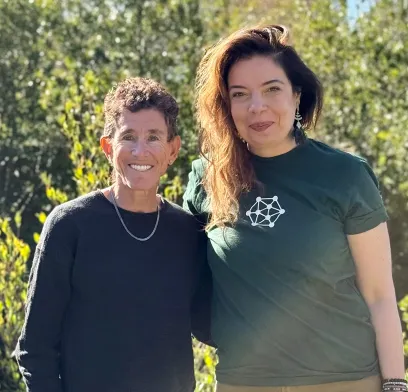
Fern Mandelbaum and Mada Seghete | Courtesy of Mandelbaum/Seghete
When Seghete brought the concept that would become Upside to Mandelbaum in 2024, her former teacher’s response was direct: “This is such a big problem. And your experience at Branch makes you the perfect person to solve it.” That clarity, from someone who understood both the market and the founder, gave Seghete the confidence she needed to ask her prospective co-founders to leave their jobs.
When it came time to raise a seed round, Seghete ran the process of finding the company’s investment partner deliberately. She fielded multiple term sheets and evaluated each using a 25-point framework that included reference calls with portfolio companies, partner assessments, and forward-looking evaluations of investor helpfulness. The results all pointed to the same place: Emerson Collective, with Mandelbaum as its lead partner and board member.
Mandelbaum has helped Upside identify early design partners and customers, challenged the company’s growth strategy, and served as a sounding board as the product evolved. Upside is now positioned as an intelligence layer atop B2B market data, and its thesis is rooted directly in the problem Seghete encountered at Branch. Most B2B companies have accumulated enormous volumes of internal data across their CRM systems, marketing attribution tools, and product usage signals, but that data is often siloed, inconsistently structured, and resistant to the kind of AI-powered analysis that go-to-market teams are increasingly trying to run. Upside unifies and cleans that data, making it AI-ready and giving revenue teams the foundation they need to drive sales.
For Seghete, the experience of building Upside with Mandelbaum as an advisor and investor has reinforced a conviction that took root at Stanford GSB: that the relationships formed inside the program are not a byproduct of the education but a core part of it.
Fervo Energy and the Formation of New Ventures Course
Tim Latimer, MBA ’17, came to Stanford GSB with a specific goal: build an enhanced geothermal company. He shaped his course load around that goal, taking lecturer Don Wood’s Formation of New Ventures alongside multiple other climate and entrepreneurship courses. The result was Fervo Energy, which uses horizontal drilling and fiber-optic sensing techniques borrowed from the oil and gas industry to tap geothermal heat far from conventional plants — making always-on, low-carbon power viable in far more places. In May 2026, Fervo became the first next-generation geothermal firm to go public, debuting on the Nasdaq at a market capitalization over $10 billion.
When Fervo raised its $462 million Series E in December 2025, its largest round to date, the deal was led by B Capital, whose partner Karly Wentz, MBA ’20, brought both a shared Stanford GSB background and deep energy investing experience to the table. The introduction came through Wood, MBA ’80, who advises B Capital in addition to teaching Formation of New Ventures.
“Don Wood was central to building Fervo in ways that went well beyond the classroom,” Latimer says. “Connecting us to Karly and B Capital years after I graduated is exactly the kind of thing that makes the GSB network special.”
Across all three stories, the thread is the same: Stanford GSB relationships through time, opening important doors. Stefanos Zenios, faculty director of the Grousbeck-Holloway Center, sees that pattern as the defining feature of the ecosystem itself. “The entrepreneurial ecosystem at the GSB is a catalyst that helps our alums launch their ventures,” Zenios says. “Classroom learnings provide the foundations that help aspiring entrepreneurs evaluate their venture ideas. Classmates and alums become co-founders, advisors, and investors. Faculty become early champions.” As Stanford GSB builders and founders come together, they partner to manifest new companies and build a better future.
For media inquiries, visit the Newsroom.