July 23, 2026
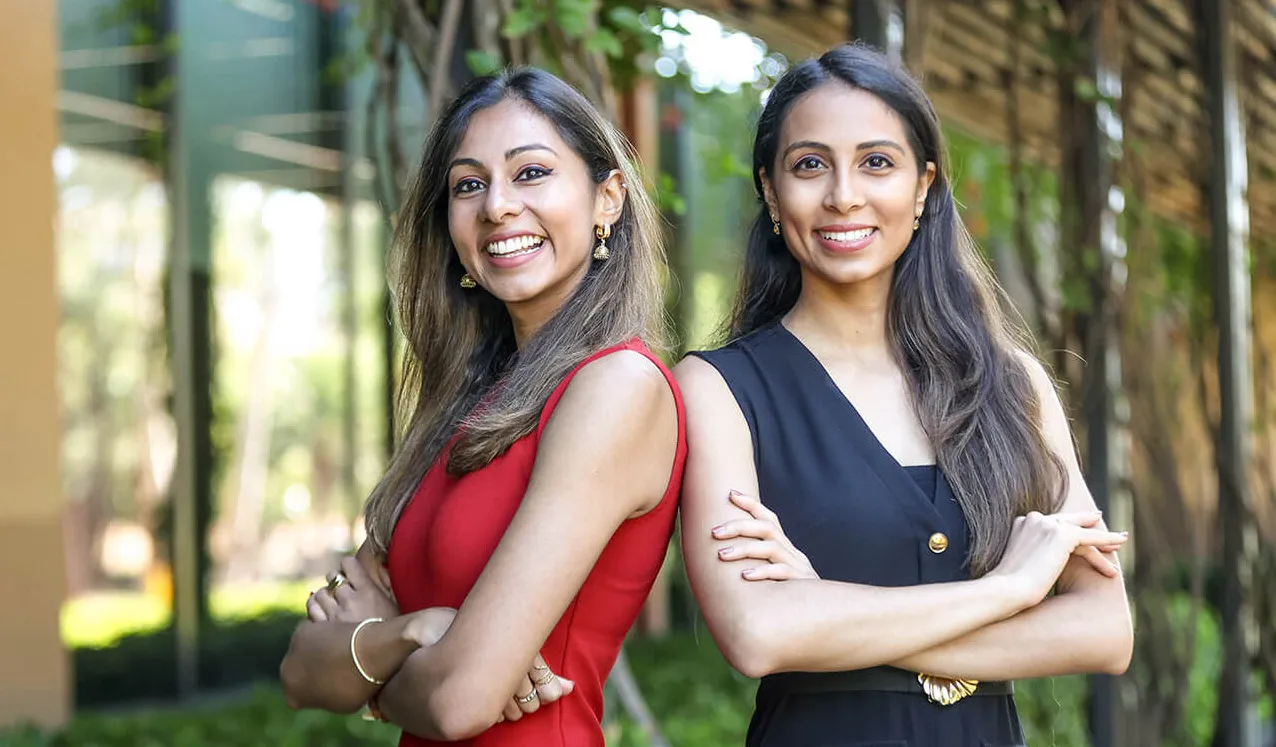
| by June D. BellThe last time Simran Mohnani, MBA ’26, and her younger sister, Krsna Mohnani, MBA ’27, attended the same school, they were elementary school students on the tiny Mediterranean island nation of Malta. Decades later — and nearly 6,700 miles from Malta — they were once again classmates, this time at Stanford Graduate School of Business.
The sisters didn’t anticipate that different career paths — for Simran, engineering, and for Krsna, medicine — would ultimately converge at business school. But both were looking to broaden and deepen their knowledge of investing, entrepreneurship, and innovation, and Stanford proved to be the right place for them.
Growing up in Malta with Indian immigrant parents, the Mohnani sisters absorbed the principle of seva — selfless service to community — which fueled how each envisioned her career. Inspired by the magical gadgets deployed in the TV cartoon Powerpuff Girls, Simran saw engineering as a vehicle for “scaling up innovation and bringing it down into the hands of the masses, where I really think it can make a difference.” Krsna has always been driven by a deep desire to care for others, and she became passionate about how tech could improve well-being, particularly for vulnerable populations.
It proved challenging for the sisters to find female role models and mentors locally whose paths mirrored the ones they hoped to take. “I remember looking for these people just to know, OK, if someone else has done it, I can do it too,” Krsna says. “Sim and I are big proponents of [the idea that] you can’t be what you can’t see. I remember thinking that if I can’t find these people, we’re just going to have to become the people I needed growing up.”
Finding Their Paths Forward
To accomplish that goal, the sisters left Malta to broaden their education. Simran, who is about 18 months older than Krsna, moved to the U.K. after high school to study chemical engineering at the University of Bath. Krsna followed, earning a medical degree at the University of East Anglia in Norwich, England, and then a biomedical engineering degree at Imperial College London.
Alarmed by the potentially devastating impact of rising sea levels on island countries like Malta, Simran focused on the industrial side of the climate problem as a chemical engineer — first on the factory floor at Cadbury, then at Deloitte, where she led the Circular Economy Innovation practice across Europe. At Stanford GSB, she took courses on investing and venture-building, including Stanford Climate Ventures and Energy Finance, and worked on the industrial climate deal team as part of the GSB Impact Fund.
Krsna, meanwhile, was a frontline doctor at the Imperial NHS Trust in London during the COVID-19 pandemic. Alongside her clinical work, she held an honorary research fellowship focused on mental health screening for asylum-seeking children. Together, these experiences inspired her to focus on socioeconomic determinants that brought the same patients back, again and again. She spent two years as an associate in London at the global consulting firm McKinsey & Company, working in life sciences, healthcare, and private equity before she, too, decided an MBA would provide both the theoretical and practical education she was seeking in policy and healthcare innovation.
Simran, who was preparing her Stanford GSB application at that time, persuaded Krsna to accompany her to an American business school panel in London. “At the end of that event,” Krsna says, “I was like, yep, Stanford is my place.” She cited three reasons: “One was being at the heart of Silicon Valley, at the heart of innovation. Two was the focus on social impact, and the third point was the culture, which is one of vulnerability, inclusivity, and openness.”
A Culture of Community Excellence at Stanford GSB
The sisters, both BOLD Fellows at Stanford and the first-ever Stanford GSB students to hail from Malta, credit their experiences as Arbuckle Leadership Fellows with cultivating their ability to mentor and lead. “The way I run interviews now is very much like coaching: to get to the human connection,” Simran says, adding that a humor course was “fundamentally game-changing” as well. Krsna gives high marks to the Interpersonal Dynamics course for fostering the culture of openness that drew her to Stanford GSB.
After receiving her MBA next year, Krsna wants to pursue opportunities at the intersection of entrepreneurship and healthtech ventures. Simran — who recently graduated — plans to work in scaling climate tech ventures. The sisters, who served as presidents of the Health & Wellbeing and Business & Environment clubs at Stanford GSB, respectively, share “a big aspiration” to collaborate and launch a female-focused fund, with Krsna running the human health aspect and Simran tackling the planetary health angle.
For now, they enjoy Stanford GSB’s climate of enthusiasm and community support from classmates, professors, and friends. Both sisters have put Stanford’s entrepreneurship programs to work — they cite Lean Launchpad, Startup Garage, and Stanford Climate Ventures as great examples — building and commercializing breakthrough tech across robotics, carbon removal, and healthtech. “Whenever you tell someone about your idea,” Simran says, “their reaction is, ‘OK, here are all the people I know who can help you do it. I’m pinging you with an iMessage with all their names.’ It’s so collaborative. … We’ve benefited from so many mentors.”
Krsna dubs this Stanford GSB phenomenon “the culture of possibility — that more is possible than what I thought. It’s expanding the ceiling of what you know, changing the perception of what is possible.”
For media inquiries, visit the Newsroom.