April 30, 2026
| by June D. BellThe Problem: Environmental degradation threatens Indigenous communities and their ecosystems.
The Solution: Supporting Indigenous groups with funding and eco-friendly technology.
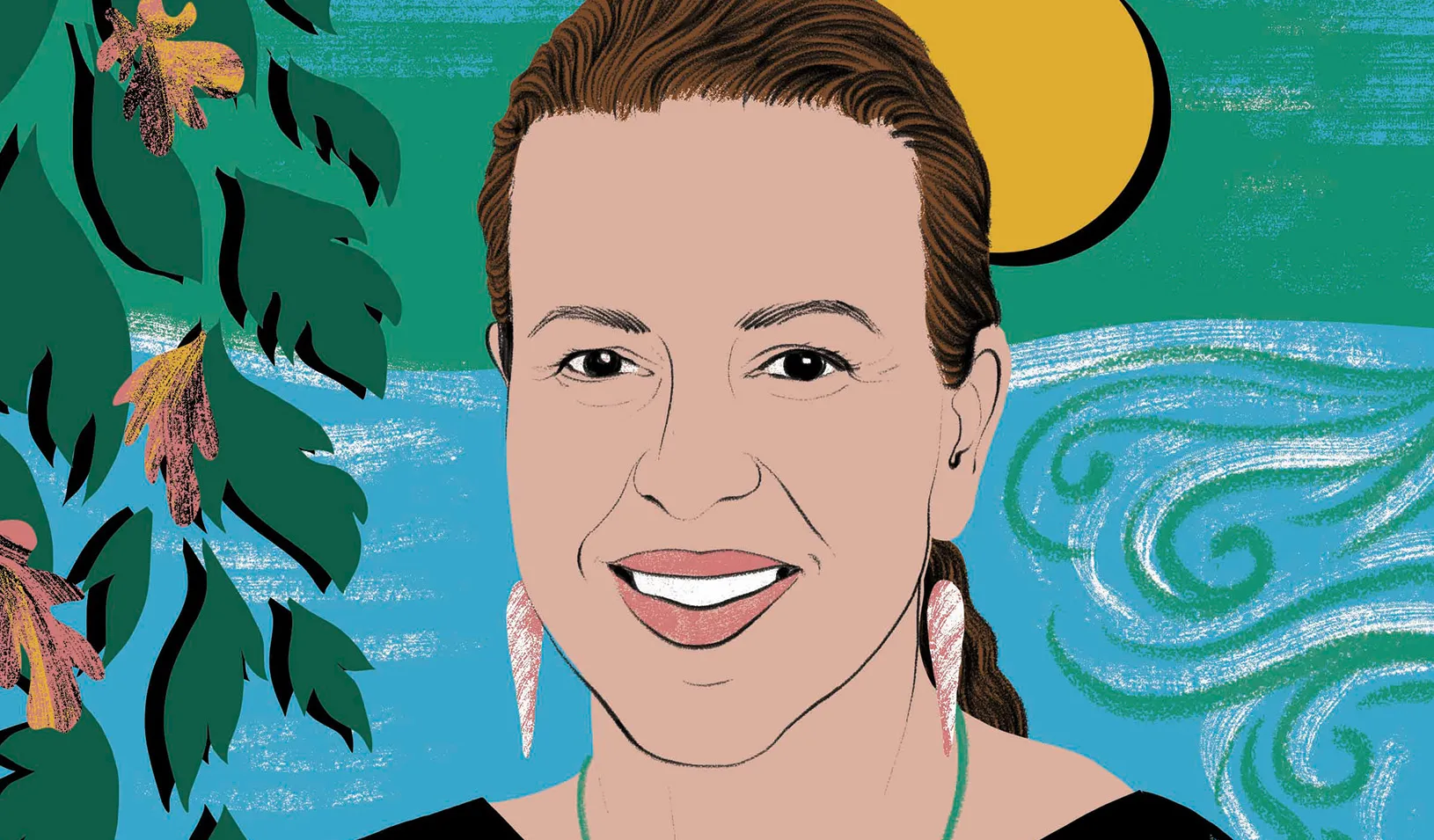
‘Aulani Wilhelm, MS ’14, can’t remember a time when she wasn’t building bridges. The daughter of a Native Hawaiian mother and a Swiss German father, she’s been “literally translating in my own family every day,” she says. “Living between those worlds has just been something that I was born into.”
Editor’s Note
In this ongoing series, we highlight work by alumni and executive program participants to solve contemporary problems.
These days, Wilhelm bridges divides across the globe as the head of Nia Tero, an international nonprofit that partners with Indigenous peoples’ stewardship of their homelands and waters. Since becoming CEO in 2025, the longtime environmental advocate has been spearheading efforts to channel funding, change policy, and provide eco-friendly technology to Native communities.
Nia Tero — which means “our Earth” in Esperanto — has worked with about 270 Indigenous peoples and tribes, largely in the southwest Pacific Islands, Africa, the Amazon rainforest, and North America. Founded in 2017, Nia Tero has about 60 staff at its Seattle headquarters and around the globe. It has channeled $125 million from individual donors and foundations to Indigenous groups on more than 300 million acres of their territory — an area larger than California and Texas combined.
Nia Tero is not the first organization to promote Indigenous leadership, but Wilhelm says the nonprofit is unique in recognizing that supporting Native communities is important for everyone. “We are bringing direct financing to Indigenous people, and our model of high-touch grantmaking is an important contribution to this field,” she says. “The idea is truly being a bridge between worlds and demystifying how Indigenous peoples can work most effectively with non-Indigenous entities and peoples.”
She emphasizes that Nia Tero does not speak on behalf of Indigenous peoples. Rather, the nonprofit helps them advocate for themselves and connects them with other like-minded groups to share wisdom about governance, ecosystems, and access to green technology, such as solar-powered boats for Indigenous Amazonians.
“They operate by river,” Wilhelm says, “and roads are some of the greatest threats. One way to stop further incursions of mining or logging is to not allow roads. But that means river transport has to be effective. We’ve been working to figure out how to build solar vessels designed for rivers, so people have non-polluting ways to continue traditional pathways and to transport people and goods.” Another bonus: Solar vessels ply the waterways silently, replacing noisy diesel motors that foul the water and air.
Nia Tero understands the needs of Indigenous peoples because many of its program officers themselves are Indigenous. Deep regional knowledge and connections are the keystone to fruitful relationships, Wilhelm says: “Our model isn’t to be a grantmaker but to develop an agreement to bring funding or access to technology or policy support. We don’t work with individuals; we work with communities to make sure that these solutions and support will endure.”
Wilhelm joined Nia Tero in 2023 as its chief strategy and external affairs officer after spending about 18 months as the assistant director for ocean conservation, climate, and equity in the White House Office of Science and Technology Policy during the Biden administration.
Wilhelm has spent her career in conservation. Before attending Stanford, she was superintendent of the Papahānaumokuākea Marine National Monument, one of the world’s largest marine conservation areas. She received a Stanford GSB Social Impact Founder (SIF) Fellowship in 2014 and founded Island Water, a nonprofit that provided island communities with locally produced potable water in reusable, plastic-free bottles. She also served as senior vice president of Conservation International’s Center for Oceans from 2016 to 2022.
To expand Nia Tero’s influence, Wilhelm is positioning it as both a template and a collaborator. “If it was up to Nia Tero alone, we’d never reach the scale or impact we want to have,” she says, emphasizing that collaboration is key to shared global prosperity. “We’ve been refining a model we have open-sourced, and I think we can do a lot together.”
One of Time’s 100 most influential climate leaders of 2025, Wilhelm is encouraged by a rising demand for corporate social accountability, including support for Indigenous peoples. “There’s a realization that if we don’t factor human rights and natural assets into our planning, we increase risk across every industry. Everything is becoming more and more scarce. We can put our heads in the sand — or we can start strategizing and think about how we plan for living and thriving.
“What keeps me going,” she says, “is the knowledge that Indigenous people are still here and have been facing these challenges and have been adapting and have been resilient throughout. If any of us — Indigenous or not — want a future for our children’s children, we need to do more to support those ways of kinship with nature.”
For media inquiries, visit the Newsroom.