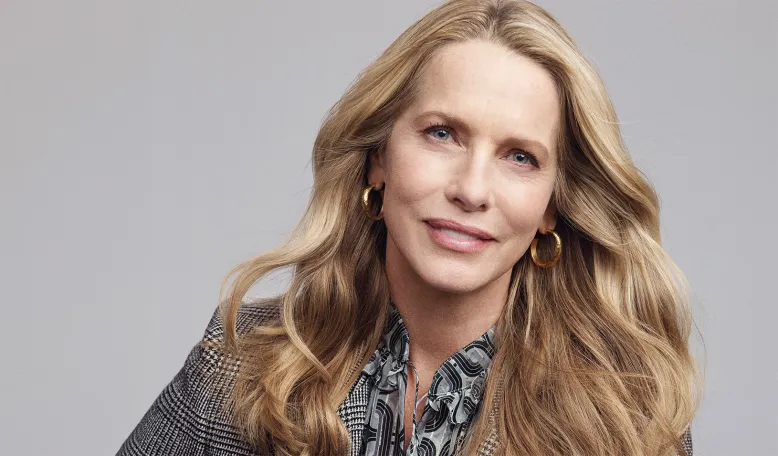
Laurene Powell Jobs, MBA ‘91, gave the keynote address to the graduating Class of 2026 at their graduation ceremony on Saturday, June 13, 2026.
Thank you, Dean Soule. I am incredibly honored to be here to celebrate the GSB Class of 2026!
It’s particularly meaningful that this is our centennial year.
Congratulations, graduates!
The GSB is a very special place. Like many of you, I arrived here from somewhere else. I had big dreams and an idea for a company I wanted to build, and I came here to learn how. I drove across the country in an ancient Volkswagen Cabriolet and rented a little house in Palo Alto, subletting two of the rooms so I could lighten my debt load.
I was drawn to the spirit of Silicon Valley, a place with audacious dreamers filled with the vision and courage needed to reimagine the world. California is a place where you are defined more by the quality of your ideas than by your family name. It is a place blessed with stunning natural beauty. A place where the rhythms of the natural world and the scale of the landscape have a way of challenging our assumptions about what is possible.
Before I arrived, I was a lifelong East Coaster. I thought, quite confidently, that Stanford would be an excellent two-year adventure. It turns out I was right about the adventure! I fell in love with California, and I also fell in love with someone who happened to live here.
During my first week of classes at the first View From The Top, I met my husband, Steve. From that day forward, we were rarely apart. He loved hearing about what I was learning at the GSB. He was especially captivated by stories from Touchy Feely. We were married by the time I was sitting where you are sitting today. And one month after graduation, along with a GSB classmate, I started the company I had come here to build.
Starting a company is both thrilling and terrifying. It requires conviction, vision, and a willingness to pursue an idea before anyone can know whether it will succeed. I know many of you are planning to do exactly that and I wish for you a better product-market fit than we had at Terravera! Not that we didn’t work incredibly hard. We did. But it turned out that the world wasn’t quite ready to obsess about longevity and pivot to healthy, fresh organic food. We were about 25 years too early.
The good news is that the GSB prepares you for both planned and un-planned lives. I assure you I could never have imagined how my life would unfold. What matters most in the unfolding is our curiosity, the size of our aperture, the ability to recognize opportunity in the setbacks, and to understand that learnings can come in a form that you might not expect.
While I was running Terravera, I was asked to speak to a class of high school seniors from East Palo Alto who were, I was told, college bound. These students had everything it takes to succeed in college: grit, tenacity, talent, and a will to persevere. In fact, they spoke about their college ambitions with excitement and confidence. But it soon became clear that none of them had taken, or planned to take, the SAT. Simply because no one had told them they needed to. And, most damaging, only three of the 35 students had even taken the high school classes required to apply to a four-year college.
That day at Carlmont High School, 30 years ago, reinforced something I have never forgotten: that while talent is equally distributed, opportunity is not. My heart and my conscience kept returning to the students I met.
And soon after, I made a pivotal decision that changed my life; I stepped away from Terravera. But in doing so, I had a realization. What I had learned at the GSB was not only how to build a company. The lessons were far broader, more enduring, and more inspiring.
I had learned to think like an entrepreneur. And when you combine an entrepreneur’s mindset with a bold idea and determination, you can create almost anything. I realized I loved the act of building. Especially when I could see that what I was building might help others.
After a year of listening and research, I started a non-profit called College Track to provide academic support and deep mentorship to local high school students. We began with 25 ninth graders and the learning curve was steep. I learned that to change academic performance, teachers must have the skills and resources they need to give extra attention to students who need it. I also learned that educational inequity, like societal inequity, is a result of complex and interconnected systems. And to address system design, we need modern policies at every level of government that support young people and strengthen the institutions that serve them.
The work at College Track continues and I continue to learn from the students and their families. Today, we serve 4,500 students in thirteen centers across the country, and we have celebrated more than 2,000 college graduations.
Starting a non-profit gave me firsthand understanding of how that sector operates. Philanthropic donors determine resource allocation that may be disconnected from outcomes. But importantly, the philanthropic sector is perfectly suited to de-risk new ideas, and to pilot innovations for social progress. Philanthropy is a powerful force for good in the world. Equally important, for-profit companies galvanize market economics to scale excellent ideas. So the ideal scenario would be to merge them, using both investing and grant making to supercharge positive change.
The discipline I learned at the GSB, thinking holistically and seeing patterns, inspired me to think more broadly, more ambitiously, and start a new type of company.
With these understandings, I built Emerson Collective. By functioning as an LLC, Emerson has the flexibility to engage and partner with business, government, and civil society in novel ways that advance social change. We focus on the hard, often unglamorous work of civic life: helping institutions function better, helping people engage more meaningfully, and helping leaders and communities navigate complexity with integrity and purpose. Unsurprisingly, we are compelled by builders with bold ideas.
I’ll give an example in the energy sector where I know many of you are engaged and concerned. The surge in energy demand, while stressing communities and families, is also creating an opportunity to accelerate the deployment of cleaner and cheaper energy technologies. Through our work with a wide range of public and private sector partners, we are exploring how this unprecedented demand for power can become a catalyst not only for innovation in energy generation, but also in storage, transmission, and efficiency.
And because Emerson operates across philanthropy, investing, policy, and partnerships, we can engage these opportunities in a variety of ways. Our structure invites nimbleness. Our venture team has invested in geothermal energy, nuclear fission and fusion energy, new battery technologies, and grid optimization.
Our policy team hosted a trip to Iceland with a delegation of U.S. mayors to understand how geothermal energy can be deployed at scale. We hold frequent roundtables in Washington DC with entrepreneurs and elected officials.
Through philanthropy, we support workforce training in communities across the country. We help architect community benefit agreements so that all may benefit from the next generation of energy solutions.
Our world is in flux. Our world is in need of repair and reimagining. We need to challenge old assumptions — and to create space to step back from the repetitive drumbeat of daily life.
Isn’t that what made your time at the GSB so valuable? It gave you the opportunity to widen your aperture, to encounter new ideas, and to reconsider familiar problems. The GSB is a place that cultivates the precious act of observation.
One of my most important undergraduate classes was Art History, which I took in Paris during a semester abroad. The Louvre was our classroom, and I had an epiphany while studying Monet.
Every day while painting, Monet used incredible mental discipline to see and not just define what he was seeing. He wrote: “When you go out to paint, try to forget what objects you have before you — a tree, a house, a field. Merely think, here is a little square of blue, here an oblong of pink, here a streak of yellow.”
I never thought like that before. Imagine encountering a forest and seeing color instead of trees. Incredible thoughts come up, even during the most mundane daily activities. It’s a quality in Zen called Beginner’s Mind. It allows for creativity and imagination and wonder to penetrate what may otherwise be rote thinking.
What Monet was really teaching was not how to paint. He was teaching us how to observe the world in new ways. And here is the great thing: We can all think like artists.
Art demands close attention. Artists coax texture, friction, strangeness, and truths out of the familiar.
Our role here, all of us, is to preserve and renew those deeply human dimensions of life that technology cannot replace; beauty, contemplation, craftsmanship, silence, transcendence. I believe the arts are a vital vehicle for truth and an essential part of human flourishing.
Perhaps it seems incongruous to talk about art here at graduation. But the way I understand the world, and the way I learned to see it here at the GSB, it makes complete sense.
The challenges you will face and the opportunities you will find may be shaped by technology, but they will ultimately be rooted in the instincts and actions of being human.
Our ability to shape a better future will depend on how we learn to see both what is broken and what we can fix.
Consider this: In 1954, a 25-year-old Dr. Martin Luther King Jr. delivered a sermon entitled “Recovering Lost Values” to a congregation in Detroit. It was another era of tremendous technological and scientific innovation and disruption. Commercial jetliners were just taking flight, DNA’s double helix had just been discovered, and the transistor was replacing vacuum tubes. Looming over it all was the atomic age.
Dr. King said, “When we stop to analyze the cause of our world’s ills… we begin to wonder if it is due to the fact that we don’t know enough. But it can’t be that. Because in terms of accumulated knowledge we know more today than men have known in any period of human history.” He noted that scientific progress had made the world far more interconnected and then he concluded, “The real problem is that through our scientific genius we’ve made of the world a neighborhood, but through our moral and spiritual genius we’ve failed to make of it a brotherhood.”
The world has grown far more interconnected in the 70 years since Dr. King delivered that sermon, thanks in large part to inventions that emerged from Silicon Valley. We can see more clearly than ever how entwined our fates have become. That makes Dr. King’s call to our spiritual well-being and our responsibility to our broader human community, all the more urgent.
Graduates, you are heading out into a world that is being shaken by generational forces. There is no map to follow. But humans have always been drawn to wonder what lies beyond the horizon and then invent the means to find out. What is required is both the preparation, like you have received here at the GSB, and the willingness to meet new realities as they take shape.
But no matter how far we travel, we must always remember our obligations to our communities and environments. We can learn to see possibilities others overlook, as Monet taught, and remember our responsibilities to one another, as Dr. King reminded us.
The world needs your intellect, your empathy, and your creativity. Somewhere ahead of you there will be doors you are not looking for and perhaps do not even know exist. But they will be there. And when they open, I hope you will be ready to walk through them with courage and clarity.
The world awaits. I cannot wait to see how you will change it.
Congratulations graduates!