
We empower faculty to design and discover original research that challenges conventions and creates breakthroughs that push boundaries of knowledge.
Publication Types
Journal Articles
Books
Working Papers
Case Studies
Browse Publications
Leadership Development in Business Schools: An Agenda For Change
There is surprisingly little evaluation of business school or, for that matter, company leadership development efforts. What evidence exists suggests that business schools have not been particularly effective, overall, in their leadership…
Limited Records and Reputation
We study the impact of limited records on reputation dynamics, that is, how the set of equilibria and equilibrium payoffs changes in a model in which one long-lived player faces a sequence of short-lived players who observe only limited…
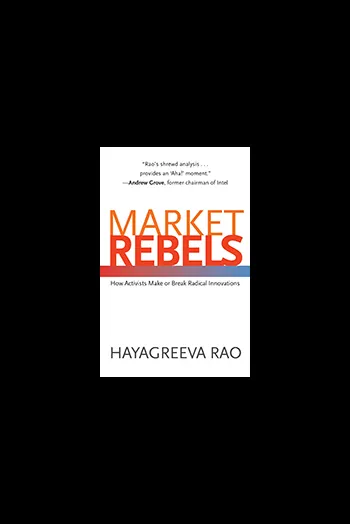
Market Rebels: How Activists Make or Break Radical Innovations
Activists who challenge the status quo play a critical but often overlooked role in both promoting and impeding radical business innovation. Their importance stems from the very nature of innovation, which frequently challenges existing interests…
Modal Constructions in Sociological Arguments
This paper introduces modal logics to a sociological audience. We first provide an overview of the formal properties of this family of models and outline key differences with classical first-order logic. We then build a model to represent…
Models of Job Preference for Stanford MBA's '78
An experiment was conducted to determine if the decision-making process for choosing between alternative job offers by Stanford MBA’s is affected by a task requiring an individual to evaluate hypothetical combinations of a limited number of job…
Multiple roles for minority sources in persuasion and resistance
Research on minority influence over the years has revealed that although sources in the numerical majority tend to be very persuasive on an immediate, public, and direct level, sources in the numerical minority tend to be resisted on this level (…
Objective versus Subjective Indicators of Managerial Performance
Managerial bonus payments are frequently determined by both objective and subjective indicators of managerial performance. By its very nature, subjective information is not verifiable for contracting purposes. The inclusion of such information in…
On the Heritability of Choice, Judgment, and "Irrationality": Genetic Effects on Prudence and Constructive Predispositions
Despite the very long history of research on heritable traits, we still know very little about genetic effects on judgment and choice, including consumer decision making. Building on recent advances in epigenetics, we hypothesize that people…
On the Malleability of Ideology: Motivated Construals of Color-Blindness
The authors propose that the content of certain sociopolitical ideologies can be shaped by individuals in ways that satisfy their social motivations. This notion was tested in the context of color-blind ideology. Color blindness, when construed…
Organizational ambidexterity: IBM and emerging business opportunities
The empirical evidence is that only a tiny fraction of organizations live to age 40. Why this should be is a puzzle, since when firms are doing well they have all the resources (financial, physical, and intellectual) to continue to be successful…
Performance Impact of Technological Assets and Reconfiguration Capabilities: The Case of Small Manufacturing Firms in Japan
The purpose of this study is to investigate the relationships between firm resources and performance. We divide firm resources into two types: primary resources and support resources. Primary resources include technological assets and…
Personal Emotions and Political Decision Making: Implications for Voter Competence
According to what criteria do citizens make political decisions, and what do these criteria say about democratic competence? An impressive body of evidence suggests that voters competently evaluate diagnostic information such as macroeconomic…
A Positive Theory of Moral Management, Social Pressure, and Corporate Social Performance
This paper provides a theory of firm behavior motivated by moral duty, self-interest, and social pressure. A morally managed and a self-interested firm compete in a market in which their corporate social performance (CSP) provides product…
Prigogine‘s Theory of the Dynamics of Far-From-Equilibrium Systems Informs the Role of Strategy-Making in Organizational Evolution
This paper offers a perspective on how Ilya Prigogine‘s theoretical ideas rooted in the physical sciences can inform and inspire organization theory and strategic management scholars. To that end, the next section of this paper provides a brief…
Problems in Creating and Sustaining Trust in Managed Care Settings: Physician's Perspectives
Skewed Bidding in Per Per Auction Models of Online Advertising
Online search, as well as keyword-based contextual advertising on third-party publishers, is primarily priced using pay-per-click: advertisers pay only when a consumer clicks on the advertisement. Slots for advertisements are auctioned, and…
Social Capital Creation: Collective Identities and Collective Action
Strategic Management of Technology and Innovation (5th edition)
The 5th edition of Strategic Management of Technology and Innovation continues its unmatched tradition of market leadership, by using a combination of text, readings, and cases to bring to life the latest business research on these…
