We empower faculty to design and discover original research that challenges conventions and creates breakthroughs that push boundaries of knowledge.
Publication Types
Journal Articles
Books
Working Papers
Case Studies
Browse Publications
The Evolution of Collective Strategies Among Organizations
Many organizations are made up of other organizations that have decided to act collectively as with research and development consortia, industrial alliances, trade associations, and formal political coalitions. These collective organizations can…
The Genesis of Venture Capital: Lessons from the German Experience
Why does venture capital work in some countries but not in others? This clinical study of the first German venture capital firm examines the difficulties of creating a venture capital market in a bank-based financial system. The analysis…
The Pleasures and Pains of Distinct Self-Construals: The Role of Interdependence in Regulatory Focus
Regulatory focus theory (Higgins, 1997) distinguishes between self-regulatory processes that focus upon promotion (gain-focused) and prevention (loss-focused) strategies for goal pursuit. Five studies provide support for the hypothesis that these…
The Politics of Blame: Bargaining Before an Audience
An important, but largely unexplored, class of bargaining problems involve two negotiators, who send signals to a third party. Such problems are especially common in politics, where elected officials must worry about approval from voters and…
The Relevance of Traffic for Internet Stock Prices
We find that web traffic is relevant for explaining market values and stock returns of pure Internet companies after controlling for accounting information such as book and values earnings. However, we find weak associations between web traffic…
The Role of Explanations and Need for Uniqueness in Consumer Decision Making: Unconventional Choices Based on Reasons
This research investigates the interaction effect of a very common task, explaining decisions, and an individual difference, need for uniqueness (NFU), on buyer decision-making. We propose that explaining (or providing reasons for) decisions…
The Summer that Saved Baseball
The strike of 1994 took a lot out of Major League Baseball. For the first time, a World Series was cancelled, something that hadn’t even happened during World War II. When play resumed, people stayed away from the ballparks in droves, and…

Theories of Delegation in Political Science
We survey modern models of delegation which assume that a boss and subordinate pursue their own goals. Among the major themes covered are the following: the conditions under which the boss will prefer to delegate versus those in which she will…
Thinking and Feeling
Mistakes give us a window into the brain. Just as optical illusions help us understand visual information processing, mistaken choices help us understand decision-making. The mistakes described below suggest that economics can usefully…
Trade Liberalization and Intersectoral Labor Movements
This paper examines the impact of trade liberalization episodes on movements of labor across sectors. The aim is to evaluate the empirical support for two classes of models: those where the effects of trade are mediated by structural change, and…
Transform Analysis and Asset Pricing for Affine Jump-Diffusions
In the setting of ‘affine’ jump-diffusion state processes, this paper provides an analytical treatment of a class of transforms, including various Laplace and Fourier transforms as special cases, that allow an analytical treatment of a range of…
Upending the Status Quo: Cognitive Complexity in Supreme Court Justices Who Overturn Legal Precedent
Studies of reasoning by majority and minority members show that group members in the majority think more about the trade-offs associated with alternative decision outcomes than do group members in the minority, who are more single-minded in…
Value Investing: The Use of Historical Financial Statement Information to Separate Winners from Losers
Venture Capital and the Professionalization of Start-up Firms: Empirical Evidence
This paper examines empirical evidence on the impact that venture capitalists have on the development path of new firms. We use a hand-collected data set on Silicon Valley start-up companies that allows us to “look inside the black box” and…
Venture-Capital Financing and the Growth of Startup Firms
Venture capital firms have unique capabilities in terms of dealing with high uncertainty, high degrees of information asymmetry, and providing access to a strategic network. This study examines the association between the presence of venture…
Visionaries, Managers, and Strategic Direction
Incentives for profitable innovation may be enhanced by employing a “visionary” CEO whose “vision” biases him in favor of certain projects. CEO vision changes which projects get implemented and thus affects the incentives of employees who can be…
What Do Groups Learn from Their Worldliest Members? Direct and Indirect Influence in Dynamic Teams
This study investigated the consequences of temporary membership changes for itinerant members (who leave their group of origin temporarily to visit a foreign work group) and indigenous members of those origin and foreign groups. We tested the…
Why Corporate Demography Matters: Policy Implications of Organizational Diversity
Although several attempts were made in the 1950s and 1960s to develop a demography of organizations, none were successful. While recent work shows more promise, it is still the case that organizational demography does not really exist, either as…
Why the microbrewery movement? Organizational dynamics of resource partitioning in the U.S. brewing industry
The number of small specialty brewers in the U.S. beer brewing industry has increased dramatically in recent decades, even as the market for beer became increasingly dominated by mass-production brewing companies. Using the resource-partitioning…
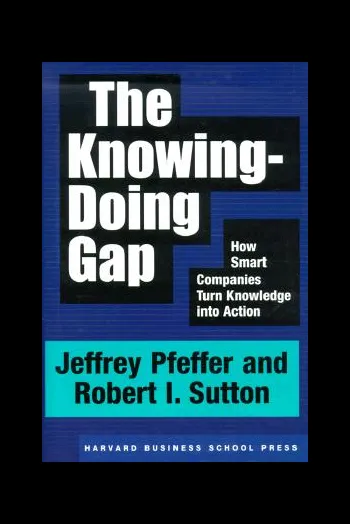
The Knowing-Doing Gap: How Smart Companies Turn Knowledge into Action
Why are there so many gaps between what firms know they should do and what they actually do? Why do so many companies fail to implement the experience and insight they’ve worked so hard to acquire? The Knowing-Doing Gap is the first book to…