
We empower faculty to design and discover original research that challenges conventions and creates breakthroughs that push boundaries of knowledge.
Publication Types
Journal Articles
Books
Working Papers
Case Studies
Browse Publications
Choice in Context: Tradeoff Contrast and Extremeness Aversion
Consumer choice is often influenced by the context, defined by the set of alternatives under consideration. Two hypotheses about the effect of context on choice are proposed. The first hypothesis, tradeoff contrast, states that the tendency to…
Coalitions, Leadership, and Social Norms: The Power of Suggestion in Games
This paper examines the set of outcomes sustainable by a leader with the power to make suggestions in games. By acting as focal points, these suggestions are important even if players can communicate and form coalitions. For finite-horizon…
Comparing Equilibria
We develop an ordinal approach to comparing the equilibria of economic models. The main advantages of this approach, compared to the traditional approach based on signing derivatives, are that (1) it utilizes only a subset of the assumptions…
Competitive Political Action and Policy Neutrality
This paper develops a signaling theory of competitive political action. Despite the free rider problem associated with mass political participation, rational and self-interested individuals may take costly political action to inform or manipulate…
Condorcet Dynamics
The Condorcet Jury Theorem has classically presumed a static context: the decision making group faces a fixed set of alternatives, compares the options in a pairwise fashion, and the process ends when the group makes a final choice. This is a…
Contractual Arrangements in Franchising: An Empirical Investigation
In this paper we conduct an empirical investigation of the recent explanations offered for the nature of a franchising contract. In particular, we focus on the arguments posited by Lal (1990) where it is suggested that since both the franchisor’…
A Control Theory of Dynamic Capital Structure
This paper develops a model in which debt serves to constrain inefficient investments of empire building managers due to the consequent control implications of bankruptcy. Unlike related free cash flow models, capital structure is voluntarily…
Converters, Compatibility, and the Control of Interfaces
Converters, emulators, or adapters can often make one technology partially compatible with another. The authors analyze the equilibrium market adoption of otherwise incompatible technologies when such converters are available and the incentives…
Cooperation and Organizational Identification
Organizational theorists have long recognized the important role cooperation plays in organizations. However, current theories say little about the antecedents of cooperative behavior in organizations. In this chapter, I present a conceptual…
Corporate Conservatism, Herd Behavior and Relative Compensation
This paper demonstrates that in a simple setting with managerial concern for reputation and asymmetric information on ability, most managers may refrain from undertaking innovations which stochastically dominate an industry standard. Common…
A Cross-Sectional Analysis of the Theory of Corporate Disclosure Due to Adverse Selection
In this paper we examine the determinants of firms’ level of voluntary disclosure. We use analysts’ published evaluations of firms’ disclosures as a comprehensive measure of disclosure level and use a model of discretionary disclosure to explain…
Cultures in Organizations: Three Perspectives
Despite the surge of interest over the last decade in cultural phenomena in organizations, researchers of widely differing disciplinary backgrounds, epistemologies, methodological preferences, and political ideologies continue to disagree…

Delegation and the Regulation of Risk
It has been argued that U.S. regulatory agencies take an extreme and often inconsistent approach to the regulation of risk: they tend to overreact to dramatic, well-publicized accidents and disasters. The standard explanation invokes the…
Divided Government and U.S. Trade Policy
We develop a distributive politics theory of delegation and accommodation in U.S. trade policy. Congress may choose to delegate trade policymaking authority to the president in order to implement more efficient and less protectionist trade policy…
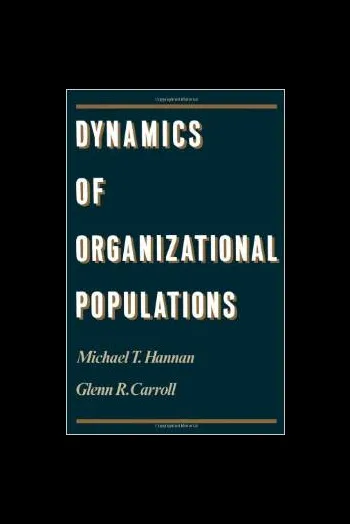
Dynamics of Organizational Populations: Density, Legitimation and Competition
Why does the number of organizations of any given kind vary over time? Utilizing a diverse group of organizations including national labor unions, newspapers and newspaper publishers, brewing firms, life insurance companies, and banks, this book…
Employee Stock Options
This paper considers the optimal exercise policy for employee stock options taking into account the tax incidence of exercise on both the employee and employer as well as the employee’s risk preferences. A recursive algorithm that determines the…
Escaping the Inherent Conservatism of Empirical Organizational Research
Those of us who have uncooperative political convictions and a commitment to doing empirical organization research have a problem: Empirical research in our field trends to be inherently conservative. Presuming that we confine our data collection…
Fading Memories: A Process Study of Strategic Business Exit in Dynamic Environments
The comparative study of the evolution of Intel Corporation’s strategic position in two semiconductor memory businesses and in the microprocessor business provides insight in the forces that drive the strategic business exit process in dynamic…
Feelings about a Disneyland Visit: Photography and the Reconstruction of Bygone Emotions
Hedging in Incomplete Markets with HARA Utility
In the context of Merton’s original problem of optimal consumption and portfolio choice in continuous time, this paper treats an extension in which the investor is endowed with a stochastic income that cannot be replicated by trading the…