This year’s winning team shares their strategies, lessons, and top takeaways.
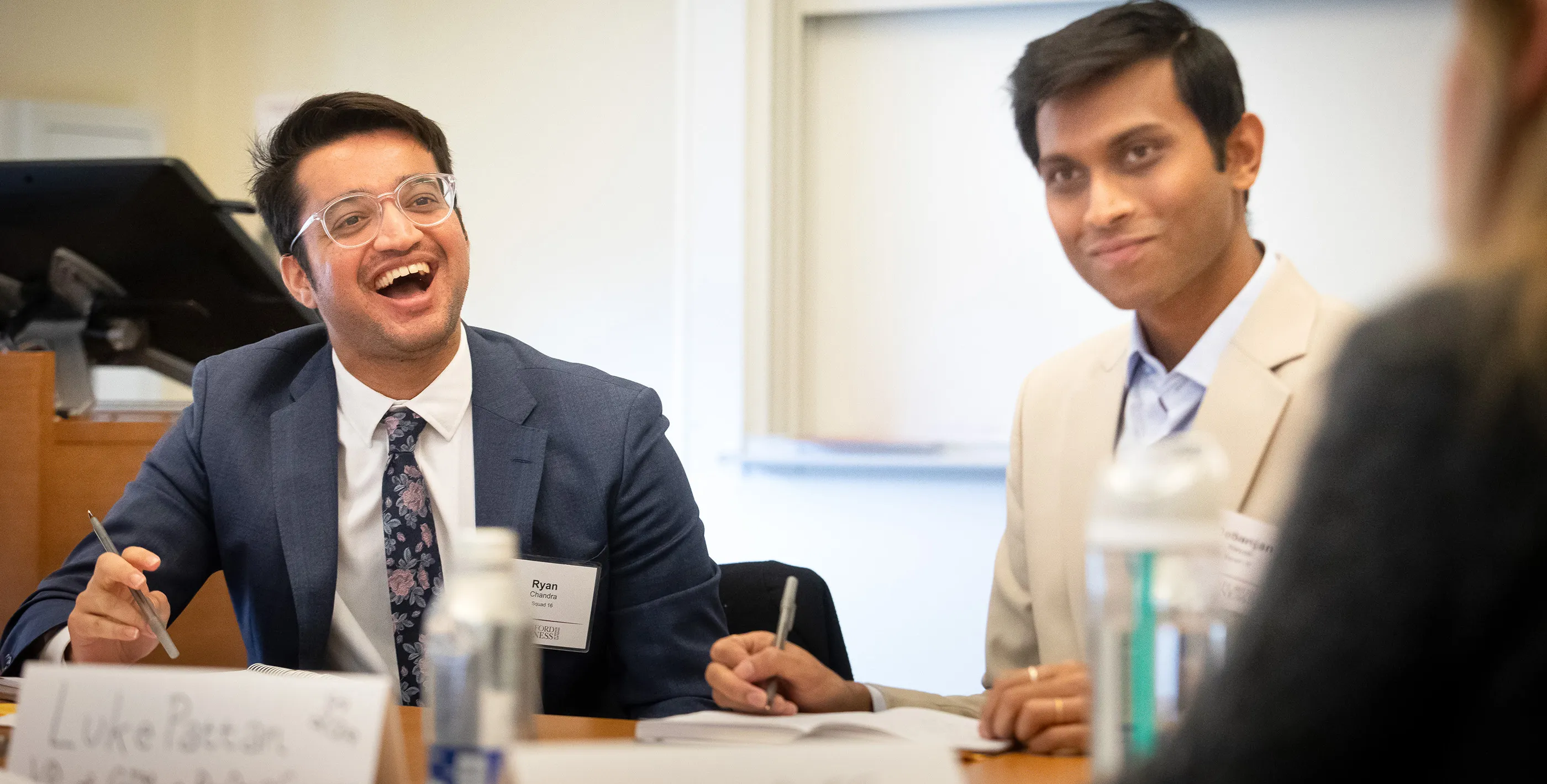
Even though her team won Stanford GSB’s Executive Challenge, Phoebe Stoye, MBA ’27, says that was never really the point of the experience. “I saw it more as a practice to grow and take what we learned with other students and apply it to the real world,” she clarifies. “Winning was the cherry on top.”
Every year, all first-year MBA students at Stanford GSB participate in Executive Challenge, a role-playing event that, since 2007, has served as the culminating event for Leadership Labs. Part of the required curriculum for all MBA students, the challenge is a GSB-wide, daylong event in which squads of six students role-play three business cases. The cases are unknown to the students in advance, as are the 200 alumni who make up the panels that judge the teams’ performance.
“Executive Challenge is experiential learning at its best,” says Dikla Carmel-Hurwitz, a Stanford GSB lecturer in management. “It’s a real-time simulation where students must integrate functional knowledge with leadership behaviors to navigate ambiguous, high-stakes environments.”
The premise of Leadership Labs, she explains, is based around one simple but potent question for future leaders: “Why would anyone follow you?” To answer that question, students spend the quarter setting leadership goals, conducting deep dives into interpersonal dynamics, and distilling lessons from their other courses in areas such as strategy, operations, finance, and organizational behavior.
On December 3, 2025, a new batch of MBA students had a chance to put their accumulated learning to the test.
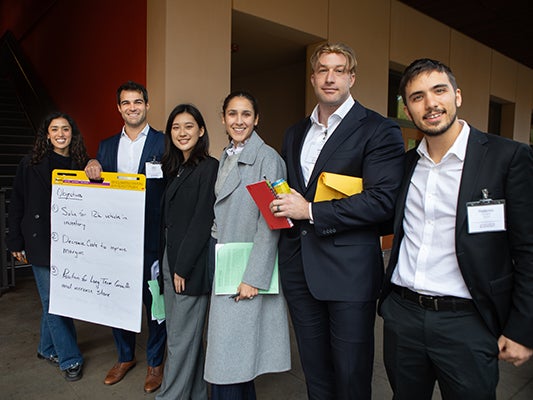
Students arrived at Knight Management Center early on the day of Executive Challenge.
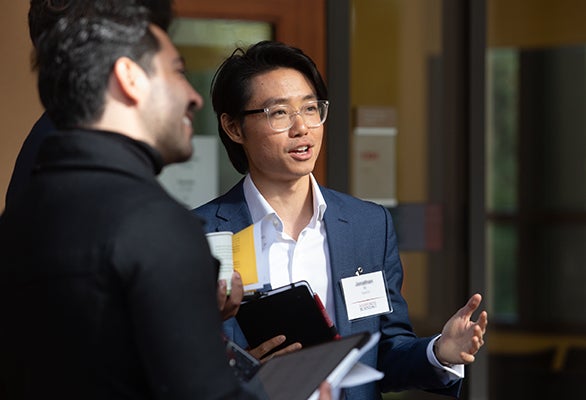
December 3 was a day of applied learnings for MBA students.
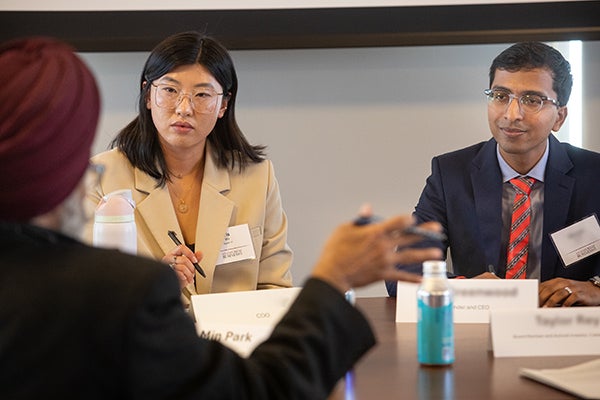
Alumni gave students valuable feedback and asked tough questions during Executive Challenge.
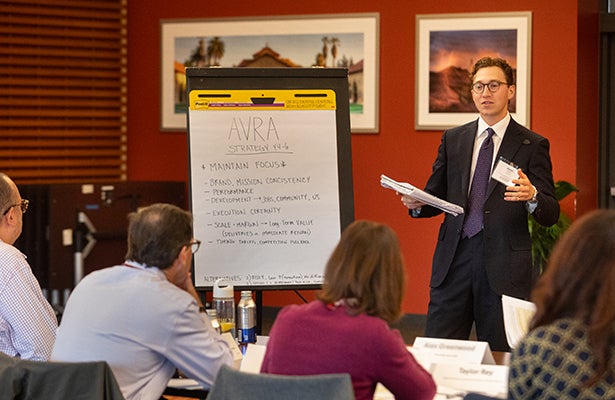
Students learned to present to board members in simulated scenarios.
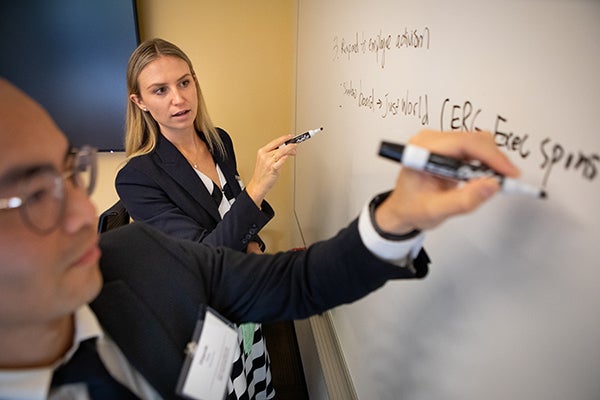
Executive Challenge helped teach students to think on their feet.
Preparing for the Challenge
Stoye and her squadmates on Squad 16 — Ryan Chandra, Randy Clark, Debanjan Nayak, and Joyce Yu, all MBA ’27 — approached the day with a mixture of trepidation and excitement. Their team was short the usual six-member configuration, yet the run-up to the event was the same for all their fellow first-year classmates, with coaching, feedback sessions, and simulated role-playing opportunities in Leadership Labs done in tandem with other squads.
“Some of the simulations we went through brought up tough emotions,” says Stoye. “And knowing what are my strengths, what are my weaknesses, and reminding myself to respond to tough situations with a mantra to breathe, listen, and then respond — having done the simulations really made me feel mentally prepared for the day.”
Each squad is supported by an Arbuckle Fellow, a second-year MBA student chosen through a competitive process to work with first-year students throughout their first quarter. That fellow becomes integral to the students’ overall journey to Executive Challenge, mentoring the squad through the process and drawing on their own experience in the previous year. “Throughout the quarter, I led from the outside: modeling behaviors, surfacing blind spots, and giving clear, thoughtful feedback while letting the squad own their learning,” says Aditi Mahajan, MBA ’26, Squad 16’s Arbuckle Fellow. “I could also participate in role-plays, showing how to stretch beyond comfort zones.”
“What Aditi really helped with was coaching: never giving me the direct answers, but helping me think on the exact questions and do a lot of self-reflection,” says Nayak.
Indeed, much of the squad’s recipe for success was fostered through the dynamics of the team — strengthening their collaborative team spirit while bolstering individual self-confidence, which was a challenge for this particular squad.
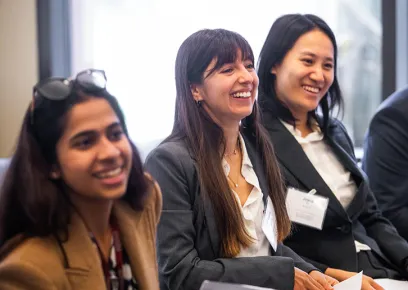
Aditi Mahajan (at left), a second-year MBA student, coached and supported the students as they prepared for Executive Challenge. She’s shown here with two of the students from Squad 16: Phoebe Stoye (center) and Joyce Yu (at right). | Saul Bromberger
Stoye remembers a particular piece of advice from Mahajan that exemplified her approach and helped the squad communicate more effectively. “Aditi let us build our rapport and our trust with each other. Then three weeks before the challenge, she said, ‘Let’s think about how we can stop speaking into the middle but actually direct our feedback toward each other.’ It didn’t come naturally to people on our squad, because we were trying to be nice and support each other. Aditi gave us that little push, and from then on, we gave each other at least one piece of constructive feedback every session.”
“Sometimes I try to say things nicely to people because I’m worried how they’ll take it, but it was kind of an aha moment to realize that just being honest and direct is actually the nicest thing you can do for your teammates,” Stoye says.
The Secret Sauce
First-year MBA students arrived at the Knight Management Center on a chilly-for-California December morning, full of nervous anticipation and dressed in formal business attire. Alumni judges, including presidents, partners, and C-suite executives — spanning over 50 years of GSB classes — welcomed them into their mock boardrooms for the day.
In this sea of excitement, “the energy of our squad helped keep us calm,” Nayak remembers. “That, and focusing on our preparation for the first case.” The team had a little under two hours to ready themselves and decide on roles, which they allocated based on interest rather than comfort. Fueled by coffee and adrenaline, the team took turns presenting their cases to the judges.
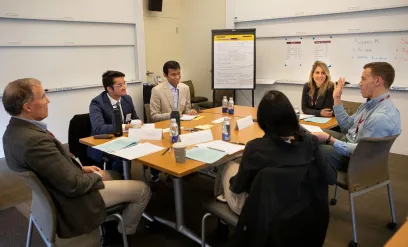
As Squad 16 students presented to alumni on December 3 at Executive Challenge, “the energy of our squad helped keep us calm,” says Nayak. | Saul Bromberger
Ultimately, their rigor in pre-preparation served them well, but it was their team dynamic and grounded perspective that helped give them an edge. “We had no idea how the simulation would take place, or how the board members would be,” says Nayak. “But we knew the comfort was there within our team to face anything and think on our feet to come up with solutions. What really helped that day was putting away the pressure of seeing it as a competition. What we decided as a squad was, ‘Let’s get a beautiful learning experience out of it.’”
The judges took note of their approach. “Squad 16 demonstrated exceptional partnership and self-confidence, with a genuine ability to make each board member feel heard while still bringing them into a shared solution. Doing this well within the very limited time of the role-play is extremely difficult, and this team truly excelled,” says one of their judges, Patty Soriano, MS ’18, senior director at the financial services company Oportun, noting why the squad won. “They held the room in a way that allowed them to actively listen to opposing viewpoints while confidently exercising their authority as CEO and COO. They balanced empathy with decisiveness, which is a rare and powerful leadership combination.”
Class Learnings
The ultimate lessons of the event stretch far beyond the day itself.
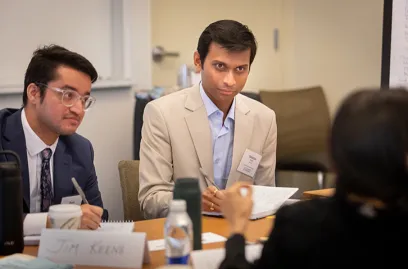
Nayak (at right) and Chandra (at left) learned that the lessons of Executive Challenge were invaluable to their career journey as leaders. | Saul Bromberger
“Executive Challenge gives students an opportunity to operate as an actual executive team: making strategic decisions, managing stakeholder dynamics, and building consensus,” says Carmel-Hurwitz. “For their long-term career journey, this experience is invaluable because it focuses on leadership as a set of behaviors rather than a formal title.”
Students agreed, sharing that the outcome of the event — and the class itself — helped shape the way they will think about their own leadership journey moving forward.
As Nayak reflects, “Executive Challenge was all about team dynamics, team effectiveness. At the end of the day, you need to motivate people and really focus on having the right people around you.”
Stoye echoes these sentiments. “When I came into this course, my goal was to be confident and assertive. But what I learned is that I could actually focus on listening and leading with my heart. Flipping something that I felt was a weakness — being empathetic and sensitive — into a strength really came through.”
For next year’s crop of Executive Challenge participants, Soriano has a few words of advice that are aligned with that more collaborative, human-centered leadership approach. “Depending on the situation, leaders may need to approach the board differently: sometimes seeking approval, other times informing or aligning on direction,” she says. “Students often default to asking for sign-off when the real opportunity is to seek feedback or intentionally bring the board into shaping the solution.”
In the end, Nayak returned to the question at the center of Leadership Labs. “We were always directed to think and reflect on this question — ‘Why would anyone follow you?’ Executive Challenge was the first step toward that answer.”
Explore More
An Astronaut Lands at Stanford GSB
![]Marcus_Wandt_in_Cupola Key Image](https://www.gsb.stanford.edu/sites/default/files/2026-10/key-Marcus_Wandt_in_Cupola%20credit%20ESA%201.jpeg)
Office Artifact: Erica Plambeck’s Miniature Rickshaw
Jenna Nicholas, MBA ’17: What Matters to Me Now and Why