We empower faculty to design and discover original research that challenges conventions and creates breakthroughs that push boundaries of knowledge.
Publication Types
Journal Articles
Books
Working Papers
Case Studies
Browse Publications
Playing-Side Analytics in Team Sports: Multiple Directions, Opportunities, and Challenges
This paper describes developments in the player-side analytics in major team sports. We take a decision-making lens to the role of analytics in player decisions by general managers and coaches. We outline key accelerators and inhibitors to the…
Higher Medicare Expenditures Are Associated With Better Integrated Care as Perceived by Patients
Integrated care that is continuous, coordinated and patient-centered is vital for Medicare beneficiaries, but its relationship to health care expenditures remains unclear. This study explores—for the first time—the relationship between integrated…
Augmenting Markets with Mechanisms
We explain how the common practice of size-discovery trade detracts from overall financial market efficiency. At each of a series of size-discovery sessions, traders report their desired trades, generating allocations of the asset and cash that…
A Better Boom: How to Capture the Pandemic’s Productivity Potential
The article discusses how to capture the productivity potential of the COVID-19 pandemic which has triggered technological and organizational innovation. Topics covered include what businesses and governments can do to capitalize on the positive…
Breiman’s Two Cultures: A Perspective from Econometrics
Breiman’s “Two Cultures” paper painted a picture of two disciplines, data modeling, and algorithmic machine learning, both engaged in the analyses of data but talking past each other. Although that may have been true at the time, there is now…
Buying Data from Consumers
New technologies have enabled firms to elicit granular behavioral data from consumers in exchange for lower prices and better experiences. This data can mitigate asymmetric information and moral hazard, but it may also increase firms’ market…
Distribution-Free Assessment of Population Overlap in Observational Studies
Overlap in baseline covariates between treated and control groups, also known as positivity or common support, is a common assumption in observational causal inference. Assessing this assumption is often ad hoc, however, and can give misleading…
Double-Robust Two-Way-Fixed-Effects Regression For Panel Data
We propose a new estimator for the average causal effects of a binary treatment with panel data in settings with general treatment patterns. Our approach augments the twoway-fixed-effects specification with the unit-specific weights that arise…
How Can We Inspire Nations of Learners? An Investigation of Growth Mindset and Challenge-Seeking in Two Countries
Here we evaluate the potential for growth mindset interventions (that teach students that intellectual abilities can be developed) to inspire adolescents to be “learners” — that is, to seek out challenging learning experiences. In a previous…
Market Fragmentation
We model a simple market setting in which fragmentation of trade of the same asset across multiple exchanges improves allocative efficiency. Fragmentation reduces the inhibiting effect of price-impact avoidance on order submission. Although…
Monitoring with Limited Information
We consider a system with an evolving state that can be stopped at any time by a decision maker (DM), yielding a state-dependent reward. The DM does not observe the state except for a limited number of monitoring times, which he must choose, in…
Notching R&D Investment with Corporate Income Tax Cuts in China
We study a Chinese policy that awards substantial tax cuts to firms with R&D investment over a threshold or “notch.” Quasi-experimental variation and administrative tax data show a significant increase in reported R&D that is partly…
Quantitative Analysis of Multiparty Tariff Negotiations
We develop a model of international tariff negotiations to study the design of the institutional rules of the GATT/WTO. A key principle of the GATT/WTO is its most‐favored‐nation (MFN) requirement of nondiscrimination, a principle that has long…
Redistribution Through Markets
Policymakers frequently use price regulations as a response to inequality in the markets they control. In this paper, we examine the optimal structure of such policies from the perspective of mechanism design. We study a buyer-seller market in…
Regulating Conglomerates in China: Evidence from an Energy Conservation Program
We study a prominent energy regulation affecting large Chinese manufacturers that are part of broader conglomerates. Using detailed firm-level data and difference-in-differences research designs, we show that regulated firms cut output and…
Small-Business Survival Capabilities and Fiscal Programs: Evidence from Oakland
Using City of Oakland data during COVID-19, we document that small-business components of survival capabilities (i.e., revenue resiliency, labor flexibility, and committed costs) vary by firm size. Nonemployer businesses rely on low-cost…
Subjective Age and the Greater Good
Contradicting existing associations between old age and negative societal consequences, such as being frail and unproductive, this research finds that people contribute more to the greater good of society (e.g., by helping strangers in need) when…
Supply Constraints and Directors’ Reputational Incentives
We study the labor market consequences that result from directors’ limited capacity to sit on boards and their resulting incentives stemming from career concerns and future prospects. We find that directors who leave one board are more likely to…
Temporal Concatenation for Markov Decision Processes
We propose and analyze a temporal concatenation heuristic for solving large-scale finite-horizon Markov decision processes (MDP), which divides the MDP into smaller sub-problems along the time horizon and generates an overall solution by simply…
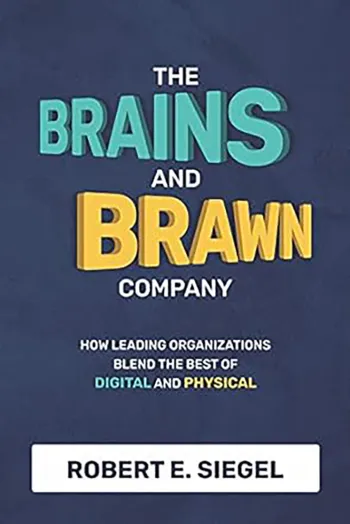
The Brains and Brawn Company: How Leading Organizations Blend the Best of Digital and Physical
The grounded, clear-sighted guide you need to blend digital and traditional business functions for long-term competitive advantage.
Business leaders are continually told they need to embrace digital disruption wholeheartedly to thrive in…