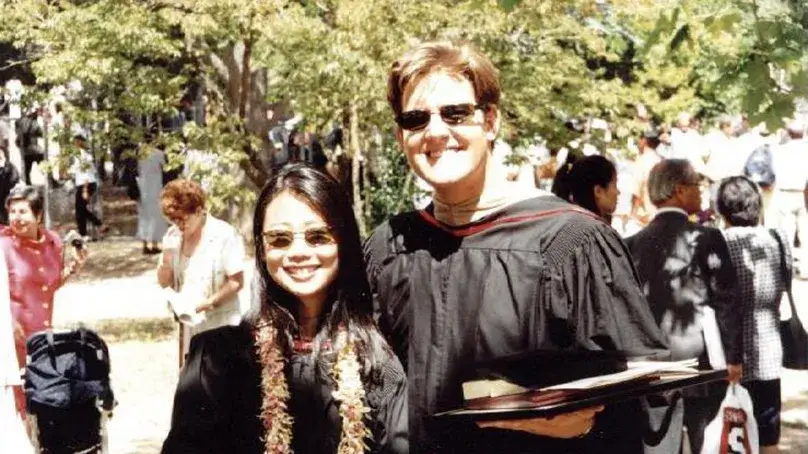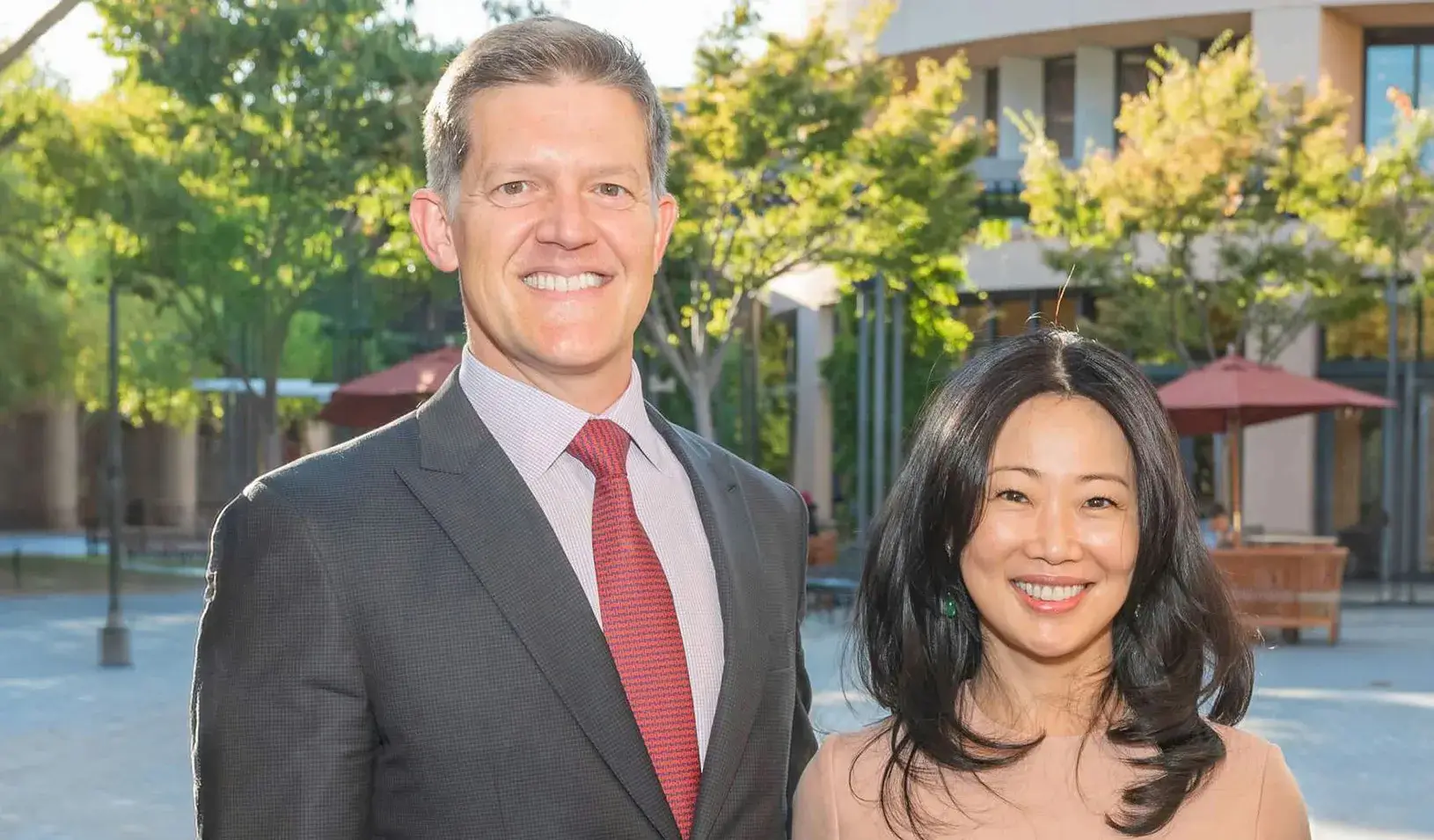
Roelof Botha, MBA ’00, and Huifen Chan, MBA ’00, attended the dedication of the Botha-Chan Faculty Building in 2022 at the Knight Management Center. | Javier Flores
When they met as students at Stanford Graduate School of Business, Roelof Botha, MBA ’00, and Huifen Chan, MBA ’00, would have benefited from the innovation program that now bears the couple’s name at the Grousbeck-Holloway Center for Entrepreneurial Studies.
“Candidly, for both of us, doing a summer job was meaningful. I needed the income, I needed the experience, I needed the exposure,” says Botha, who is now a partner at Sequoia Capital and member of the Stanford University Board of Trustees, as well as chair of the Stanford GSB Advisory Council.
The couple each financed their business education on tight budgets. “I came from, I would say, a lower middle-class family financially,” says Chan, who received a scholarship to attend Carnegie Mellon University as an undergraduate and then worked for a startup after graduation.
Once she had saved enough for her brother’s college tuition back in Singapore, she applied to Stanford GSB. “I felt like this was something I could do for myself.”
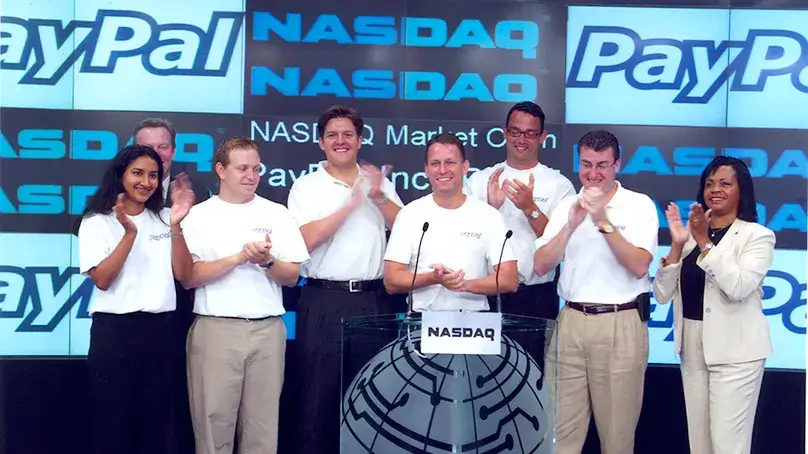
Botha faced similar financial pressures coming to Stanford as an international student from South Africa on a student visa, with no work authorization. He remembers coming up short for rent his last quarter before graduation. While at the GSB, he enrolled in a one-credit course that let him start building PayPal’s financial model; he officially joined the company the day after graduation. Just two years later, he had risen to CFO and led PayPal’s IPO and subsequent acquisition by eBay.
Once they were in a position to give back, Botha and Chan began to lend their support to Stanford as philanthropists. Chan says this stemmed from gratitude for the opportunities that became available to them after graduation, enabling Botha to pursue a career as a venture capitalist and to her becoming CEO at Perfect Bridal, one of the first companies to introduce customizable retail for the digital age.
“Roelof has been extraordinary in supporting the school, and incredibly creative,” says Stanford President Jonathan Levin, who served as dean of Stanford GSB from 2016 to 2024. “Just to pick one example, the Botha-Chan Fellows came out of an Advisory Council meeting at the start of the pandemic when internships were being canceled right and left. Roelof called an hour later and said that he and Huifen would create a summer entrepreneurship program — six years later, students across Stanford are still benefiting.”
The Botha-Chan Innovation Program named for their gift connects Stanford graduate students with paid summer internships that enable them to investigate and validate a for-profit venture idea. It is now considered a mainstay of Stanford GSB.
“Nearly every student at the GSB today enrolls in an entrepreneurial class, and it’s great if they’re able to pursue that path after graduation,” Botha says. “Think of Nubank and DoorDash and Ethos, and so many great companies that have come out of the GSB. But even if they don’t succeed, the exercise of trying to go from zero to one is a great learning experience.”
Chan said their support of the program reflects a shared passion. “Entrepreneurship has always been near and dear to my heart. That’s the environment that I love to work in — that we love to work in.”
Students who participate in the Botha-Chan Innovation Program “always tell us how much they appreciate it,” says Chan. “What I say to them is: If you truly appreciate your experience here, be a mentor. Come back and participate in some way, and give back to the program.”
Dedication to GSB excellence
Botha and Chan remained involved as volunteers after graduation, each in their own way. Botha served as a presenter for the Grousbeck-Holloway Center for Entrepreneurial Studies; Chan became a member of their reunion planning committee. Over time, Botha became increasingly involved as a mentor and advisor, joining the GSB Advisory Council in 2022.
Together, the couple have made gifts to strengthen the GSB faculty and name the Botha-Chan Faculty Building at the Knight Management Center. Their philanthropy also has extended to other areas of the university, including gifts for the Hoover Institution and School of Medicine.
“Huifen and Roelof have had a profound influence on the university, and Stanford GSB in particular,” says Sarah A. Soule, the Philip H. Knight Professor and Dean and Morgridge Professor of Organizational Behavior. “We are all at our best when we are generous with our ideas, our time, our attention, our resources — and I am truly grateful that they embody this kind of open-hearted generosity.”
In prioritizing support for faculty, Chan and Botha cite the influence of their professors at Stanford GSB. Chan says her interest in entrepreneurship was piqued by the now emeritus professors Charles Holloway and H. Irving Grousbeck, who cofounded Stanford’s first center dedicated to entrepreneurial studies in 1996.
Botha says one of his most influential professors was Garth Saloner, PhD ’82, a professor of economics who served as GSB dean from 2009 to 2016. It’s not lost on Saloner that the Botha-Chan Professorship he now holds is named for his former students. “Roelof sat in the back of the class, a tiny bit to the right,” he recalls. “He was the guy who would just sit there like a sphinx and let everybody struggle. Then he’d raise his hand and completely nail it.”
In 2022, Botha and Saloner teamed up to launch Stanford dy/dx, an invitation-only program for startup leadership teams, where Saloner is faculty co-director.
“It’s really Roelof’s brainchild,” Saloner says. “We brought other VCs on board, and to date 91 companies and 225 cofounders and senior leaders have completed the program. Almost all of them are technical founders, which is why they need this.”
Botha says he sees the Stanford dy/dx program as filling a gap.
“There’s a whole generation of up-and-coming founders who may never go to the GSB or get a formal management education,” he explains. “Stanford dy/dx can help these founders get some of those tools and know-how.”
A trail of gratitude
The couple are proud parents of Saskia, a second-year computer science major at Stanford, and high school senior Bosman — who inspired them to become serious as philanthropists after doctors found a rare, inoperable tumor on his brain stem when he was 5 years old.
“We learned he had severe hydrocephalus, and when the doctor went in for the operation to drain the fluid, he told me he wasn’t 100 percent sure that he could save Bosman,” says Chan. “Those were the hardest words I’ve ever heard.”
Their son survived the surgery and relearned how to walk, talk, and eat. At age 14, the tumor had regrown to the point where he required a second surgery; he had to learn how to walk, talk, and eat once again. Bosman picked up table tennis as part of his physical therapy and steadily gained the speed and strength to compete at an international level.
The family established an endowed professorship in pediatric neurosurgery at Lucile Packard Children’s Hospital Stanford. “That was our first gift because we felt such immense gratitude,” Chan says. They later established a fund to advance research on brain tumors.
In 2020, they helped launch the 888 Table Tennis Center in Burlingame, a 30,000-square-foot training facility built to International Table Tennis Federation standards, which is being used by the U.S. national team.
“It’s a labor of love,” she says. “The building of the center was really our attempt to give back to a sport that we felt had helped Bosman so much.”
Their gifts at Stanford have followed a similar trail of gratitude: for the professors who mentored them, for the school that has felt like home for over a quarter century, and for the surgeons who helped save their son’s life.
Crucible moments
Konstantine Buhler, BS ’14, MBA ’16, MS ’17, met Botha early in his career as a venture capitalist. Botha was on the board of a startup, and Buhler was there as an investor. Right from the start, he could tell Botha was different from many other board members.
“I’ve heard that about 50 percent of board members don’t even open the materials before a meeting,” he says. “That is the opposite of Roelof. He had studied every piece of material. He knew the company in and out. He was perfectly focused the entire conversation. And he got straight to the points that mattered most for the business.”
Botha would go on to recruit Buhler to join him at Sequoia Capital. Seven years later, Buhler describes him as a leader “who shows by example and lets you succeed on your own.”
In October 2025, as part of the Stanford GSB Centennial celebrations, Botha was asked to moderate a panel with all of Stanford GSB’s living deans. He asked each of them to talk about a crucible moment in their careers.
“For me, a crucible moment is largely an irreversible decision,” Botha explains. “In business terminology, there’s a one-way door or a two-way door. You could try something and then quickly reverse it, but there are certain decisions that are irreversible or very hard or expensive to reverse — decisions that, if you get them right, have an enormous bearing on the ultimate outcome.”
He puts his decision to come to Stanford firmly in that category.
Botha muses that management education could soon be facing its own crucible moment. “Technology’s implication for the job market, the relative attractiveness of studying undergraduate or graduate programs… It has a big impact on education.”
He and Chan are confident that Stanford GSB is well-positioned for the future.
“Yes, the GSB has its challenges,” Botha adds. “Any place has its imperfections and problems that we have to try to solve. Of course, I’m not trying to be naïve about that, but the fact is that Stanford continues to be such a magnet.”
He thinks back to the first time he drove up iconic Palm Drive. “I was lucky enough to get into Stanford. I’d never been to America. For us as immigrants, there’s that level of appreciation for just being in this country in the first place and then enormous gratitude toward Stanford.”
“It’s just magical to be in and around Stanford.”